
The Quiet Ledger · Independent analysis
The Quiet Ledger: Issue #9 | 9 October 2026
The CFTC proposes treating prediction market contracts as swaps and carves out casino bets, ESMA sets a three-month stablecoin deadline, and bitcoin funds lose about $681 million as oil and the Fed set the price.
Subject: The CFTC says prediction markets trade swaps, not bets, in a week when oil and the Fed set the price
Preview: On Friday the CFTC proposed treating event contracts as swaps and carved casino bets out of its remit. The same week, as oil topped $101 and Fed minutes pointed to more hikes, bitcoin funds lost about $681 million.
THE QUIET LEDGER
Issue #9 | Saturday 3 October to Friday 9 October 2026
A week in which regulators redrew who governs what while the price answered to oil and the Fed: the CFTC proposed treating prediction market contracts as swaps, and ESMA gave EU firms three months to stop servicing unauthorised stablecoins
Reporting window Saturday 3 October to Friday 9 October 2026. Data cutoff 23:59 UTC on Friday 9 October (01:59 Saturday, Europe/Stockholm). Weekly price changes use CoinGecko hourly readings at 23:00 UTC on each Friday; the chart uses CoinGecko's 00:00 UTC daily snapshots. US fund flows cover the five completed sessions from Monday 5 to Friday 9 October, as reported after each close. This issue was published retrospectively on 16 October 2026 to fill a gap in the archive; it uses only information available at the cutoff.
Are prediction markets regulated as swaps? On Friday the Commodity Futures Trading Commission answered yes, by proposal, and in a companion rule placed casino bets outside its reach. It capped a week in which American, EU and British authorities all redrew crypto's regulatory perimeter. Our reading is that the rulebooks set the long-term map this week, while oil and a Federal Reserve that is still raising rates set the price.
1. The Macro Pulse
- Bitcoin: $82,563 at 23:00 UTC on Friday, down about 2.3 percent from $84,543 a week earlier, after a daily snapshot high of $86,490 on Monday.
- Ether: $2,487, down about 6.8 percent from $2,668, close to three times bitcoin's fall.
- Fear and Greed: 59, Greed, down 13 points from 72 the previous Friday and the week's lowest reading.
- US spot ETFs, five completed sessions: bitcoin funds lost about $681 million, $487.1 million of it on Wednesday. Ether funds lost money in every session, $510 million to $542 million in all, because Monday is disputed: $18.9 million on Farside's count against about $50 million implied by SoSoValue-based totals. Last Friday's session, pending in Issue #8, added $189.8 million to bitcoin funds.
- Rates, oil and the Fed: the 10-year Treasury yield hit 5.31 percent on Monday and closed the week at 5.24. Brent crude rose above $101 on Wednesday after attacks on tankers near the Strait of Hormuz, and that evening the September FOMC minutes said most officials thought another rate increase "would likely be appropriate by year end". Futures priced an 85 percent chance of another hike by December, Governor Waller noted. About $1.19 billion of leveraged positions, mostly bets on higher prices, were liquidated in the 24 hours into Friday.
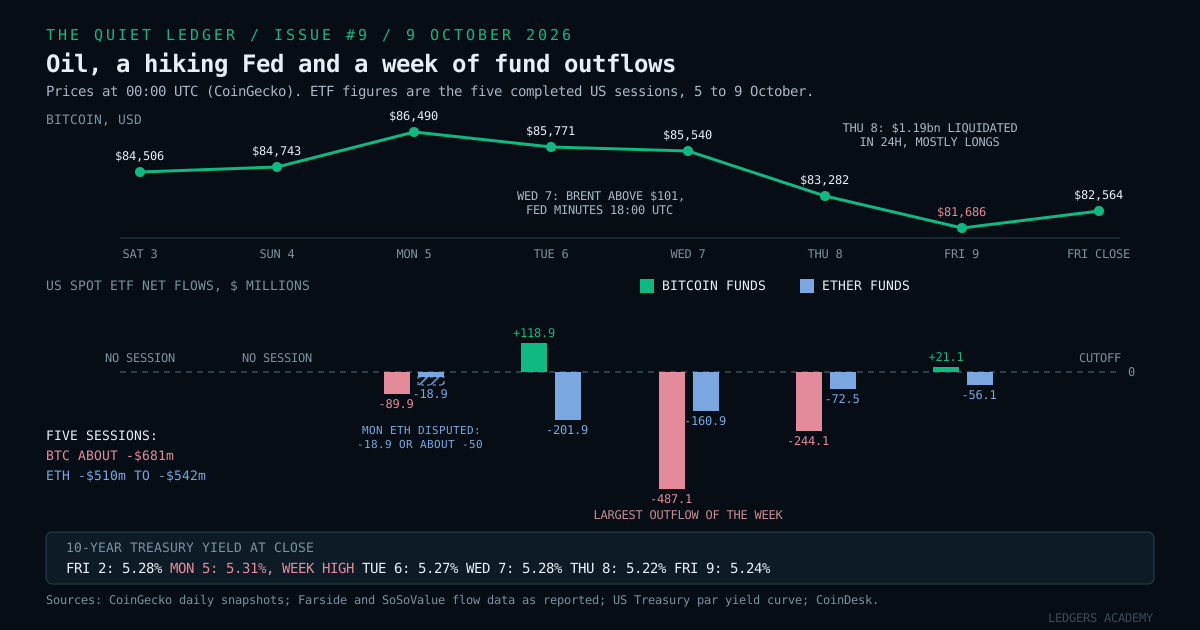
The takeaway: the heaviest outflow came on the day oil jumped and the minutes confirmed a Fed leaning towards higher rates; leveraged long positions paid the next day, and ether fell further than bitcoin, with fund outflows in every session. That describes a completed week.
2. This Week in Headlines
Washington: one rulebook opened, one closed
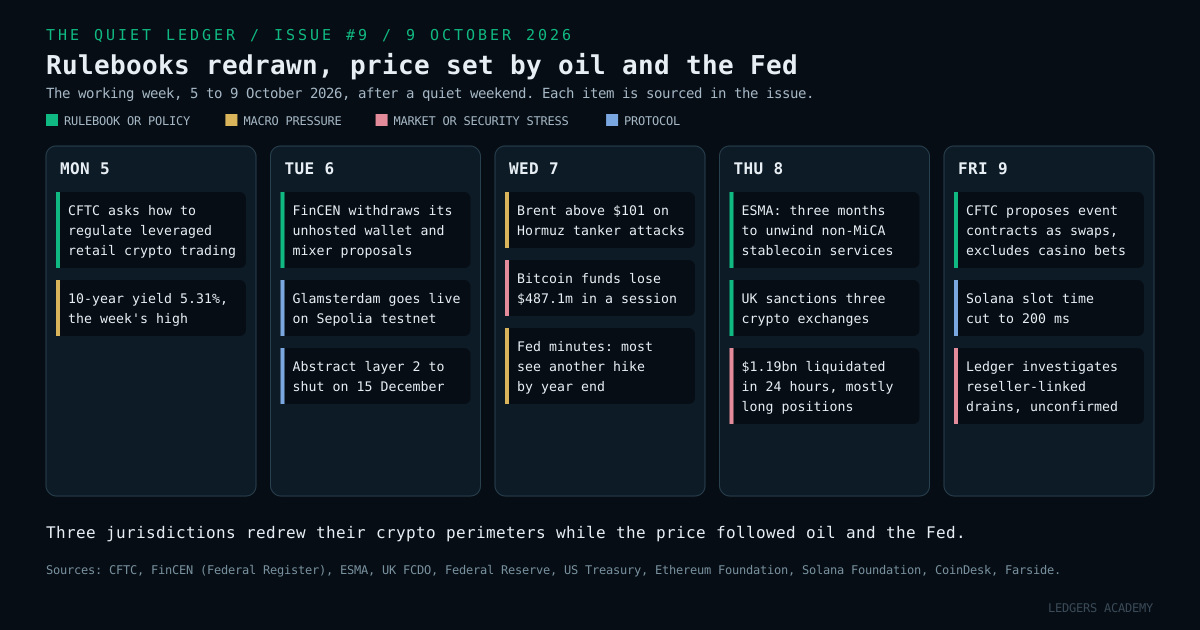
On Monday the CFTC published an advance notice of proposed rulemaking, a request for views before any rule is drafted, on leveraged, margined or financed retail crypto trades, floating a new "crypto asset market" category of exchange. Plain spot trading without leverage stays outside it, the gap CoinDesk notes only Congress can close.
On Tuesday FinCEN, the Treasury's anti-money-laundering bureau, withdrew its 2020 proposal to make banks and money transmitters record and report transfers involving unhosted wallets, those no bank or exchange holds for the user, saying it "will not take any further action". It also withdrew its 2023 finding against international crypto mixing. Existing Bank Secrecy Act duties are unchanged, and Brazil, as Issue #8 reported, has just moved the other way.
Europe and beyond: stablecoins and sanctions
On Thursday the European Securities and Markets Authority told national supervisors that firms licensed under MiCA, the EU's crypto rulebook, should stop clients acquiring or adding to unauthorised stablecoins and remediate remaining holdings within three months, allowing only liquidation, conversion, withdrawal, transfer or safekeeping. ESMA names no token; CoinDesk identifies USDT as the most prominent.
The same day the UK sanctioned three crypto exchanges and two payment platforms, two of which had processed transactions for A7, a Kremlin-backed network that claimed to move more than $90 billion last year; CoinDesk names Cryptomus and TokenSpot.
Institutions and protocols
Strategy's 8-K reported 334 bitcoin bought from 1 to 4 October, for 848,000 in total, and an estimated $20.91 billion third-quarter gain on digital assets, a fair value mark rather than cash. BitMine reported 6,016,414 ether, 4.9 percent of supply, close to the 5 percent target its chairman addressed on Wednesday. US government-linked wallets moved 12,267 seized bitcoin to new addresses on Thursday, according to Arkham data. A transfer is not a sale, and none was confirmed.
Ethereum's Glamsterdam upgrade went live on the Sepolia test network on Tuesday, running near 200 million gas per block with no mainnet date. Solana cut its slot time to 200 milliseconds on Friday. And the Abstract layer 2 network will shut on 15 December with about $47 million still on it.
3. The Weekly Deep Dive: are prediction markets regulated as swaps?
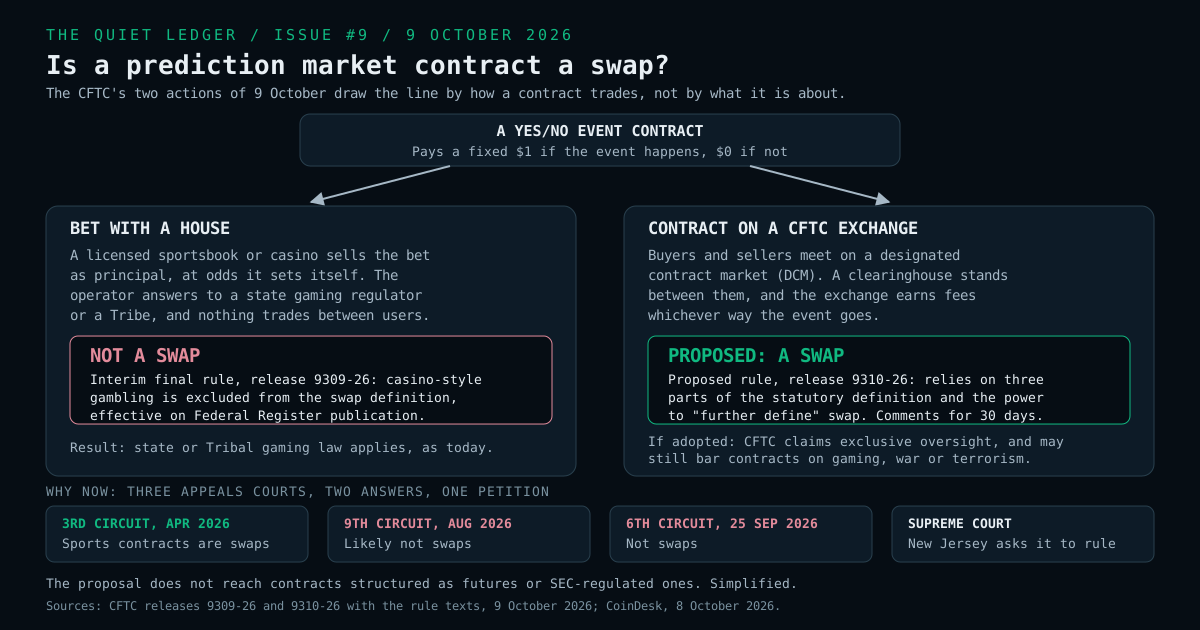
A prediction market lists event contracts: yes or no contracts that pay a fixed amount, usually $1, if something happens and nothing if it does not, so the price reads as the crowd's estimate of the probability. In the United States the regulated ones trade on CFTC-registered exchanges called designated contract markets. Whether they count as "swaps" under the Commodity Exchange Act decides who is in charge: if they are, the CFTC argues its jurisdiction is exclusive; if not, each state's gambling law may apply.
How the CFTC's swap proposal works
The proposed rule would write event contracts, "including those based on sports-, politics-, cultural-, and weather-related events", into the definition of a swap. It cites three parts of the statute: the contracts are binary options, which the law counts as swaps; they pay on an event "associated with a potential financial, economic, or commercial consequence"; and they are "commonly known to the trade as" swaps, exchanges having self-certified thousands. It also invokes Congress's express power to "further define" the term.
The interim final rule does the reverse for casino-style gambling: a sportsbook wager, casino game or lottery is not a swap if a state gaming regulator or a Tribe supervises the operator and nothing trades between multiple buyers and sellers. The line is structural. A house sets the odds and takes the other side of your bet; an exchange matches buyers and sellers, a clearinghouse stands between them, and the exchange earns fees whichever way the event goes.
Why the CFTC acted this week
Courts disagree. As the proposal recounts, the Third Circuit held in April that sports event contracts are swaps; the Ninth Circuit in August and the Sixth on 25 September held they are not. Minnesota has made offering them a crime, and New York has asked a court to bar one exchange from offering them in or from the state. This week the NFL, Gary Gensler and former senator Chris Dodd filed Supreme Court briefs backing the states, in a dispute New Jersey has asked the Court to settle.
The limits
This is a proposal, open for 30 days of comment after Federal Register publication; only the casino exclusion takes effect at once. Courts no longer defer to agencies on what a statute means, so a final rule depends on judges accepting that Congress delegated this definition. Being a swap is not the same as being permitted: the CFTC can still bar contracts involving gaming, war, terrorism or unlawful activity as contrary to the public interest. And the proposal does not reach futures-style or SEC-regulated contracts.
What you can check: whether a platform is on the CFTC's list of designated contract markets, which source a contract settles on, and whether your state is in litigation. Clearing is explained in our letter on what a derivatives clearing organisation does.
4. Security and Onchain Radar
On Friday Ledger said it was investigating reports of drained wallets among customers who bought devices through CryptoBilis, a Southeast Asian reseller. It asked the reseller to pause sales, told anyone who had bought from it in the past 90 days not to set the device up, and advised those who had to consider moving funds to a new device with a newly generated recovery phrase.
Confirmed at the cutoff: the investigation, the paused sales and that advice. Not confirmed: the cause, the number of victims and the total. The quoted figure of more than $86 million is an estimate by a pseudonymous investigator, Specter, and there was no evidence that Ledger's own systems were breached. Tampering before delivery is a possibility, not a finding.
The lesson does not depend on the cause: a hardware wallet protects a key only if the key was created on a device nobody else handled first. The rules:
- Buy from the manufacturer where you can. If you use a reseller, check it on the manufacturer's own list, and treat an unusually low price as a warning.
- Generate the recovery phrase yourself, on the device, at first setup. A device that arrives with a phrase or already set up should never hold funds. Our note on how to spot a counterfeit hardware wallet covers the physical checks.
- If you bought from the named reseller, follow Ledger's instructions now rather than waiting for a final figure.
5. From the Academy Library
Why some crypto derivatives stay closed to American traders is in our letter on Polymarket perps and US traders. MiCA and the US rulebooks are mapped in the crypto tax and regulatory guide, and new readers can start at Academy School.
Three useful, non-affiliate tools: the CFTC's register of trading organisations, Regulations.gov for comments once the proposal is published, and the full proposal text.
Dates to keep
- 27 and 28 October: the next Federal Reserve meeting.
- 15 December: Abstract shuts down.
- Early January 2027: the end of ESMA's three-month window for unwinding services in unauthorised stablecoins.
The rules moved a long way this week and the price moved with oil. Neither the CFTC's proposal nor ESMA's deadline changed what a bitcoin was worth on Friday, but both shape where, and through whom, people can trade.
Disclaimer: This publication is for education and information only. It is not financial, investment, legal, tax, or security advice.
Sources and further reading
Prediction markets and the CFTC
- CFTC release 9310-26: proposed rule including certain event contracts in the definition of swap, 9 October 2026
- CFTC: proposed rule text, Further Definition of "Swap": Inclusions (RIN 3038-AF82)
- CFTC release 9309-26: interim final rule excluding casino-style gambling from the definition of swap
- CFTC: interim final rule text (RIN 3038-AF81)
- CoinDesk: the CFTC moves to fold event contracts into swaps regulation
- CoinDesk: the NFL joins pushback against prediction markets at the Supreme Court
- CFTC: register of trading organisations
Regulation and policy
- CFTC release 9307-26: advance notice on crypto asset transactions and crypto asset markets, 5 October 2026
- CoinDesk: the CFTC joins the SEC in proposing crypto rules, though a spot market gap lingers
- Federal Register 2026-20430: FinCEN withdraws the unhosted wallet proposal
- Federal Register 2026-20429: FinCEN withdraws the crypto mixing proposal
- ESMA: supervisory expectations on services related to unauthorised stablecoins, 8 October 2026
- CoinDesk: ESMA gives EU platforms three months to drop non-MiCA stablecoins
- UK government: new sanctions hit the money, oil and supply chains fuelling Russia's war
- CoinDesk: the UK sanctions three crypto exchanges over alleged Russia links
Institutions and protocols
- SEC EDGAR: Strategy Inc Form 8-K, 5 October 2026
- SEC EDGAR: BitMine holdings update, 5 October 2026
- SEC EDGAR: BitMine October chairman's message, 7 October 2026
- CoinDesk: the US government moves $1 billion in bitcoin, with no sign of a sale
- CoinDesk: Glamsterdam test runs near 200 million gas per block
- Ethereum Foundation: Glamsterdam testnet announcement
- Solana Foundation: reduced slot times
- Unchained: Pudgy Penguins' owner is shutting down its Abstract chain
Security
Markets and macro
- TFTC: US spot bitcoin ETF daily flows, October 2026
- KuCoin News: bitcoin and ether ETF flows, 5 October (Farside)
- KuCoin News: ether funds lose $201.9 million, 6 October
- The Crypto Times: ETF outflows on 7 and 8 October (SoSoValue)
- KuCoin News: ETF flows, 9 October
- Federal Reserve: minutes of the FOMC meeting of 15 and 16 September 2026
- Federal Reserve: Governor Waller speech, 8 October 2026
- CoinDesk: oil rally drags bitcoin below $84,000, 7 October
- CoinDesk: $1.19 billion of liquidations, 9 October
- US Treasury: daily par yield curve rates, 2026
- Federal Reserve: FOMC meeting calendar
- CoinGecko: daily price snapshots used in the chart above
- Alternative.me: Fear and Greed Index