
The Quiet Ledger · Independent analysis
The Daily Ledger: 15 October 2026
The EBA names USDC the EU's first significant e-money token and takes over supervision of its reserves from 12 November. US inflation rises to 3.7 percent, and a 37-bank euro stablecoin is licensed.
Subject: USDC becomes the EU's first significant e-money token: what that means
Preview: The EBA takes over key parts of Circle's European supervision from 12 November. Plus a 3.7 percent CPI print, a 37-bank euro stablecoin licence and a vesting-contract exploit.
THE DAILY LEDGER
15 October 2026
The EBA classifies USDC as significant under MiCA, US inflation rises to 3.7 percent on petrol prices, and Dutch regulators license a euro stablecoin backed by 37 banks.
Reporting window: 14 October 2026, 06:00 UTC to 15 October, 06:00 UTC (08:00 Europe/Stockholm). Data cutoff: 15 October, 06:00 UTC, before the US producer price release. Prices are CoinGecko 00:00 UTC daily snapshots compared with the previous day's 00:00 UTC snapshot. This issue was published retrospectively on 16 October 2026 to fill a gap in the archive; it uses only information available at the cutoff.
What is a significant e-money token under MiCA? It is a euro-regulated stablecoin judged large or interconnected enough that the European Banking Authority itself supervises the issuer's capital, reserves and liquidity. On 14 October the EBA named Circle's USDC the first of 45 notified e-money tokens to reach that status. For holders, the core promise does not change; for the issuer, the rulebook gets stricter.
1. The Day in Numbers
- Bitcoin: $81,604 at 00:00 UTC, down 1.8 percent against the previous day's 00:00 UTC snapshot of $83,115. CoinGecko daily data.
- Ether: $2,419.69 at 00:00 UTC, down 3.1 percent on the same basis.
- Fear and Greed: 53, Neutral, down 9 points from 62 and out of Greed for the first time this month. Alternative.me daily reading, 15 October, 00:00 UTC.
- US spot ETFs, Wednesday 14 October: bitcoin funds saw a net outflow of $261 million, led by Fidelity's FBTC, and ether funds $129.5 million, per Farside data reported by MarsBit. Completed session.
2. What is a significant e-money token under MiCA?
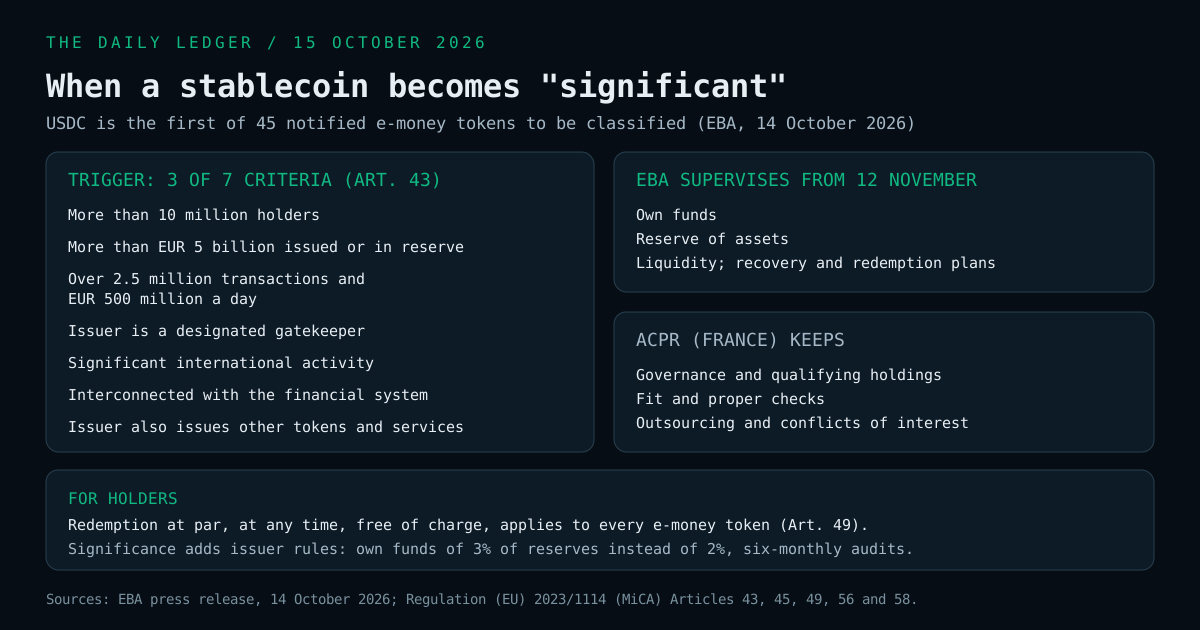
An e-money token is a stablecoin that references one official currency, such as the dollar or the euro. Under the EU's Markets in Crypto-Assets Regulation (MiCA), a token becomes significant when it meets at least three of seven criteria in Article 43, including more than 10 million holders, more than 5 billion euros issued or held in reserve, or more than 2.5 million transactions and 500 million euros a day.
USDC is issued in the EU by Circle Internet Financial Europe, supervised until now by France's ACPR. From 12 November, the EBA takes over supervision of USDC's own funds, reserve of assets, liquidity, and recovery and redemption plans. The ACPR keeps governance, qualifying holdings, fit and proper checks, outsourcing and conflicts of interest. The EBA has also signed a cooperation agreement with the New York State Department of Financial Services.
The status brings tougher issuer rules: reserve audits every six months and own funds of 3 percent of reserves rather than 2 percent. What does not change is the holder's right, under Article 49, to redeem at par, at any time and free of charge. Whether closer supervision changes how USDC is used in Europe is not yet known.
3. Today's Headlines
US inflation rises to 3.7 percent
September consumer prices rose 0.6 percent on the month and 3.7 percent on the year, with petrol up 9.1 percent and accounting for over half the monthly rise. Core inflation was 2.6 percent. Both annual figures beat forecasts, and bitcoin fell about $1,000 on the release.
A bank-backed euro stablecoin gets its licence
The Dutch central bank authorised Qivalis, a venture of 37 banks from 15 countries, as an e-money institution. Issuance is planned in the coming months, once its MiCA white paper is published.
Kraken's parent agrees to buy a Lithuanian bank
Payward agreed to acquire Saldo Bank, with about 164 million euros in assets, for an undisclosed price. The deal needs regulatory approval and is expected to close in 2027.
OCC reports on debanking
The OCC found that all nine of the largest national banks applied broad reputation-risk policies from 2020 to September 2025 that restricted sectors including digital asset activities.
4. Security Note
On 14 October, Blockaid flagged an exploit in UNCX's shared vesting pool on Ethereum, a contract that releases locked team or investor tokens over time. About $86,000 had been drained at the alert, and ExVul attributed it to a suspected accounting flaw; the loss figure is an estimate. The rule: "locked" tokens are only as safe as the contract holding them. Check whether a lock pools many users' tokens in one contract, and read what an audit does and does not prove.
5. From the Academy Library
Our crypto tax and regulatory guide covers MiCA's structure, and stablecoin address freezes explain another power issuers hold. New readers can start at Academy School.
A stablecoin's promise is only as strong as the reserves and supervision behind it. Europe has just moved the most important of those checks to a single desk.
Disclaimer: This publication is for education and information only. It is not financial, investment, legal, tax, or security advice.
Sources and further reading
- EBA: USDC classified as the first significant e-money token in the EU, 14 October 2026
- MiCA Article 43: significance criteria
- MiCA Article 56: classification of e-money tokens as significant
- MiCA Article 58: additional obligations for significant e-money token issuers
- MiCA Article 45: own funds and liquidity rules for significant issuers
- MiCA Article 49: redemption at par
- BLS: Consumer Price Index, September 2026, released 14 October
- CoinDesk: September CPI comes in hot, sending bitcoin lower
- The Paypers: Qivalis secures EMI authorisation from De Nederlandsche Bank
- CoinDesk: Payward to buy Saldo Bank
- OCC: report on large banks' debanking activities, 14 October 2026
- The Crypto Times: Blockaid reports $86K drained in UNCX vesting pool exploit
- KuCoin News (MarsBit): spot ETF flows, 14 October
- CoinGecko: bitcoin daily price snapshots
- CoinGecko: ether daily price snapshots
- Alternative.me: Fear and Greed Index history