
The Quiet Ledger · Independent analysis
The Quiet Ledger: Issue #10 | 16 October 2026
MSCI finalised its non-operating company screen with Strategy on the provisional deletion list, hot CPI and PPI left bitcoin flat for the week, and Ledger traced a hardware implant to one reseller.
Subject: MSCI has defined a company that is really a fund, and Strategy is on its list
Preview: Hot CPI and PPI pushed bitcoin under $80,000 for an afternoon and the week ended flat. The lasting news was an index rulebook, a supervisor's register and a hardware wallet supply chain that failed.
THE QUIET LEDGER
Issue #10 | Saturday 10 October to Friday 16 October 2026
A week in which inflation data moved prices for an afternoon and rulebooks moved for longer: MSCI finalised its non-operating company screen with Strategy on the provisional deletion list, and Ledger traced a hardware implant to devices sold by one reseller
Reporting window Saturday 10 October to Friday 16 October 2026. Data cutoff 15:45 UTC on Friday 16 October (17:45 Europe/Stockholm). Prices are CoinGecko 00:00 UTC snapshots unless stated; weekly changes compare the 00:00 UTC snapshots of Friday 9 October and Friday 16 October, and separately the intraday reading at 15:44 UTC today with the 9 October snapshot. US fund flows cover the four completed sessions from Monday to Thursday; Friday's session is pending. This issue was published on 16 October 2026 together with the retrospective issues that fill the gap in the archive since 4 October; it uses only information available at the cutoff.
Bitcoin began the week at $81,686 and by Friday afternoon was within $70 of it, after a brief fall below $80,000 on hot inflation data. What will outlast the week happened outside the market: MSCI finalised rules that treat companies which mostly hold assets as funds, and Ledger traced a hardware implant to devices sold by a single reseller. Our reading is that crypto's exposure this week ran through the wrappers around the coins (an index rulebook, a reseller's box, a supervisor's register) rather than through the coins themselves. It also answers, provisionally, a question shareholders have asked since August: why could MSCI remove Strategy from its index when the company still sells software?
1. The Macro Pulse
- Bitcoin: $82,156 at 00:00 UTC on Friday, up about 0.6 percent from $81,686 a week earlier. At $81,622 intraday (15:44 UTC) the week is down about 0.1 percent. Thursday's low was about $79,711, the first trade below $80,000 in about a month.
- Ether: $2,439.96 at 00:00 UTC, down about 1.3 percent from $2,472.73, and $2,441.71 intraday.
- Fear and Greed: 63, Greed, up from 59 a week earlier, after touching 53, Neutral, on Thursday.
- US spot ETFs, four completed sessions: bitcoin funds lost about $146.2 million net and ether funds about $250.3 million. CPI day alone carried a $261.5 million bitcoin outflow, against about $681 million for the whole previous week. Friday is pending.
- Inflation and rates: September consumer prices rose 3.7 percent a year, up from 3.4, with gasoline over half the monthly rise; core inflation was 2.6 percent. Producer prices for final demand jumped 1.3 percent in the month, the most since March 2022. Even so, the 10-year Treasury yield fell from 5.24 percent to 5.10. Liquidations, the forced closing of leveraged positions, reached about $948 million in 24 hours on Thursday, 90.6 percent of them bets on higher prices. Fed Chair Kevin Warsh declined to signal the Fed's next move, and CME FedWatch odds of an October hike fell to about 15 percent from about 30.
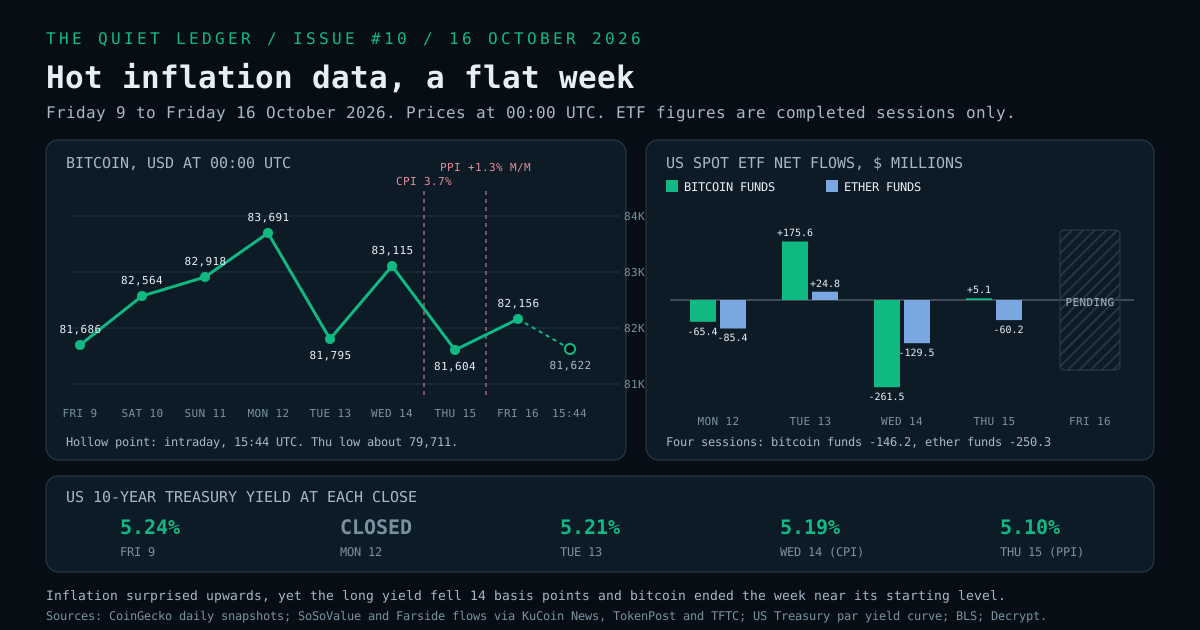
The takeaway: two inflation surprises produced one day of forced selling, then a return to where the week began. Long-dated bonds took the data calmly, and fund outflows were a fraction of the previous week's. That is a description of a completed week.
2. This Week in Headlines
Who may serve customers, outside the United States
South Korea's Financial Intelligence Unit said on Tuesday that the websites of 27 unregistered exchanges, including KuCoin, BitMart and MEXC, will be blocked, extending last year's app restrictions. Regulators warned that customers of such platforms may struggle to recover funds.
The European Banking Authority classified USDC as the first significant e-money token among 45 notified under MiCA, the EU's crypto rulebook. From 12 November the EBA, not France's ACPR, supervises Circle's own funds, reserves, liquidity and redemption plans. The Dutch central bank also licensed Qivalis, a venture of 37 European banks, as an e-money institution on the way to a euro stablecoin.
Thailand's rules for local bitcoin and ether ETFs take effect today: funds must list on the Stock Exchange of Thailand, hold at least 80 percent of net assets in one eligible coin and use Thai-regulated custodians, and brokers may not lend for purchases. An effective date is not a launch date. In Australia, ASIC opened consultation paper 392 on standards for crypto platforms under laws that start on 8 April 2027.
Banks build the pipes
Citadel Securities bought a 2-year Treasury note through BNY, which recorded it as a token on its private ledger, and settled it within minutes; Citadel then pledged it in an overnight triparty repo, a short-term secured loan, for cash from BNY. Standard Chartered began custody of Ripple's RLUSD stablecoin through its Dubai branch and plans to let clients use it as collateral at LMAX while the tokens stay in custody.
Courts and treasury companies
A New York federal judge refused to undo Gemini's $5 million settlement with the CFTC, even though the regulator now backed the request. Strategy bought 250 bitcoin, taking it to 848,250, and repurchased $192.4 million of its STRC preferred shares; its November STRC dividend of 12 percent depends on a stockholder vote on 28 October. Strive priced 7 million shares of 15 percent preferred at $90. Both fund bitcoin by selling securities, which MSCI's new screen now measures.
3. The Weekly Deep Dive: why could MSCI remove Strategy from its index?
Funds that track MSCI's global benchmarks must hold what the index holds, and MSCI already excludes investment funds and other passive vehicles. On Thursday it announced that from the November review it will also exclude "non-operating companies": listed companies that behave like funds, identified by financial ratios rather than industry.
How the non-operating screen works
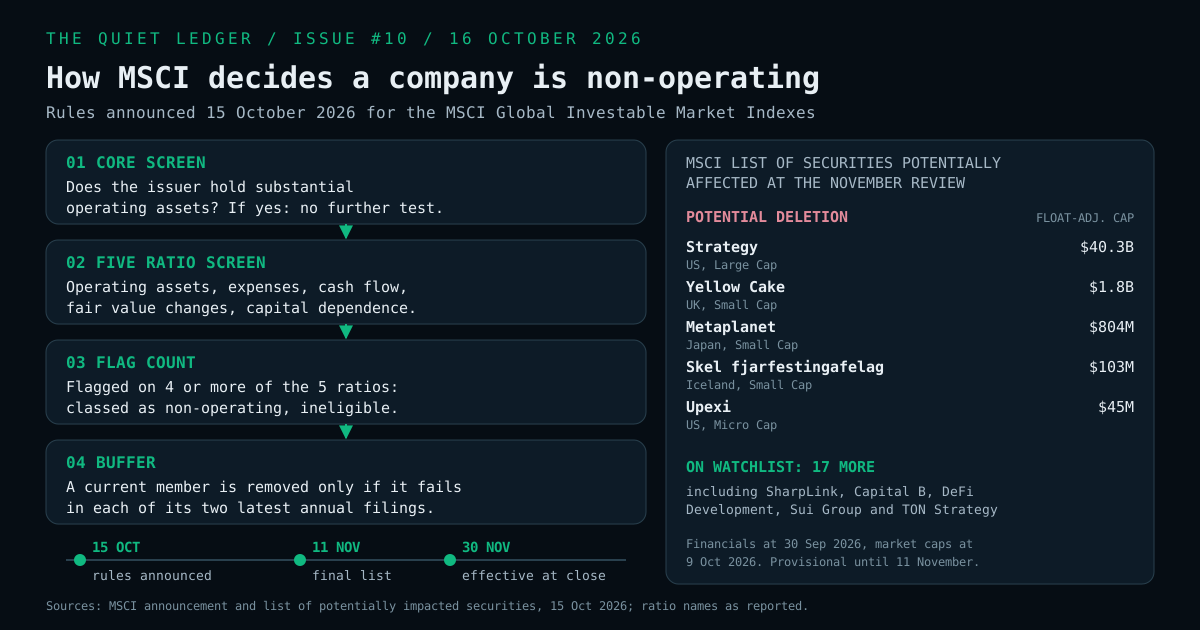
First, a core screen asks whether a company has substantial operating assets; in the August consultation, as reported, operating assets above half of total assets meant a pass. A company that fails is tested on five ratios: operating asset intensity, expense intensity, cash flow, fair value intensity and capital dependence. Flagged on four or more, it is ineligible. Buffers slow the churn: an outsider is blocked if it fails in either of its two latest annual filing periods, but a current member is removed only if it fails in both.
Why Strategy, and what removal would do
Strategy's balance sheet is dominated by bitcoin, its reported earnings swing with the bitcoin price, and it pays for purchases by issuing shares: the 250 coins announced on Monday were bought mostly with $21.0 million from selling common stock. Those are the traits the ratios look for. MSCI's own list, using financials at 30 September, marks Strategy, a large-cap constituent worth about $40.3 billion after adjusting for free float, as a potential deletion, alongside Metaplanet, the uranium holder Yellow Cake and two others, with 17 more on a watchlist. MSCI also ends its October 2025 freeze on companies holding mostly digital assets. Michael Saylor describes Strategy as an operating business with a software arm.
If Strategy is deleted, tracking funds must sell its shares whatever their managers think; JPMorgan analysts, as cited by CoinDesk, estimated about $2.8 billion of outflows. The selling would fall on the stock, not on Strategy's bitcoin, and nothing in the rule makes the company sell coins. The indirect effect matters more: weaker demand for the shares can make the next share sale, and so the next purchase, harder.
Limits and what you can check
The list is provisional until 11 November, and the rule binds only MSCI's indexes; other providers set their own. Because removal follows two annual filings, a company that changed its structure could test differently later. You can download MSCI's list yourself, read Strategy's 8-K filings to see how each purchase was funded, and check whether any index fund you hold tracks an MSCI benchmark.
4. Security and Onchain Radar
The CryptoBilis case moved from reports to mechanism in five days. On 10 October Ledger confirmed an unauthorised implant in one affected device; by Tuesday it explained that a chip inside the case read the recovery phrase off the screen during setup and sent it out over a mobile network. The secure chip and firmware were untouched: this was a supply chain attack. Ledger asked resellers in seven Asian markets to halt sales, and MediaMarktSaturn paused sales in Europe after a German customer's report, with no losses in that case.
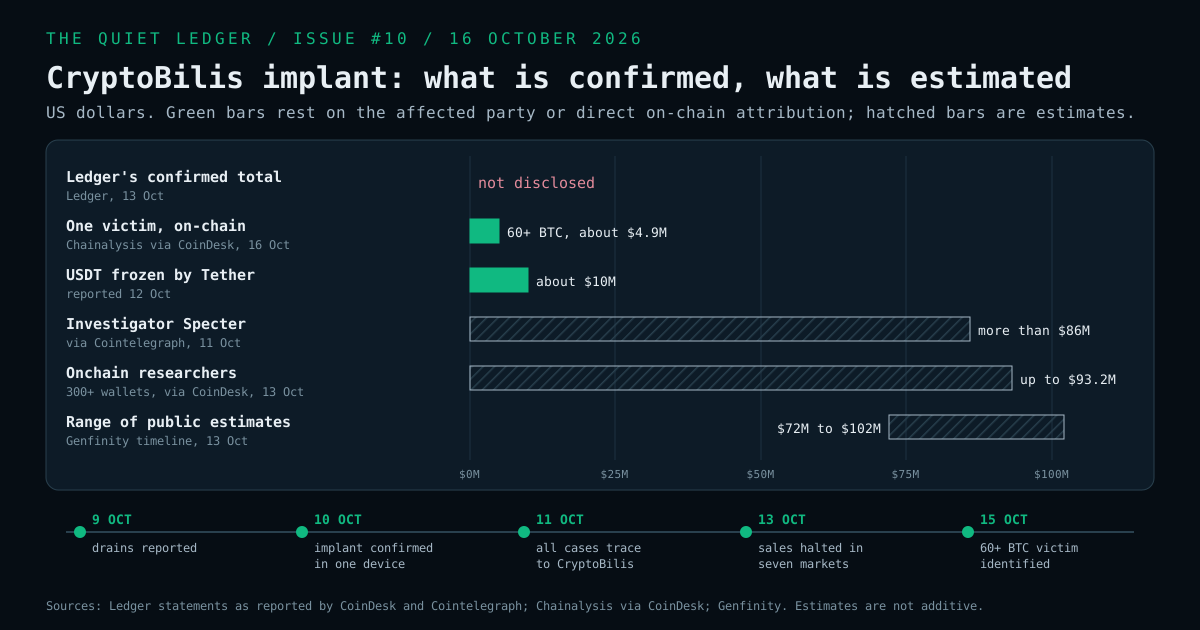
Confirmed: the implant, the reseller and the mechanism. Not confirmed: the total, which Ledger has not disclosed. Public estimates run from $72 million to $102 million; Tether froze about $10 million of USDT, and Chainalysis traced more than 60 bitcoin stolen from a fake-job scammer. Elsewhere, the casino Gamdom lost just over $3 million from hot wallets, and a flaw let an attacker mint about 20 percent of Pirate Chain's supply.
The rules:
- Buy a hardware wallet from the manufacturer or a reseller it lists.
- If you bought from CryptoBilis, Ledger says do not set the device up; if you already have, move funds to a new device with a newly generated phrase.
- Never use a recovery phrase that arrived with a device.
- Treat anyone offering to recover stolen funds for a fee as the next attack.
5. From the Academy Library
The checks that catch a fake or opened device are in how to spot a counterfeit hardware wallet and the wallet security checklist. The mechanics behind this week's fund flows are in ETF creation and redemption. Why Strategy has been buying back its preferred stock is in our 13 September Daily Ledger, and new readers can start at Academy School.
Three useful, non-affiliate tools: MSCI's index consultations page, with the impacted-securities list; SEC EDGAR search for company filings; and ESMA's MiCA page, with its interim register.
Dates to keep
- 21 October, about 14:50 UTC: Solana's Alpenglow consensus upgrade is scheduled on mainnet.
- 27 and 28 October: the next Federal Reserve meeting. Strategy's special stockholder meeting is on 28 October.
- 11 November: MSCI publishes the final list of non-operating companies.
- 12 November: EBA supervision of USDC begins.
- 27 November: comments close on ASIC's consultation paper 392.
- 30 November: MSCI's changes take effect at the close.
The price finished where it started, and the inflation scare lasted an afternoon. What changed was the paperwork around crypto: who counts as a fund, who supervises a stablecoin, and which box a hardware wallet arrives in.
Disclaimer: This publication is for education and information only. It is not financial, investment, legal, tax, or security advice.
Sources and further reading
Index rules and treasury companies
- MSCI: results of the consultation on the eligibility of non-operating companies, 15 October 2026
- MSCI: index consultations, including the consultation paper and the list of potentially impacted securities
- MSCI: list of GIMI securities potentially impacted by the non-operating screening methodology (spreadsheet)
- CoinDesk: MSCI approves rules that could eject Strategy and Metaplanet from equity indexes
- CoinCentral: MSCI proposes a new screen, August 2026 consultation details
- SEC EDGAR: Strategy press release, 12 October 2026
- SEC EDGAR: Strategy Form 8-K on the STRC dividend rate, 15 October 2026
- SEC EDGAR: Strive prices its SATS preferred offering, 15 October 2026
Regulation and institutions
- CoinDesk: South Korea blocks 27 crypto exchanges
- EBA: USDC classified as the first significant e-money token, 14 October 2026
- CoinDesk: Dutch regulator approves Qivalis as an electronic money institution
- CoinDesk: Thailand opens the door to locally listed bitcoin and ether ETFs
- ASIC: 26-245MR, consultation on implementing new digital asset laws
- BNY: tokenized US Treasury triparty repo workflow with Citadel Securities
- Standard Chartered: RLUSD custody and planned collateral integration with Ripple and LMAX
- CoinDesk: judge rejects request to void Gemini's $5 million settlement
- Solana Compass: Anza sets the Alpenglow mainnet date
Security
- Cointelegraph: Ledger confirms an unauthorised hardware implant
- CoinDesk: Ledger says a spy chip inside CryptoBilis devices transmitted recovery phrases
- Cointelegraph: Ledger asks resellers to halt sales in Southeast Asia and Hong Kong
- Cointelegraph: MediaMarktSaturn pulls Ledger products
- Genfinity: the Ledger CryptoBilis incident, what is known
- KuCoin News: Tether freezes $10 million of USDT linked to the CryptoBilis breach
- CoinDesk: a scammer loses about $5 million in bitcoin to tampered devices
- The Crypto Times: Gamdom founder confirms a hot wallet breach
- The Crypto Times: Pirate Chain exploit mints 39.8 million ARRR
Markets and macro
- BLS: Consumer Price Index, September 2026
- BLS: Producer Price Index, September 2026
- US Treasury: daily par yield curve rates, 2026
- Decrypt: bitcoin whipsaws as liquidations near $1 billion
- CoinDesk: Warsh silent on interest-rate plans, hike odds fall
- investingLive: Warsh won't prejudge the rest of 2026
- TFTC: US spot bitcoin ETF daily flows, October 2026
- KuCoin News: ETF flows, 12 October, 13 October, 14 October and 15 October
- TokenPost: spot bitcoin ETF flows, 12 October
- Federal Reserve: FOMC meeting calendar
- CoinGecko: daily price snapshots used in the charts above
- Alternative.me: Fear and Greed Index