
Master Guide
Crypto Tax Guide: Records, Transfers and Cost Basis
Build crypto tax records, reconcile transfers and compare cost-basis calculations. Learn why US, UK and Swedish reporting methods must be distinguished.
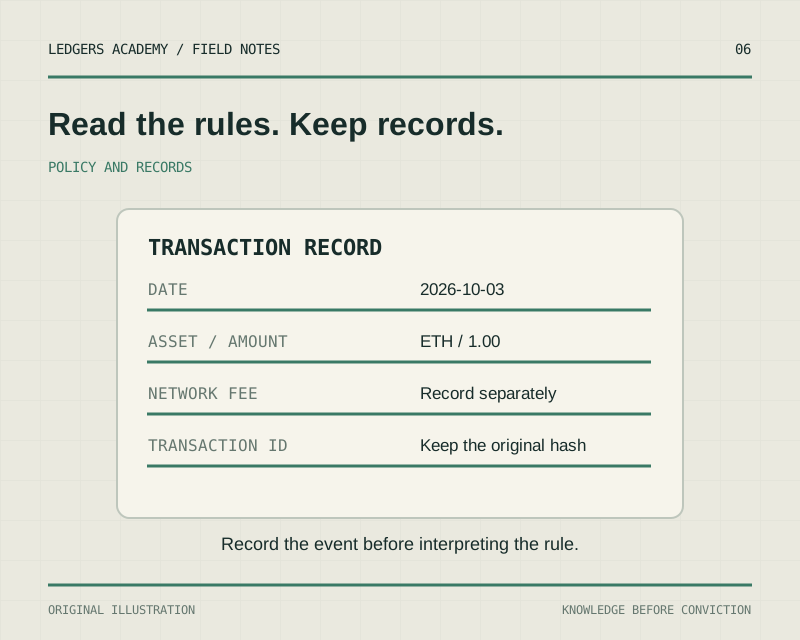
This crypto tax guide explains how to build records that a local tax calculation can actually use. Tax treatment depends on residence, activity, asset and transaction date. A blockchain transaction list is evidence, not a finished return, and a universal rule such as “everything uses FIFO” can produce the wrong answer.
Updated 3 October 2026 · By Adam · Examples below are original educational scenarios, not live market data or product tests.
Crypto tax records: start with jurisdiction and ownership
Record your relevant tax residence and reporting period before choosing a cost-basis method. In the United States, the IRS generally treats digital assets as property and distinguishes acquisitions, income and disposals. Its digital-assets guidance also distinguishes moving assets between your own accounts from changes of ownership, while noting that digital-asset fees can themselves require reporting.
In Sweden, Skatteverket describes an average acquisition-cost method for crypto of the same kind across your exchanges and wallets. In the UK, HMRC describes pooling together with same-day and subsequent 30-day matching rules. Read Skatteverket's crypto guidance and HMRC's pooling manual; do not import one country's method into another.
Keep a ledger with enough information to reconcile
- UTC timestamp, chain, transaction hash and exchange trade identifier.
- Asset contract address, quantity received or disposed of, and network fees.
- Value in the reporting currency, with pricing source and valuation time.
- Counterparty or your own receiving account, labelled separately.
- Activity category and a note explaining uncertain classifications.
- Original CSV statements, invoices and relevant protocol receipts.
Read-only exports and public wallet addresses are enough for bookkeeping. Never provide a seed phrase or signing key to a tax tool. A public address can expose transaction history, so assess the provider's privacy practices. See the Ledger Live export walkthrough for collection and reconciliation.
Compare two cost-basis assumptions
Worked example: the same trades, different calculation
A fictional person buys 0.2 BTC for 80,000 SEK and later 0.3 BTC for 150,000 SEK, then disposes of 0.1 BTC for 60,000 SEK. Ignore fees for this exercise. Under an average-cost assumption, total cost is 230,000 SEK for 0.5 BTC, or 460,000 SEK per BTC. The disposed quantity has 46,000 SEK basis, producing a 14,000 SEK gain.
Under a simple FIFO assumption, 0.1 BTC comes from the first purchase: 40,000 SEK basis and a 20,000 SEK gain. The 6,000 SEK difference is a consequence of the method. This comparison does not offer a free choice of methods; apply the one legally available in your circumstances. UK matching rules could require a different calculation if relevant later purchases occurred.
Reconcile transfers before adding a price
Worked example: an unmatched withdrawal
An exchange export shows 1 ETH leaving, while a wallet receives 0.999 ETH. First match the transaction and identify the 0.001 ETH fee. Do not automatically create a sale of 1 ETH and a new purchase of 0.999 ETH because two imports failed to match. Determine the treatment of the transfer and fee separately under local rules.
After importing all accounts, compare opening balance + receipts − disposals − fees with the closing balance for each asset. A mismatch can reveal a missing wallet, duplicate import, internal transfer or incorrect decimal precision.
Flag DeFi cases instead of guessing
Wrapping, bridging, lending receipts, staking rewards and liquidity positions can raise different ownership and income questions. A bridge is not automatically taxable everywhere, and a label in software is not a legal conclusion. Preserve the contract action, assets surrendered, rights received and valuation evidence. Ask a qualified local adviser about material uncertainty, and retain the answer with the record.
Use software to organise a complete dataset, then inspect duplicates, missing prices and negative balances. Manual records can work for small activity; paid software is not a legal requirement merely because crypto is involved. The final responsibility is to support the reporting treatment you actually use.
Sources and verification
Primary references checked on 3 October 2026. Protocol settings and local rules can change; verify the linked version before acting.
Knowledge check
Apply the example before checking the answer.
Question 1 of 3May you choose FIFO simply because software defaults to it?
Question 2 of 3What is the average-cost gain in the SEK example before fees?
Question 3 of 3Are tax software and seed-phrase access required to prepare records?