
Master Guide
Decentralized Finance Guide: Lending, Yield and Risk
Understand decentralized finance with worked health-factor and yield examples. Check contracts, oracles, asset issuers and withdrawal dependencies.
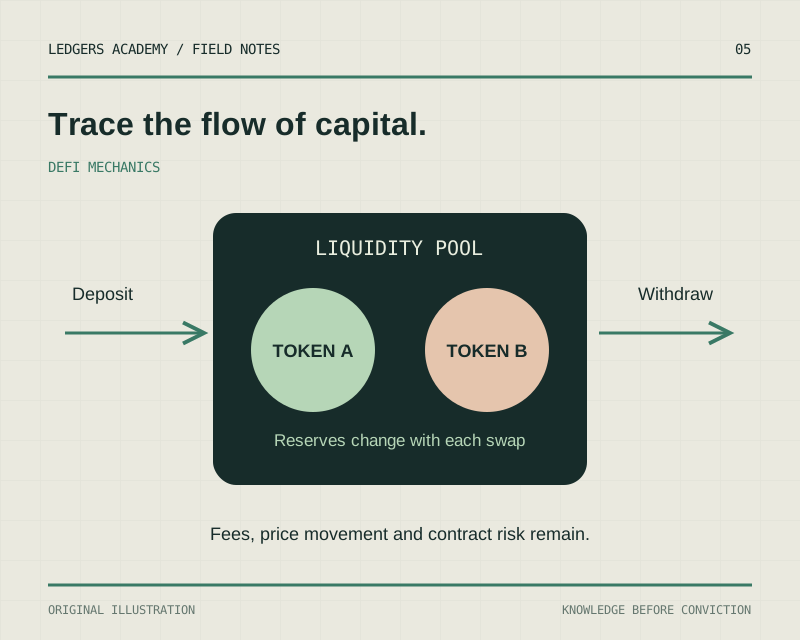
Decentralized finance, or DeFi, lets users interact with financial contracts through a wallet. The practical question is not simply whether a bank is absent. It is which contracts, price feeds, administrators and assets stand between a deposit and a successful withdrawal. This guide follows those dependencies through a lending example.
Updated 3 October 2026 · By Adam · Examples below are original educational scenarios, not live market data or product tests.
Decentralized finance: identify what you receive
A lending deposit may produce a receipt token or an accounting balance. A liquidity deposit may produce a pool share or a position NFT. A staking service may issue a token representing a claim on staked assets. None of these is automatically equivalent to cash in a bank account. Read the redemption route and its conditions before comparing the advertised yield.
Ethereum's smart-contract overview explains executable onchain code. A deployed contract can still depend on mutable parameters, administrators and external services. “Non-custodial” describes part of the control model; it does not mean no other actor can affect your position.
Calculate a lending safety margin
Aave describes health factor as collateral value multiplied by its weighted liquidation threshold, divided by debt value. A value below one can make a position liquidatable. Actual thresholds and liquidation terms depend on the market and collateral. Check Aave's current explanation and the live market configuration.
Worked example: collateral falls while debt stays unchanged
Assume $4,000 of collateral, an illustrative 80% liquidation threshold and $2,000 debt. Health factor is 4,000 × 0.80 / 2,000 = 1.60. If collateral value falls 30%, it becomes $2,800 and health factor falls to 1.12. A 40% fall leaves $2,400 and health factor 0.96, below one.
Interest can grow the debt, and the borrowed asset can change value too. The example holds both constant to isolate the collateral effect. At $2,800 collateral, reducing debt to $1,600 would raise the factor to 1.40. This calculation is a scenario, not a universal recommended buffer; collateral volatility and correlated failures matter.
Separate earned yield from token price exposure
Worked example: more tokens, less purchasing power
A fictional deposit of 100 tokens earns five tokens over a year. If each token starts at $10 and ends at $7, the ending value is 105 × $7 = $735, compared with $1,000 initially. A 5% token yield coexists with a 26.5% decline in dollar value, before costs.
Break a yield quotation into borrowing interest, trading fees and incentive tokens. Ask which part depends on new demand or temporary subsidies. Annualising a short promotional interval is not a forecast of the next year.
Build a dependency map before depositing
- Asset: issuer, peg or redemption mechanism, and freeze powers.
- Contract: verified deployment, upgrades, audit scope and privileged accounts.
- Pricing: oracle source, freshness checks and response to a market outage.
- Chain: transaction costs, congestion and any bridge used.
- Exit: available pool liquidity, withdrawal queues and redemption delays.
Restaking or layered yield strategies can combine several dependencies. A receipt token from one system used as collateral in another does not erase the first system's risk. An audit addresses a defined scope at a point in time; use the audit explainer to read limitations.
Practice a complete exit
For a learning exercise, use a small amount you can afford to lose and document deposit, fees, receipt and withdrawal. A successful test demonstrates the path under those conditions, not future solvency. Keep a reserve for gas and records for every step. Work through Academy School's DeFi chapter, then the tax-record guide before combining strategies.
Sources and verification
Primary references checked on 3 October 2026. Protocol settings and local rules can change; verify the linked version before acting.
Knowledge check
Apply the example before checking the answer.
Question 1 of 3What is the lending example health factor after a 40% collateral decline?
Question 2 of 3Does a 5% token yield guarantee a 5% dollar gain?
Question 3 of 3Does non-custodial DeFi remove all third-party dependencies?