
Master Guide
NFTs and Digital Ownership: Metadata, Rights and Royalties
Understand NFTs and digital ownership by checking token identity, metadata, licences and royalty policies. Compare what different purchases actually grant.
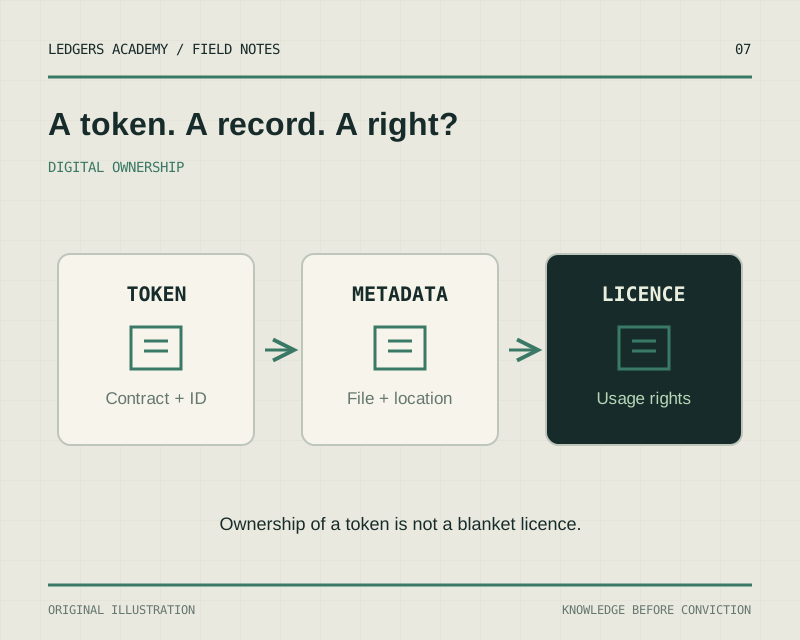
NFTs and digital ownership describe several distinct things: an onchain token, a media reference, legal usage rights and sometimes access to a service. Buying one does not automatically transfer all the others. This guide provides a practical way to examine what an NFT purchase would actually give you.
Updated 3 October 2026 · By Adam · Examples below are original educational scenarios, not live market data or product tests.
NFTs and digital ownership: identify the record
ERC-721 defines interfaces for individually identified tokens within a contract. The combination of chain, contract and token ID matters; an ID alone is not globally unique. The ERC-721 specification also describes an optional metadata interface. A compliant token does not by itself prove the minter created the artwork or owns its copyright.
A token can point to a web URL, content-addressed data or onchain metadata. Follow the actual reference and check who can change it. Content addressing can help detect a changed file, but someone still needs to retain and serve the data. A marketplace thumbnail is a convenient presentation, not evidence that the underlying file will remain available indefinitely.
Inspect the rights separately from the image
Worked example: identical artwork, different purchases
Three fictional tokens display the same image. Token A's licence allows personal display only. Token B's licence permits limited commercial use while ownership continues. Token C has no clear licence and was minted by an unverified account. A visually identical image and equal price do not establish equal rights.
Before purchase, retain the applicable licence version and identify the rights holder. Check commercial use, modification, sublicensing, transfer and termination conditions. If the licence is missing or ambiguous, a marketplace title saying “ownership” does not resolve the uncertainty.
Royalty signals are not universal enforcement
ERC-2981 defines royalty information that a marketplace can query. It does not force every marketplace or offchain transaction to make a payment. Distinguish a requested royalty, a platform policy and a legally enforceable obligation. Check the actual venue and contract before forecasting creator income.
Worked example: resale receipts after different fee policies
Assume a fictional sale at 1 ETH. A venue charging a 2% platform fee and paying a 5% royalty leaves 0.93 ETH before gas and other costs. Another venue charging 2% while paying no royalty leaves 0.98 ETH. Those five percentage points arise from different payment policies, not a change in the token's artwork.
A creator projecting 0.05 ETH from every 1 ETH resale would overstate receipts if some sales do not honour the requested royalty. Keep expected payments separate from observed payments.
Make a five-part purchase record
| Item | What to preserve |
|---|---|
| Identity | Chain, verified contract address and token ID |
| Provenance | Creator evidence and mint/transfer history |
| Media | Metadata location, content reference and update powers |
| Rights | Licence terms, issuer and dated version |
| Dependency | Service access terms, fees and shutdown consequences |
Identity credentials introduce another trust question
A non-transferable credential can record that an issuer made a claim about a wallet. It does not automatically establish a legal identity, an accurate qualification or permission to publish personal information. Ask who issued it, how mistakes are corrected, how revocation works and whether linking it to public activity creates unwanted disclosure.
Never approve a broad wallet permission simply to view an image or “verify eligibility”. Use the approval-risk entry and digital-ownership chapter. Ownership is useful only when you can state precisely what is owned and what remains dependent on someone else.
Sources and verification
Primary references checked on 3 October 2026. Protocol settings and local rules can change; verify the linked version before acting.
Knowledge check
Apply the example before checking the answer.
Question 1 of 3Does ownership of an NFT automatically grant copyright?
Question 2 of 3Does ERC-2981 guarantee payment on every resale?
Question 3 of 3What identifies a token more precisely than its token ID alone?