
Master Guide
Crypto Trading for Beginners: Orders and Risk
Learn crypto trading order types, weighted fill prices and position sizing through worked examples, including fees, slippage and stop-order limits.
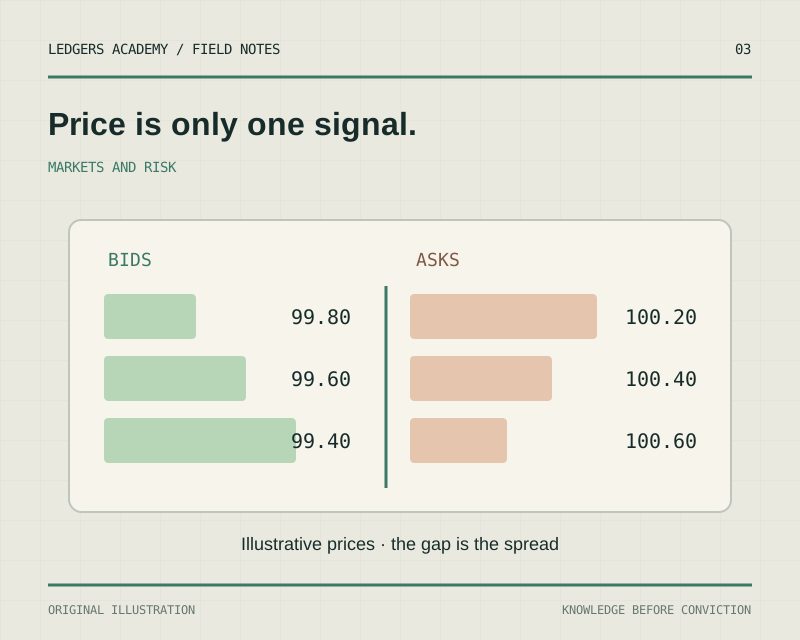
This beginner guide to crypto trading focuses on the decisions you control: order size, execution conditions, custody and the amount you can lose. A chart pattern is incomplete without those decisions. Start with spot mechanics and a paper record before considering leveraged products.
Updated 3 October 2026 · By Adam · Examples below are original educational scenarios, not live market data or product tests.
Crypto trading: distinguish spot, margin and derivatives
A spot purchase exchanges assets at the venue's execution price. Keeping assets on that venue adds custody risk. Margin involves borrowing; a derivative tracks an exposure under a contract rather than necessarily delivering the underlying coin. Funding, maintenance margin and liquidation rules are venue-specific. Never assume a stop order prevents liquidation in a fast market.
A market order prioritises execution against available liquidity. A limit order specifies a price boundary and may fill partially or not at all. A stop-limit order creates a limit order after its trigger; the market can pass the limit before it fills. Coinbase's order-type documentation provides concrete examples; check the rules of the venue you use.
Read an order book as a cost estimate
Worked example: the best ask is not the whole fill
Imagine sellers offer 0.4 BTC at $60,000 and 0.6 BTC at $60,100. A market buy for 1 BTC consumes both levels if the book does not change. Cost is 0.4 × 60,000 + 0.6 × 60,100 = $60,060, before fees. The average price is $60,060, which is $60 above the first visible ask.
A limit buy at $60,000 could take the 0.4 BTC and leave the rest unfilled, depending on order instructions. It controls price but does not promise completion. Record actual fills and fees; the chart's latest price is not your trade receipt.
Size the loss before sizing the position
Worked example: a $100 planned loss
Use a fictional $10,000 account and a 1% planned risk budget: $100. If entry is $100 per token and the proposed exit is $95, the price distance is $5. Ignoring costs, $100 / $5 allows 20 tokens, a $2,000 position. This is position value, not $2,000 of acceptable loss.
If you reserve $20 for combined fees and adverse execution, only $80 remains for price movement. That reduces size to 16 tokens. If an exit fills at $90 instead of $95, the loss is $160 plus costs. A stop helps execute a plan; it does not cap realised loss at the planned number.
Leverage increases exposure relative to posted collateral. It does not improve a strategy's forecasting ability. Read the auto-deleveraging entry and venue liquidation formula before using derivatives. Choosing no position is a valid outcome when the rules or potential loss are unclear.
Write a trade ticket with a rejection rule
- Specify the instrument, venue, direction and thesis.
- Record entry conditions and the observation that invalidates the thesis.
- Calculate size using executable loss assumptions, including fees and slippage.
- Choose the order type and expiry; define what happens after a partial fill.
- Set a maximum combined exposure across correlated positions.
- After closing, compare the planned result with actual fills and the decision process.
Evaluate the process over a sample
In a hypothetical ten-trade record, four wins of $150 and six losses of $100 net to zero before fees. The 40% win rate alone says little; payoff sizes and costs matter. Ten trades are also a small sample. Do not relabel a lucky result as proof of skill, or increase risk to recover an earlier loss.
For a DEX, add contract and liquidity checks. For storage after trading, use the hardware-wallet guide. Keep records for tax reconciliation from the first transaction.
Sources and verification
Primary references checked on 3 October 2026. Protocol settings and local rules can change; verify the linked version before acting.
Knowledge check
Apply the example before checking the answer.
Question 1 of 3Does a limit order guarantee a completed trade?
Question 2 of 3How many tokens fit the example after reserving $20 for costs?
Question 3 of 3Do four $150 wins offset six $100 losses before fees?