
Master Guide
Onchain Analysis and DEX Trading: Evidence and Risk
Use onchain analysis and DEX trading examples to distinguish transfers from sales, calculate price impact and inspect token permissions and liquidity.
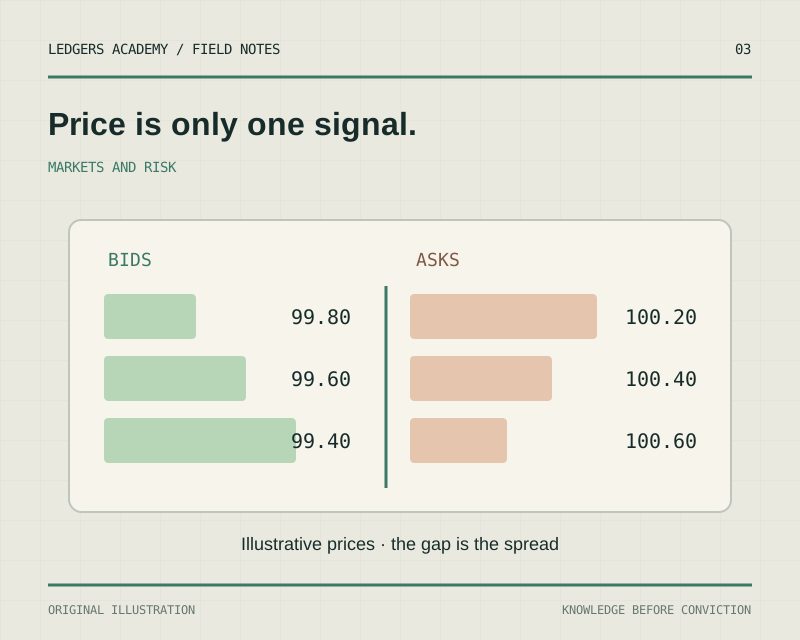
Onchain analysis and DEX trading begin with verifiable transactions, not a label saying “smart money”. Public records show movements and contract calls. They rarely explain the owner's identity, purpose, liabilities or next decision. This guide shows how to separate an observation from a trading story.
Updated 3 October 2026 · By Adam · Examples below are original educational scenarios, not live market data or product tests.
Onchain analysis: record evidence before interpreting it
For an Ethereum transaction, capture the chain, transaction hash, block number, status, sender, destination and relevant token-transfer events. An explorer is a convenient presentation of data; compare material details with another source if a conclusion depends on them. Ethereum's oracle documentation explains why a chain cannot simply know external facts such as real-world identity.
Worked example: an exchange deposit is not a completed sale
A labelled address receives 200 ETH from wallet A. The observation is a transfer. Possible explanations include sale preparation, collateral movement, custody consolidation or an incorrect label. Before claiming selling pressure, check whether the destination label is corroborated, whether wallet A belongs to the same operator, and whether a later onchain swap actually occurred.
Keep an evidence log with three columns: observation (“200 ETH moved”), inference (“possibly a deposit”), and missing evidence (“no executed sale observed”). Confidence should follow the weakest link. Do not turn a cluster of addresses into a named person's portfolio without support.
Calculate a DEX quote before setting tolerance
An automated market maker trades against reserves rather than an order book. In a basic constant-product pool the reserve product constrains the output. Newer concentrated-liquidity pools behave differently across price ranges. Uniswap's protocol overview describes the distinction.
Worked example: price impact before fees
Assume a simple pool has 1,000 token A and 1,000 token B, with no fee. Its product is 1,000,000. Adding 100 A leaves 1,100 A, so B becomes 1,000,000 / 1,100 = 909.09. The trader receives 90.91 B, although the initial one-to-one price suggested 100 B. The average execution price is 100 / 90.91 = 1.10 A per B.
The missing 9.09 B is price impact from the trade itself. Slippage tolerance is a separate limit on changes between the quote and execution. Increasing tolerance does not restore the original price, and can expose you to a worse fill. Real execution also includes pool fees, gas, routing and token-specific behaviour.
Check the asset, permissions and exit route
- Match the contract address and chain to the issuer's documented address. Names and ticker symbols can be copied.
- Inspect permissions: minting, freezing, upgrades and transfer restrictions. Read who controls them, not just whether the code is verified.
- Check usable liquidity for your order size. Headline volume can be artificial and is not an exit guarantee.
- Review the spender and allowance separately from the swap. Avoid a request whose meaning you cannot establish.
- Estimate both entry and exit costs, including gas in the chain's native asset. A visible token balance is not necessarily sellable.
A small successful sale is evidence about that moment, not proof that future sales will work. A token operator may change permissions; liquidity may disappear. An audit, liquidity lock or scanner score narrows particular questions without settling every risk.
Account for transaction ordering
Your transaction may compete with searchers and builders. Ethereum's MEV documentation describes ordering-related opportunities, including sandwich attacks. Limit tolerances, compare routes and investigate the execution policy of any protective service. “Private” routing does not make a malicious token safe.
Use the slippage entry and trading risk guide before treating a transaction feed as a strategy. Keep your evidence log even when you choose not to trade; a rejected thesis is useful research.
Sources and verification
Primary references checked on 3 October 2026. Protocol settings and local rules can change; verify the linked version before acting.
Knowledge check
Apply the example before checking the answer.
Question 1 of 3Does a transfer to an exchange-labelled wallet prove a sale?
Question 2 of 3How much B does the fee-free example return for 100 A?
Question 3 of 3Does a successful small sale establish that a token is safe?