
Crypto Lexicon
Slippage
Slippage is the difference between the expected price of a trade and the actual executed price at which the transaction is finalized on the blockchain, caused by market volatility, low liquidity, or high network latency.
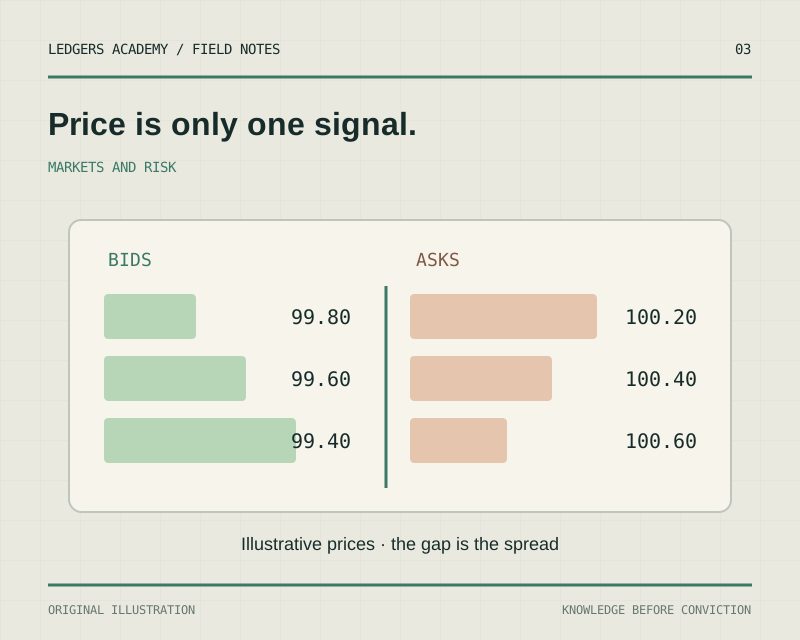
The Two Main Causes of Slippage
- Market Volatility During Block Inclusion: Between the millisecond you submit a swap and the moment a block validator confirms it onchain, other traders may execute orders that move the market price.
- Price Impact from Liquidity Pool Depth: When buying a large position in a small liquidity pool on a decentralized exchange (like Uniswap or Raydium), your own order consumes available liquidity, pushing the execution price significantly higher against yourself.
Slippage Tolerance Settings
When trading on decentralized exchanges, you manually define your Slippage Tolerance (typically 0.1 to 1.0 percent):
- If Price Moves Within Your Tolerance: The transaction executes successfully.
- If Price Moves Beyond Your Tolerance: The smart contract automatically cancels the transaction, refunding your tokens and protecting you from massive unexpected price spikes.
The Danger of High Slippage (MEV Sandwich Attacks)
Setting your slippage tolerance too high (such as 5 to 15 percent) is the number one mistake made by memecoin traders: 1: Automated MEV (Maximum Extractable Value) searcher bots detect your transaction sitting in the public mempool.
- A bot may buy before your trade and sell after it, worsening your execution price and attempting to capture value from your slippage tolerance. Fees, ordering and competition affect whether the attempt succeeds.
- Check before signing: Compare expected price impact, fees and minimum received. Use the smallest tolerance compatible with your intended execution and investigate protective routing where available. A private RPC endpoint alone does not guarantee protection from transaction-ordering attacks.
Learn how to trade safely on decentralized exchanges in our Complete Guide to Onchain Analysis and DEX Trading.
Execution-risk explanation updated 3 October 2026. Primary reference: Ethereum's MEV documentation. Transaction-ordering strategies are attempts to extract value, not guaranteed profits.
Knowledge check
Three quick questions on this entry. Pick an answer to see whether it is right.
Question 1 of 3Which description matches Slippage?
Question 2 of 3Which part of the lexicon does Slippage sit in?
Question 3 of 3Which of these also belongs to Trading & Market Structure?