
Master Guide
Memecoin Trading: Liquidity, Permissions and Evidence
Assess memecoin trading risk with original exit-liquidity and holder-concentration examples. Check token authorities and distinguish valuation from reserves.
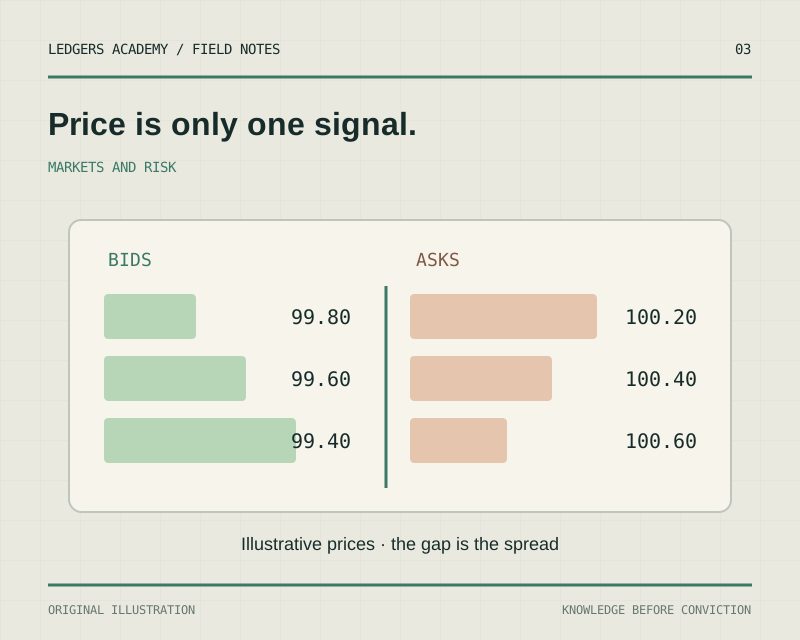
Memecoin trading and onchain surveillance require a different discipline from following a viral chart. A market can be easy to enter and impossible to exit at the displayed price. This guide focuses on liquidity, token control and evidence quality rather than promising a way to identify winners.
Updated 3 October 2026 · By Adam · Examples below are original educational scenarios, not live market data or product tests.
Memecoin trading: locate the actual market
A token name can refer to multiple contracts on multiple chains. Confirm the exact address, deployment and trading venue. A launchpad may use a bonding curve before transferring trading to an AMM. Its pricing, migration conditions and fees are application-specific; do not assume one platform's rules apply to another.
A market-cap figure often multiplies a marginal quoted price by a supply figure. It is not a pool of cash available to holders. Check circulating versus total supply and distinguish quoted valuation from immediately usable quote-asset reserves.
Calculate what the pool could actually pay
Worked example: a million-dollar headline, small exit liquidity
Imagine one million tokens and a simple pool containing 10,000 tokens plus $10,000 of a dollar-valued quote asset. The starting marginal price is $1, implying a $1 million headline valuation. Ignore fees and assume the quote asset stays worth $1.
A seller adding 1,000 tokens changes token reserves to 11,000. Under a constant product of 100,000,000, quote reserves become $9,090.91. The seller receives $909.09, an average of about $0.9091 per token. Selling 10,000 tokens instead leaves 20,000 token reserves and $5,000 quote reserves, so the seller receives only $5,000.
The headline valuation did not mean the pool could pay $1 for every token. The calculation illustrates price impact; real launch curves and concentrated liquidity can differ. Uniswap's AMM overview provides the underlying model.
Inspect privileges that survive launch
For a Solana token, mint and freeze authority are distinct roles. Solana's authority documentation describes how authorities can be changed or revoked. Check the token program and relevant extensions too. An Ethereum token can have other transfer, fee or upgrade logic; a familiar ticker does not establish familiar permissions.
- Can more supply be minted, and who has that authority?
- Can accounts or transfers be frozen or selectively restricted?
- Can contract logic or fee settings change?
- Who controls liquidity, and what exactly does a claimed lock cover?
- Are major holder balances related, or merely labelled that way by a dashboard?
A renounced permission removes one identified capability. It does not guarantee a fair launch, independent holders, durable demand or an honest website. Scanner warnings are useful leads; their absence is not proof of safety.
Treat surveillance labels as hypotheses
Worked example: five holders may be one operator
A fictional dashboard shows five top holders with 6% each, apparently below a 10% concentration rule. If credible transaction evidence shows they share an operator, combined exposure is 30%. The opposite error is also possible: a common funding source might be an exchange serving unrelated customers.
Document address relationships and the evidence for each. Do not assign certainty from timing alone, and do not publish a person's identity from a weak cluster. Wash trading can inflate activity without creating genuinely independent demand.
Write a stop condition before a purchase
If contract control is unclear, the sell route fails, or plausible exit cost exceeds your tolerance, reject the trade. Keep speculative exposure small enough that a complete loss does not affect essential expenses. A small successful test cannot rule out later restrictions or disappearing liquidity.
Use the wash-trading explainer, bonding-curve entry and token-launch risk chapter. A useful surveillance result can be a documented decision not to trade.
Sources and verification
Primary references checked on 3 October 2026. Protocol settings and local rules can change; verify the linked version before acting.
Knowledge check
Apply the example before checking the answer.
Question 1 of 3Does a $1 million token valuation mean a pool contains $1 million for exits?
Question 2 of 3What does a 10,000-token sale return in the simplified pool example?
Question 3 of 3Does revoking mint authority remove every token risk?