
Master Guide
Bitcoin Mining: Hashrate, Power Costs and Break-Even
Understand Bitcoin mining with worked electricity, efficiency and operating-margin calculations. Separate consensus validation from mining economics.
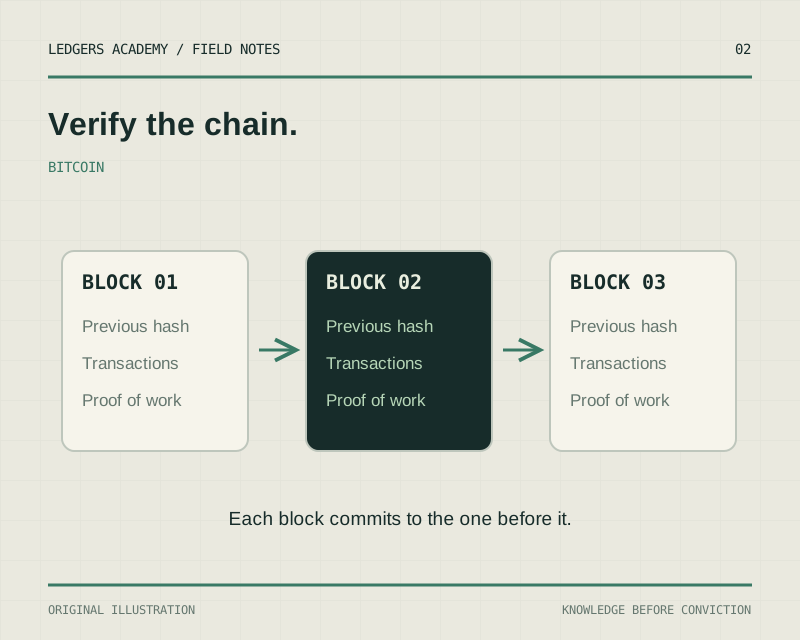
Bitcoin mining combines a probabilistic search for valid blocks with a business whose costs are paid whether a block is found or not. Hashrate, difficulty, electricity and revenue are different quantities. This guide shows how to calculate a first operating estimate and identify what it leaves out.
Updated 3 October 2026 · By Adam · Examples below are original educational scenarios, not live market data or product tests.
Bitcoin mining: work is proposed, validity is checked
Miners construct candidate blocks and search for a header hash below the required target. Nodes check the resulting block against consensus rules. A miner with more equipment does not thereby gain permission to create invalid coins. The Bitcoin mining documentation describes block construction and the difference between solo and pooled mining.
Hashrate measures computations per second; difficulty regulates how demanding a valid proof is. Bitcoin periodically adjusts difficulty toward its target block interval. Subsidy and transaction fees provide block revenue, but revenue per unit of hashpower also depends on competing hashpower. The blockchain guide covers these protocol rules.
Calculate electricity before projecting a profit
Worked example: a fictional 3 kW machine
Assume a miner draws 3 kW continuously. Daily energy use is 3 × 24 = 72 kWh. At $0.08 per kWh the energy cost is $5.76 per day. At $0.15 it is $10.80. Those figures exclude cooling, network equipment, downtime and any tariff demand charges.
For an illustrative gross revenue of $9 per day and a 2% pool fee, receipts are $8.82. After $5.76 energy, the operating margin is $3.06. At the higher tariff the margin is −$1.98. Holding other assumptions fixed, the electricity-only break-even tariff is $8.82 / 72 = $0.1225 per kWh.
A $1,500 machine would take about 490 days to recover its purchase price at a constant $3.06 daily margin. This is simple arithmetic, not a realistic payback forecast: network competition, difficulty, price, fees, failure and resale value can all change during that period.
Measure efficiency and uptime
For a fictional 100 TH/s machine drawing 3,000 W, efficiency is 30 joules per terahash. Lower energy per hash can improve the operating model, but does not establish profit. Use measured wall power for the whole setup where available; a manufacturer's nominal device figure may omit external equipment.
With 90% uptime, a nominal 100 TH/s installation averages approximately 90 TH/s over the measurement period. Record interruptions and actual pool receipts rather than multiplying a headline specification by a full calendar year.
A pool reduces variance, not every risk
Pooling distributes rewards according to a particular payout method. It can smooth receipts compared with solo mining, while introducing payout, operator and connection dependencies. Compare the actual fee policy, share accounting, payout thresholds and rejected-share reporting. The pool's hashrate is not necessarily the same as independently owned hardware under one person's control.
Worked example: your share of a larger network
If your hashpower is unchanged while total network hashpower doubles, your proportional share halves. Under an unchanged aggregate reward assumption, expected revenue also halves. A fixed electricity bill does not halve with it. This is why a profit screenshot from last month is not an operating budget.
Build a sensitivity sheet
- Power draw, tariff structure and total installation costs.
- Observed hashrate, uptime and pool deductions.
- Coin-denominated revenue and the conversion price used.
- At least one scenario with lower revenue and higher costs.
- Hardware failure, maintenance and a shutdown threshold.
Read the consensus comparison and market-cycle guide. Mining is a useful way to understand Bitcoin's incentives even if operating a miner makes no sense for your circumstances.
Sources and verification
Primary references checked on 3 October 2026. Protocol settings and local rules can change; verify the linked version before acting.
Knowledge check
Apply the example before checking the answer.
Question 1 of 3How much energy does the hypothetical 3 kW miner use per day?
Question 2 of 3What is the example operating margin at $0.15 per kWh?
Question 3 of 3Can a miner make invalid coins valid by controlling more hashrate?