
Master Guide
Cold Storage and Hardware Wallets: A Beginner Guide
Learn cold storage and hardware wallet setup, backup checks and approval risks, with an example showing why offline keys cannot prevent every loss.
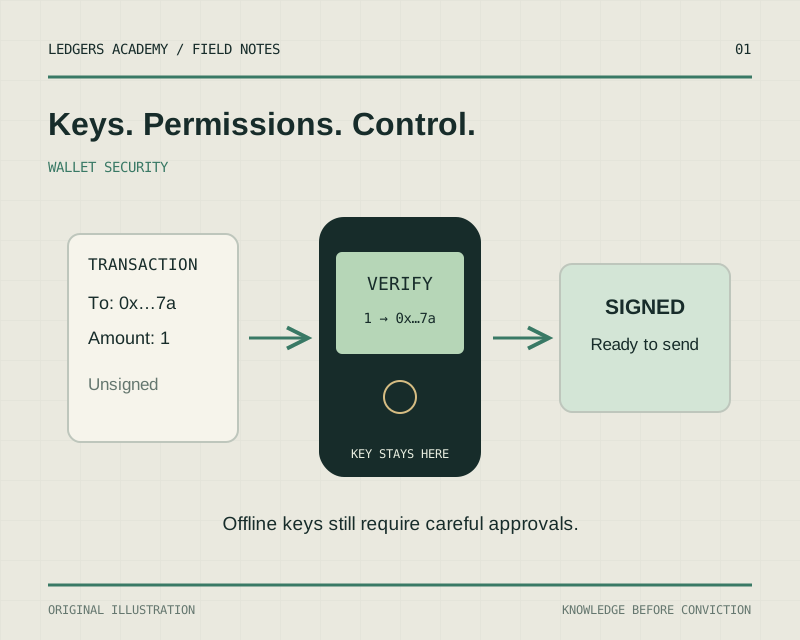
This beginner guide to cold storage and hardware wallets starts with a practical question: who can authorise a transaction, and how would you recover access if your device disappeared? A wallet changes the way keys are held. It does not remove every way funds can be lost.
Updated 3 October 2026 · By Adam · Examples below are original educational scenarios, not live market data or product tests.
Cold storage and hardware wallets: what is protected?
Your coins remain recorded on their blockchain. A hardware wallet keeps signing keys separate from the everyday computer and asks you to confirm transactions on its own screen. Devices differ in architecture; not every wallet uses the same secure element or backup standard. Consult the maker's security model rather than assuming all products are interchangeable. Ledger's hardware documentation describes its implementation.
Self custody reduces dependence on an exchange for withdrawals. You still depend on the chain, the asset issuer where applicable, software and your backup process. Stablecoin freezes, contract bugs and malicious approvals can affect assets whose keys you control. A connected hardware wallet is a signing tool; it is not a guarantee that an application is honest.
A transaction you should refuse
Worked example: a $50 swap with a $5,000 permission
Imagine a wallet holds 5,000 units of a token worth $1 each. A website advertises a $50 swap but asks for permission to spend every token. The intended trade is 1% of the balance; the proposed allowance exposes 100%. An approval and a swap are different actions. Signing the approval can give another contract the ability to transfer tokens later.
Read the spender address, token and allowance. Prefer a limited amount where supported, and refuse a request you cannot interpret. A subsequent revocation can reduce remaining exposure, but it cannot undo tokens already moved. Token approvals and wallet drainers explains this distinction.
Device confirmation helps only if you understand what you confirm. Some interactions require blind signing, where the screen cannot fully describe the action. Ledger's blind-signing explanation covers the risk. A phishing site does not need to extract your key if it can persuade you to approve a harmful transaction.
Set up without creating a second attack path
- Buy from the maker or a reseller the maker actually lists. Packaging alone is not proof of authenticity; use the manufacturer's genuine-device checks.
- Install software from a bookmarked official address. Initialise the device yourself. Reject a device supplied with a completed recovery phrase.
- Record the backup using the method supported by that device. Do not type a hardware-wallet recovery phrase into a website or send it to support.
- Check the complete receiving address on the device screen. Send a small test amount before the main transfer.
- Use the maker's on-device backup-check procedure before storing meaningful funds. Trezor documents a Safe 3 backup check; follow the procedure for your own model.
Plan a recovery, then review the plan
Write a private recovery plan describing where the backup is, which wallet standard it uses, and whether a separate passphrase is required. Keep sensitive words out of the plan itself. A BIP39 passphrase creates a different wallet; forgetting it can make a correct word backup insufficient. Splitting or hiding words without a tested recovery method introduces another failure point.
Ask three questions: could a thief obtain both device and backup; could a fire destroy every copy; could your intended heir reconstruct the process without broadcasting the secret? More copies improve availability but create more places to steal the backup. Decide deliberately, revisit after moving home, and keep exchange statements for your tax records.
Sources and verification
Primary references checked on 3 October 2026. Protocol settings and local rules can change; verify the linked version before acting.
Knowledge check
Apply the example before checking the answer.
Question 1 of 3Can a hardware wallet prevent every remote attack?
Question 2 of 3What is exposed by the $5,000 allowance in the example?
Question 3 of 3Is a replacement device enough to recover a lost wallet?