
Master Guide
Crypto Policy and CBDCs: Read the Rules and Evidence
Evaluate crypto policy and CBDCs using official sources. Distinguish proposals from implementation and reserve transfers from new market purchases.
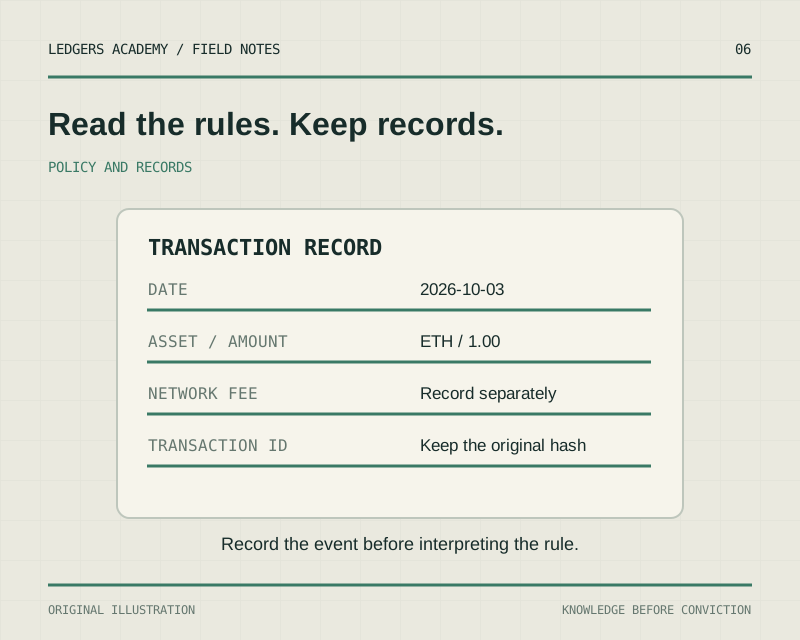
Crypto policy and CBDCs are often discussed through sweeping claims about bans, surveillance and national reserves. The useful starting point is a specific instrument, jurisdiction, effective date and source. A proposal, an executive order and an operating payment system are different stages of policy.
Updated 3 October 2026 · By Adam · Examples below are original educational scenarios, not live market data or product tests.
Crypto policy and CBDCs: classify the claim
- Proposal: a suggested rule that may change before adoption.
- Enacted instrument: a law, regulation or order with a defined legal scope.
- Implementation: funding, institutions and systems that make the instrument operational.
- Observed outcome: documented effects, measured separately from stated goals.
For each headline, ask which stage it describes. A policymaker's ambition is evidence of an ambition; it is not evidence that the promised infrastructure already works. Legal status can also vary between trading, custody, payments and taxation within the same country.
A CBDC design is not a universal spending restriction
A central bank digital currency is central-bank money in digital form. Access, privacy, intermediaries and technical design depend on the project. The ECB's digital-euro FAQ explicitly distinguishes conditional payments from programmable money and says the proposed digital euro would not restrict use to predefined purposes. That is a project-specific statement, not proof about every possible CBDC.
The ECB project page describes ongoing work and records a draft rulebook update in July 2026. Read a proposed design as a proposed design; check legislation and deployment status before telling readers that it is already circulating.
Read a reserve announcement literally
The US 6 March 2025 executive order establishes a Strategic Bitcoin Reserve and a separate Digital Asset Stockpile. It describes initial capitalisation from eligible forfeited assets, subject to legal conditions, and directs development of budget-neutral additional Bitcoin acquisition strategies. Those statements do not establish the size of a completed purchase programme or that every other token will be bought.
Worked example: holdings change without a market purchase
Suppose a fictional treasury reports 10,000 BTC in one agency and later reports the same coins in a reserve account. The reserve balance rose by 10,000 BTC, but the government's aggregate holdings did not rise. An accounting transfer created no new open-market purchase in this scenario.
A later claim that “the reserve added coins” therefore needs an acquisition record, a date and a definition of holdings. Distinguish custody transfers, forfeitures, purchases and asset returns. Price analysis based only on a new account balance can double-count assets already held.
Evaluate practical effects rather than predicting inevitability
| Question | Evidence needed |
|---|---|
| Who is covered? | Defined persons, activities and jurisdiction |
| When does it apply? | Effective date and transitional provisions |
| Who enforces it? | Named authority and enforcement powers |
| What actually changed? | Implemented rules, access or documented transactions |
| What remains uncertain? | Pending legislation, guidance or operational details |
A government can restrict exchanges, services and access even if a distributed network continues elsewhere. Network persistence does not give a user legal immunity. Likewise, holding Bitcoin in a reserve does not remove volatility, custody costs or governance questions, and historical correlations can change.
Keep a dated policy notebook
Save the official instrument and a short note stating the activity relevant to you. Recheck before transacting or publishing a current-status claim. Use the tax and records guide for reporting, macro guide for market interpretation, and Academy School's policy chapter to test the distinctions. Avoid turning a political announcement into a guaranteed investment thesis.
Sources and verification
Primary references checked on 3 October 2026. Protocol settings and local rules can change; verify the linked version before acting.
Knowledge check
Apply the example before checking the answer.
Question 1 of 3Are all CBDCs necessarily programmable money with spending restrictions?
Question 2 of 3Does moving existing government coins into a reserve prove a market purchase?
Question 3 of 3Does a network continuing abroad exempt a user from local law?