
The Daily Ledger: 5 September 2026
Why Polymarket Perps Are Unavailable to US Traders
Polymarket expands to 67 perpetual markets while US traders remain excluded, BTC and ETH cool, and quantum-security planning moves forward.
THE DAILY LEDGER | 5 SEPTEMBER 2026
Polymarket's 67-market expansion creates a regulatory split
Leverage is growing around prediction-market brands, but product structure and jurisdiction still decide who can trade.
Editor's note: Market data and developments were checked at 04:45 UTC on 5 September 2026. Prices and sentiment can change quickly.
The Day in Numbers
- Bitcoin: $79,536, down 1.8% over 24 hours.
- Ether: $2,451, down 2.4% over 24 hours.
- Total crypto market cap: $2.69 trillion, down 3.9% over 24 hours.
- Fear and Greed: 73, Greed, one point below the previous reading.
The combination matters: prices and total market value fell while sentiment stayed elevated. Greed can persist during a pullback, so it should be read as positioning context rather than a buy signal.
Why can't US traders use Polymarket Perps?
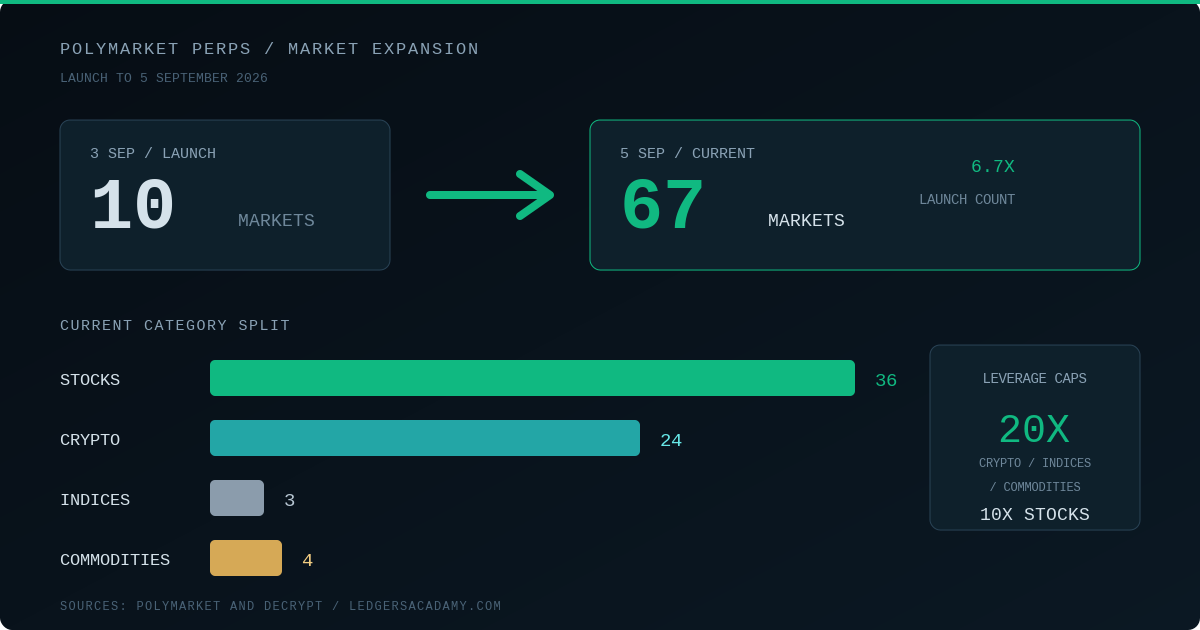
Polymarket Perps now lists 67 markets: 36 stocks, 24 crypto assets, three indices, and four commodities. Decrypt reported that the product launched with 10 markets on 3 September and offers up to 20x leverage on crypto, indices, and commodities, with up to 10x on individual equities. US users cannot place orders on the venue.
A perpetual future tracks an underlying asset without an expiry date. Periodic funding-rate payments help keep its price near the spot market. That makes a perp different from a prediction-market contract, even when both products appear under the same brand.
The US restriction reflects the regulated path for derivatives. In 2022, the CFTC said Polymarket had operated an unregistered event-contract facility and required it to wind down noncompliant markets. In May 2026, the agency separately approved Kalshi's Bitcoin perpetual futures contract. The contrast shows that US access is possible, but only through an approved venue and contract structure.
For traders, the practical order is simple: check geographic eligibility, understand the venue, then assess leverage. A 20x position loses its posted margin after roughly a 5% adverse move before fees and maintenance rules, so liquidation normally comes sooner.
Today's Headlines
Zcash rally forced short positions closed
Decrypt reported that Zcash reached about $1,029 on Friday while roughly $34.5 million in short positions were liquidated. Forced buying can accelerate a rally, but liquidation-driven momentum is not proof of durable demand.
Injective records more than $1 billion of mortgage data
Injective said Pineapple Financial moved records representing more than $1 billion in mortgages onto its network. The announcement concerns tokenized records and audit trails, not ownership of the underlying loans. That distinction is essential when evaluating real-world asset claims.
G7 cyber agencies call for post-quantum preparation
A new G7 cybersecurity report urged organizations to inventory cryptography and begin migration planning before quantum threats become practical. The international message is about preparation time, not an active break of Bitcoin, Ethereum, or modern banking encryption.
Security Note: quantum risk is a migration problem today
No current quantum computer can break Bitcoin or Ethereum cryptography. The near-term concern is "harvest now, decrypt later," where encrypted data is collected for a future attack. There is no consumer switch that makes a Bitcoin address quantum-proof today. Avoid products promising instant protection and keep using proven controls such as offline backups, hardware wallets, address verification, and timely software updates.
Build the Context
Read the beginner guide to crypto trading before using leveraged products, then study funding rates and perpetual futures. For a structured path from custody to market risk, start at Academy School.
Bottom line: Polymarket's expansion shows demand for always-open leveraged markets. The US exclusion shows why a familiar brand does not make two financial products legally or mechanically equivalent.
Sources
- Binance: BTC 24-hour market snapshot
- Binance: ETH 24-hour market snapshot
- CoinGecko: global crypto market snapshot
- Alternative.me: Crypto Fear and Greed Index
- Polymarket Perps: current markets
- Decrypt: Polymarket launches crypto perpetual futures
- CFTC: 2022 Polymarket enforcement order
- CFTC: Kalshi Bitcoin perpetual futures approval
- Decrypt: Zcash rally and liquidations
- Injective: Pineapple Financial mortgage-record announcement
- Decrypt: G7 post-quantum migration report
Disclaimer: This publication is for education and information only. It is not financial, investment, legal, tax, or security advice.