
The Quiet Ledger: Issue #15 | 20 November 2026
What Is a Peg Stability Module? The Sky USDC Freeze Risk
What is a peg stability module? Sky's PSM lost $1.4 billion of USDC in an hour after a report on illicit swaps and its single freezable reserve address. Plus a $6.5 billion freezing order and bitcoin's 13.8 percent fall.
THE QUIET LEDGER
Issue #15 | Saturday 14 November to Friday 20 November 2026
A week about who can stop money once it moves: a DeFi swap desk's whole reserve sat in one freezable address, and an Abu Dhabi court froze $6.5 billion held by people it cannot name
Reporting window Saturday 14 November to Friday 20 November 2026, continuing from Issue #14's cutoff at 22:00 UTC on Friday 13 November. Data cutoff 22:00 UTC on Friday 20 November (23:00 Europe/Stockholm, CET). Weekly price changes compare CoinGecko hourly readings at 22:00 UTC on each Friday; daily snapshots are 00:00 UTC. Friday's ETF session is pending. This issue was added to the archive on 28 November 2026 and uses only information available at the cutoff.
What is a peg stability module, and why did $1.4 billion leave one in an hour? On Thursday a report traced $518 million of illicit-linked swaps through Sky's module and noted that its entire USDC reserve sits in one address Circle could freeze; within hours the reserve had fallen by more than two thirds. Courts in Abu Dhabi and Manhattan spent the week on the same question: who can stop crypto once it moves. Bitcoin fell 13.8 percent.
1. The Macro Pulse
- Bitcoin: $58,923 at the 22:00 UTC cutoff, down 13.8 percent from $68,337 at Issue #14's cutoff. Its lowest hourly reading of the week, near $58,300, came at 21:00 UTC on Friday.
- Ether: $1,617.57 at the cutoff, down 16.1 percent from $1,926.92.
- Fear and Greed: 12, Extreme Fear, from 20 a week earlier, and between 10 and 13 all week.
- US spot ETFs: last Friday's session, pending in Issue #14, closed $185.5 million out. This week's four completed sessions took $1,120.5 million out of bitcoin funds, Thursday's $582.2 million the largest, leaving November about $3.47 billion out; ether funds lost $208.5 million, per Farside. Friday is pending.
- Rates and leverage: Fed minutes released on Wednesday say almost all officials judged further rate increases likely to be appropriate; a couple floated more than a quarter point if inflation data disappointed. Liquidations approached $2 billion in 24 hours over the 14 to 15 November weekend, ForkLog reports.
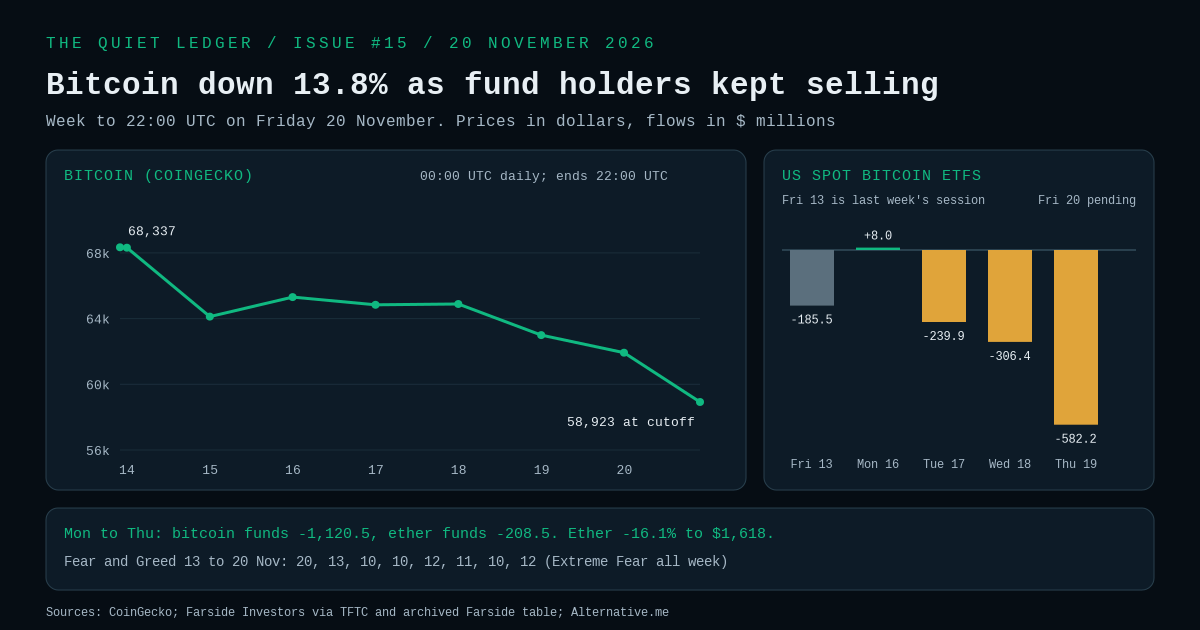
The takeaway: fund holders sold on four of the five sessions reported here, the Fed's minutes pointed to tighter money, and sentiment sat near the floor of its range all week.
2. This Week in Headlines
Courts: one freeze, one acquittal
Binance won a $6.5 billion worldwide freezing order from the Abu Dhabi Global Market courts against the unidentified thieves behind its 29 October hack, with a living list of about 26,000 wallet addresses; its lawyers say the orders can be served via blockchain. About $2.85 billion is already frozen or intercepted, Gulf News reports. The order names tainted coins; an exchange or issuer still has to act, as our entry on tracing and recovering stolen crypto explains.
In Manhattan, Judge Jessica Clarke acquitted Anton and James Peraire-Bueno, who took about $25 million from Ethereum trading bots with bait transactions in 2023, finding no material misrepresentation in what she called a "trustless, highly adversarial environment with no terms of use". On the Editorial Desk's reading, exploiting what code permits is not wire fraud unless someone was lied to; our lexicon explains maximum extractable value.
Banks: a closed door and a new application
The Supreme Court on Monday declined to hear Custodia Bank's appeal, leaving intact the Tenth Circuit's ruling that Reserve Banks may refuse a master account, the direct link to the Fed's payment system. The same week MoonPay applied to the OCC for a national trust bank charter covering custody and stablecoin issuance, without taking deposits, ahead of the GENIUS Act taking effect on 18 January 2027.
Russia opens, Singapore experiments
From 17 November Russian retail investors may buy bitcoin, ether and USDT through intermediaries after a test, capped at ₽300,000 a year per intermediary (Ordinance 7441-U); exchanges may start organised trading from 22 November, crypto.news reports. In Singapore, MAS announced a sandbox for AI agents paying with programmable money, said $100 million of tokenised MAS Bills was issued and settled against a Singapore dollar CBDC in November, and said a stablecoin regime is coming.
Standard setters and protocol engineers look ahead
IOSCO's 63-page report on quantum computing, published Thursday, calls the migration for blockchains "slow and fragmented", noting that post-quantum signatures are 35 to 40 times larger than today's. Ethereum's core developers laid out three timelines for Glamsterdam: mainnet in mid-January 2027 as specified, late February or early March if the decision waits until January, or April to May if the gas changes that could break existing contracts are rewritten. No decision was taken.
3. The Weekly Deep Dive: what is a peg stability module?
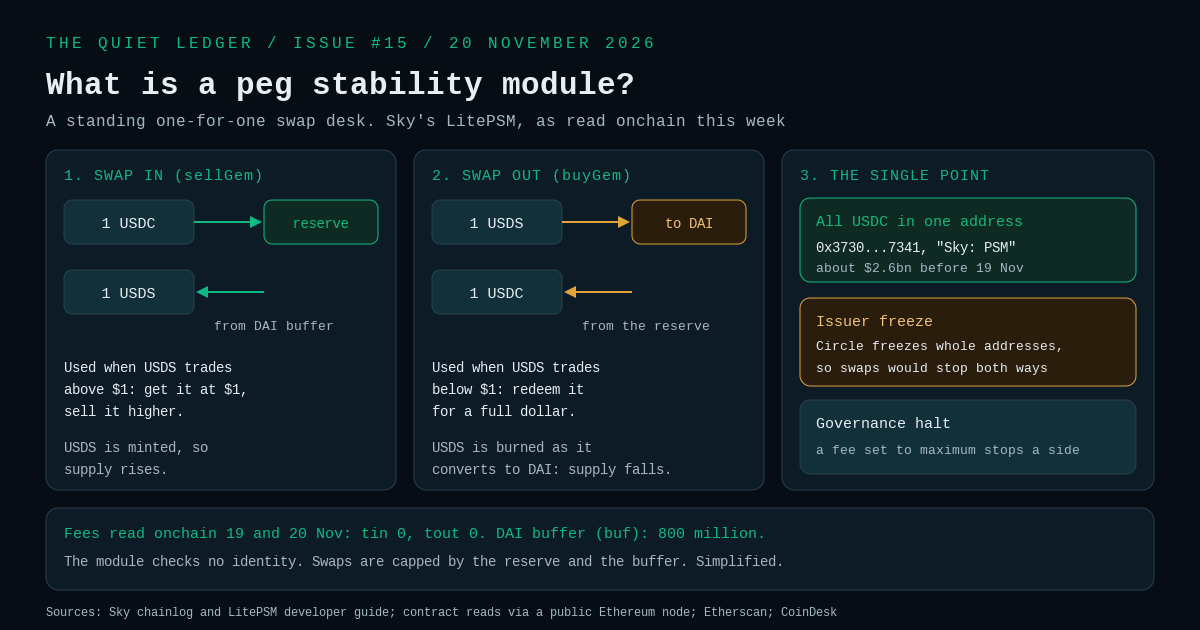
A peg stability module (PSM) is a standing swap desk inside a stablecoin protocol. It exchanges one dollar token for another at a fixed rate, in any size up to its balance. Sky, formerly MakerDAO, introduced one in March 2020; today's LitePSM swaps USDC for DAI and, through a wrapper, USDS. Its fees, tin on the way in and tout on the way out, read zero when the Editorial Desk checked the contract on Thursday and Friday, so the rate is one for one.
How it holds the peg
Arbitrage does the work. If USDS trades at 99 cents, a trader buys it and redeems it at the module for a full USDC; above $1, the trade runs the other way. When USDC comes in, it goes to a separate address the guide calls the pocket, and the seller is paid from a DAI buffer, converted to USDS, that governance caps at 800 million. Because USDS is burned as it converts to DAI on the way out, heavy redemptions shrink USDS supply.
What the week exposed
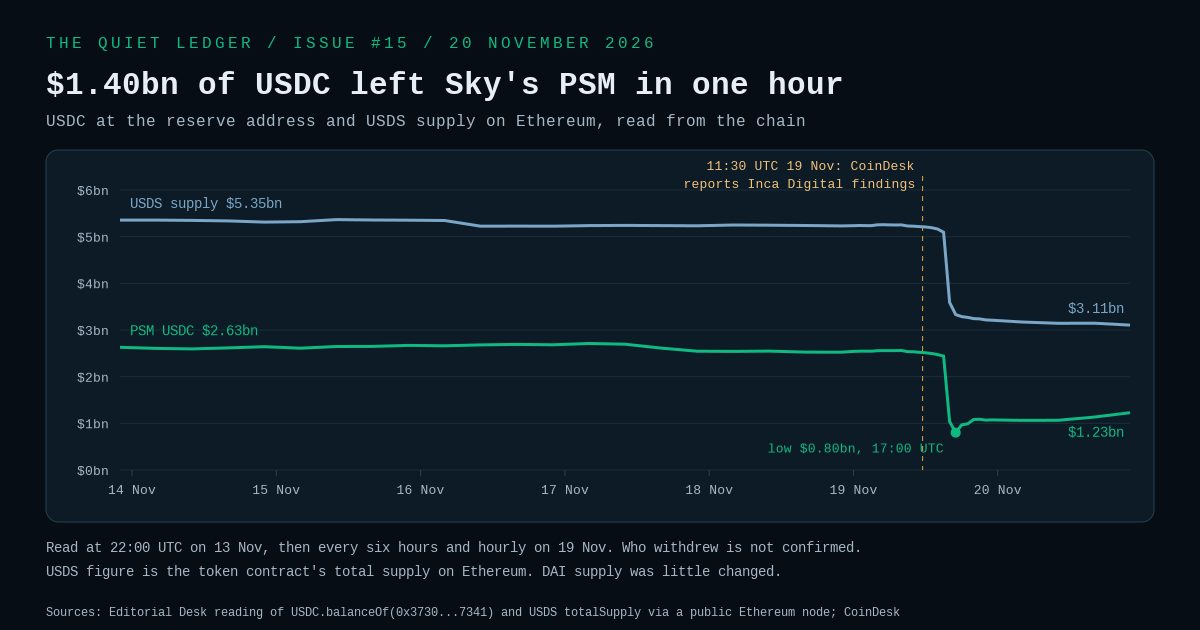
At 11:30 UTC on Thursday, CoinDesk published Inca Digital's findings: $518 million of swaps from 422 wallets tied to hackers, phishing and sanctioned entities, including $101.9 million linked to North Korea, most of it within ten days of the February 2025 Bybit theft. Its reserve, about $2.7 billion, sat in a single Ethereum address set up through Coinbase Prime, and Circle freezes addresses, not slices of them. Sky said the flagged flows were under 0.06 percent of more than $930 billion of volume and that none came through its own websites, which screen wallets. Circle has not frozen the address, Bankless notes.
Then holders left. Reading the reserve address hourly, the Editorial Desk found $2.56 billion at 08:00 UTC, $2.44 billion at 15:00, $1.04 billion at 16:00 and a low of $802 million at 17:00. USDS supply on Ethereum fell from $5.25 billion to $3.29 billion by 18:00, down 37 percent, while DAI barely moved. Who withdrew has not been confirmed.
Limits and tradeoffs
- A PSM imports the risks of what it holds: a decentralised stablecoin backed by USDC depends on Circle's freeze power, whatever its governance says.
- Capacity is finite. A rush for the exit drains exactly the liquidity that holds the peg.
- Governance can halt either side by raising a fee to its maximum, and CoinDesk reports a 2024 exception allowing a halt without the usual delay: a safety valve, and a point of control.
- The contract screens no one; Sky's front ends do. It kept honouring swaps one for one all week, which is why holders could leave at par.
What you can check
- The reserve's balance on Etherscan, and the module's addresses in Sky's chainlog.
- For any stablecoin you hold, what backs it and who can freeze that backing. Our entry on stablecoin address freezes explains the mechanics.
4. Security and Onchain Radar
Permissions that outlive their purpose. Two of the week's losses came from keys doing exactly what they were allowed to do. Confirmed: on Monday the perpetuals exchange Lighter paused withdrawals, blaming a leaked API key for one trader's account; its contracts were unaffected. Estimate: the researcher 0xTria put losses near $15.5 million across two market-maker accounts. The key could not send funds to another party, but it could open a zero-fee pool from a victim's account, and transfers between accounts sharing one address needed no extra signature, Bankless reports. The attacker's wallet withdrew $10.39 million at 10:11 UTC, before Lighter's first post. The same day a Safe multisig lost about $6.45 million in one transaction; Zodiac's co-founder said it came from the likely compromised key of a long-standing role member, and the wallet's custom permissions policy allowed it, almost certainly unintentionally, Cointelegraph reports.
The rules:
- Give every delegated key the narrowest scope: a trading key should not be able to move balances between accounts.
- Read role policies as if they were withdrawal keys. If a role can send the full balance anywhere, it is one.
- Rotate or revoke keys held by long-serving members and bots on a schedule, not only after an incident.
- Alert on large outflows in real time; this week's attacker was out before the first public warning.
5. From the Academy Library
Start with how stablecoins hold a dollar, then the complete guide to DeFi for where modules like Sky's sit. Issue #13 explains how Binance replaced the assets the Abu Dhabi order now chases, and the dailies explain the freezing order and the acquittal. New readers can begin at Academy School.
Three useful, non-affiliate tools: Etherscan, to watch the module's reserve; Sky's chainlog, to find its contracts; and the Fed's FOMC calendar.
Dates to keep
- 8 and 9 December: the next Federal Reserve meeting.
- 18 January 2027: the GENIUS Act takes effect.
A peg stability module does what it promises: one dollar for another, on demand, to anyone. This week showed that the promise is only as free as the address holding the dollars, and that anyone can check that address.
Disclaimer: This publication is for education and information only. It is not financial, investment, legal, tax, or security advice.
Sources and further reading
Sky's peg stability module
- CoinDesk: North Korean hackers used Sky's stablecoin system, putting billions at freeze risk, 19 November 2026
- Bankless: North Korean hackers used Sky's PSM, 19 November 2026
- Sky developer documentation: LitePSM guide
- Sky chainlog: mainnet contract addresses (MCD_LITE_PSM_USDC_A and its pocket)
- Etherscan: Sky PSM reserve address
Courts and banking
- Cointelegraph: Binance says it won a $6.5 billion worldwide freezing order after hack, 18 November 2026
- Gulf News: Binance wins $6.5 billion asset-freezing order from Abu Dhabi court
- Decrypt: Judge acquits MIT brothers in $25 million Ethereum MEV case, 16 November 2026
- American Banker: Supreme Court denies Custodia's appeal, 16 November 2026
- Banking Dive: Supreme Court denies Custodia petition on Fed master account access
- Cointelegraph: MoonPay seeks US bank charter for stablecoin and custody services, 19 November 2026
- OCC: MoonPay National Trust Bank charter application (public file)
International and protocols
- crypto.news: Russia opens bitcoin, ether and USDT to retail investors
- MAS: keynote address by the Managing Director at the Singapore FinTech Festival 2026
- Decrypt: quantum upgrade could be particularly challenging for blockchains, IOSCO says, 19 November 2026
- Cointelegraph: Ethereum's Glamsterdam could slip to May 2027, 19 November 2026
Security
- Bankless: Lighter pauses withdrawals after leaked API key drain, 16 November 2026
- Cointelegraph: Safe wallet reportedly loses millions after key compromise, 16 November 2026
Markets and macro
- TFTC: US spot bitcoin ETF flows, November 2026 (Farside data)
- Farside Investors: ether ETF flows, all data
- Federal Reserve: minutes of the FOMC meeting of 27 and 28 October 2026, released 18 November
- ForkLog: bitcoin ETFs break outflow streak amid market decline, 17 November 2026
- CoinGecko: bitcoin price history
- CoinGecko: ether price history
- Alternative.me: Fear and Greed Index history