
The Daily Ledger: 24 November 2026
How Civil Forfeiture of Stolen Crypto Works
The Justice Department sues to forfeit about $1.17 billion of USDC stolen from Binance: how civil forfeiture of stolen crypto works and why Circle will issue new tokens. Plus the CFTC lets exchanges count bitcoin toward reserves.
THE DAILY LEDGER
24 November 2026
The Justice Department sues to forfeit about $1.17 billion of USDC stolen from Binance, the CFTC lets exchanges count bitcoin toward their reserves, and the Ethereum Foundation doubles its protocol security team.
Reporting window: 23 November 2026, 06:00 UTC to 24 November, 06:00 UTC (07:00 Europe/Stockholm, CET). Data cutoff: 24 November, 06:00 UTC. Prices are CoinGecko 00:00 UTC daily snapshots compared with the previous day's 00:00 UTC snapshot. This issue was added to the archive on 28 November 2026 and uses only information available at the cutoff.
How does civil forfeiture of stolen crypto work? The government sues the coins themselves, not a person, and a judge decides who owns them. On 23 November the Justice Department filed such a case over USDC taken in the 29 October Binance theft. Because Circle cannot move the frozen tokens, it has agreed to issue the same amount of new USDC to the United States if the court orders forfeiture.
1. The Day in Numbers
- Bitcoin: $61,228 at 00:00 UTC, up 0.1 percent against the previous day's 00:00 UTC snapshot of $61,172. CoinGecko daily data.
- Ether: $1,709.32 at 00:00 UTC, down 0.7 percent on the same basis. CoinGecko daily data.
- Fear and Greed: 11, Extreme Fear, unchanged from 23 November. Alternative.me daily reading, 24 November, 00:00 UTC.
- USDC in circulation: $69.37 billion on 24 November, per DefiLlama. The USDC named in the case is about 1.7 percent of that. Daily data can be revised.
2. How civil forfeiture of stolen crypto works
The case is titled United States v. All USDC Associated with 36 Virtual Currency Addresses on 18 Different Blockchains. The name is the mechanism: a civil forfeiture complaint is filed in rem, against property, so no one has to be arrested. The government must show, by a preponderance of the evidence (more likely than not), that the property is crime proceeds or was used in laundering. The verified complaint, filed in federal court in Washington, D.C., alleges both and blames North Korea's Lazarus Group. A restraining order has held the funds since 12 November.
Its balance table adds up to about 1.167 billion USDC: $824.7 million at four addresses the attackers controlled, and $342.3 million at 32 Binance hot wallet and contract addresses they took over. Fourteen of the 36 hold nothing.
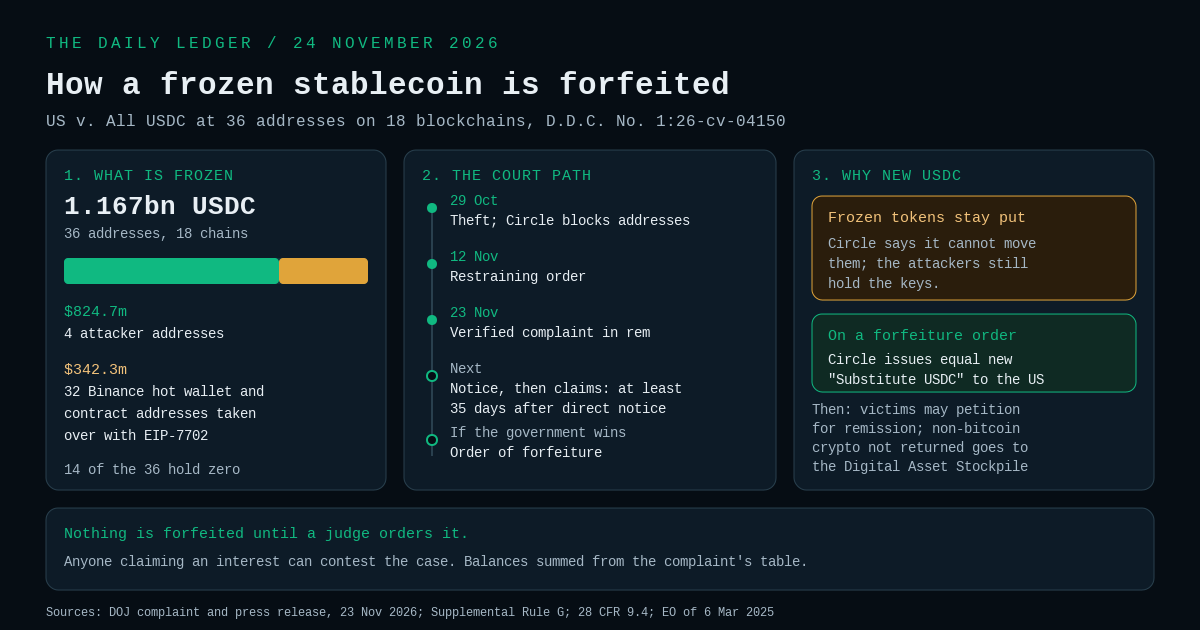
Why new tokens? Circle froze about $1.1 billion soon after the theft, but the complaint says it "does not have the technical ability" to move the frozen USDC, and the attackers still hold the keys. A freeze stops tokens moving; it hands them to no one. So Circle will issue equal "Substitute USDC" once forfeiture is ordered. Anyone claiming an interest, which could include Binance, can contest the case by the deadline in the notice. Victims can later petition the Attorney General for remission, a return of forfeited funds. Under a March 2025 order, forfeited crypto other than bitcoin that is not returned or released goes to the Digital Asset Stockpile. Unknown: whether Binance, which says it has replenished the lost assets, will claim.
3. Today's Headlines
CFTC lets exchanges count bitcoin toward reserves
CFTC staff said exchanges, swap platforms and clearing houses may count bitcoin, ether and payment stablecoins toward the 12 months of operating costs they must hold, after haircuts of at least 20 percent for bitcoin and ether and 2 percent for stablecoins. A haircut is a discount on an asset's value. Crypto still cannot meet the separate liquidity requirement.
Strategy buys 457 bitcoin
Strategy's filing reports 457 BTC bought for $29.6 million from 16 to 22 November, taking holdings to 851,305 BTC. Its board raised a buyback plan for its preferred "digital credit" securities from $3 billion to $4 billion.
Ethereum Foundation doubles its security team
The Foundation says it has doubled its protocol security team, calls AI that finds bugs faster than people can review them a more urgent risk than quantum computers, and favours hash-based cryptography over elliptic curves.
Singapore: stablecoin payments into bank accounts
OCBC and StraitsX are piloting cross-border business payments: StraitsX collects and screens the on-chain payment, OCBC credits ordinary money. NTT DOCOMO Asia is the first customer.
4. Security Note
The complaint also says how the Binance theft began. Binance told investigators an employee approached by a supposed recruiter downloaded software during a job interview. It contained malware, which let the attackers plant an EIP-7702 delegation, take control of hot wallets and sweep funds as they arrived. These are Binance's findings, untested in court. The rule: never install software sent by a recruiter on any device that can sign for funds, and run job interviews on a separate machine.
5. From the Academy Library
Read what a stablecoin address freeze is, whether stolen crypto can be recovered, and how to revoke an EIP-7702 delegation. New readers can start at Academy School.
A freeze decides where coins cannot go. Only a court decides whose they are.
Disclaimer: This publication is for education and information only. It is not financial, investment, legal, tax, or security advice.
Sources and further reading
- US Department of Justice: action to recover more than $1 billion stolen in the Binance hack, 23 November 2026
- Verified complaint for forfeiture in rem, United States v. All USDC Associated with 36 Virtual Currency Addresses, No. 1:26-cv-04150 (D.D.C.)
- 18 U.S.C. 983: civil forfeiture proceedings
- Supplemental Rule G: forfeiture actions in rem
- 28 CFR 9.4: petitions for remission in judicial forfeiture cases
- White House: Strategic Bitcoin Reserve and US Digital Asset Stockpile, 6 March 2025
- Circle: the Binance incident, 5 November 2026
- The Block: DOJ seeks $1.17 billion in USDC tied to Binance hack
- CFTC: staff advisory on crypto assets and financial resources, 23 November 2026
- CFTC Staff Letter 26-31
- Strategy: Form 8-K, 23 November 2026
- Ethereum Foundation: PQAI #0, preparing Ethereum for a post-quantum, post-AI world
- The Coin Republic: OCBC and StraitsX stablecoin payments pilot
- DefiLlama: USDC circulating supply
- CoinGecko: bitcoin daily price snapshots
- CoinGecko: ether daily price snapshots
- Alternative.me: Fear and Greed Index history