
The Daily Ledger: 26 November 2026
Can Spain Freeze a Crypto Account Without a Court Order?
Can authorities freeze a crypto account without a court order? Spain's new decree-law lets Sepblac do so for up to five business days. Plus Ukraine's crypto tax law, Fed hike odds and a hashrate hijacking warning.
THE DAILY LEDGER
26 November 2026
Spain gives its financial intelligence unit a five-day power to freeze bank and crypto accounts, Ukraine's parliament passes a crypto tax law, and hot US inflation data push markets to price a December Fed hike.
Reporting window: 25 November 2026, 06:00 UTC to 26 November, 06:00 UTC (07:00 Europe/Stockholm, CET). Data cutoff: 26 November, 06:00 UTC. Prices are CoinGecko 00:00 UTC daily snapshots compared with the previous day's 00:00 UTC snapshot. This issue was added to the archive on 28 November 2026 and uses only information available at the cutoff.
Can authorities freeze a crypto account without a court order? In Spain, from 25 January 2027, yes, for a short time. Royal Decree-law 44/2026, published in the official gazette on 25 November, lets the financial intelligence unit Sepblac suspend bank, payment and crypto-asset accounts for up to five business days on signs of money laundering or terrorist financing.
1. The Day in Numbers
- Bitcoin: $60,374 at 00:00 UTC, up 1.0 percent against the previous day's 00:00 UTC snapshot of $59,759. CoinGecko daily data.
- Ether: $1,690.52 at 00:00 UTC, up 0.7 percent on the same basis. CoinGecko daily data.
- Fear and Greed: 11, Extreme Fear, down 2 points from 13. Alternative.me daily reading, 26 November, 00:00 UTC.
- US PCE inflation, October: 3.8 percent year on year, and 3.3 percent excluding food and energy, in the BEA release at 13:30 UTC on 25 November.
2. Can authorities freeze a crypto account without a court order?
The decree adds article 46 bis to Spain's anti-money-laundering law. On signs that an account or a transaction in progress may be linked to laundering or terrorist financing, Sepblac can suspend the account for up to five business days, or stop the transaction for up to 10. After a suspicious activity report from a bank or exchange it must act within three business days; it can also act on its own analysis or at a police or foreign unit's request. Until now, the decree's preamble says, Spain could suspend only at a foreign unit's request.
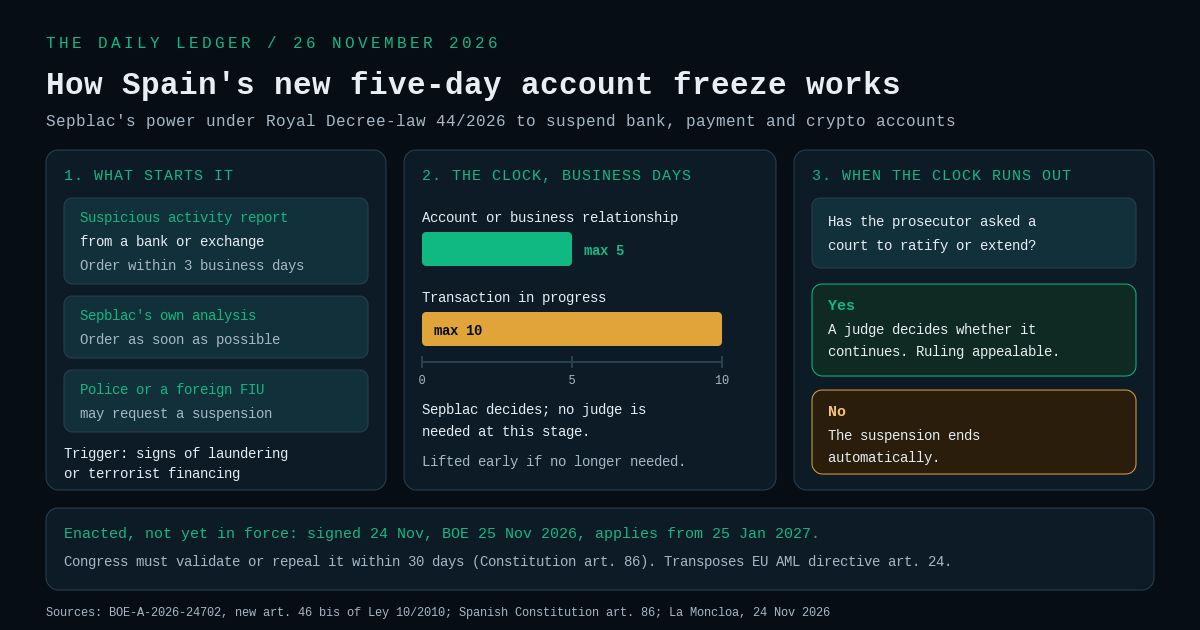
That makes it neither a court order, where a judge decides first, nor an issuer freeze, where a stablecoin company blocks an address with no fixed end. An agency decides, the clock is short, and the suspension lapses unless the public prosecutor asks a court, before the deadline, to ratify or extend it. That ruling can be appealed under criminal procedure rules.
The decree sets no notice or appeal route for Sepblac's first order, and the existing law bars an exchange from telling customers it has reported them. The protections are the deadline and the court step. Still open: Congress must validate or repeal the decree-law within 30 days of its 24 November signing. The government says it brings Spain in line with the rest of Europe; it implements article 24 of the EU's 2024 anti-money-laundering directive.
3. Today's Headlines
Ukraine's parliament passes a crypto tax law
The Verkhovna Rada approved bill 10225-d with 271 votes, lawmaker Yaroslav Zhelezniak said. From 1 July 2027 profits would be taxed at 18 percent plus a 5 percent military levy, with a reduced rate in 2027 and 2028 and no tax on crypto-to-crypto swaps, Decrypt reported. It still needs President Zelensky's signature.
EU banking regulator maps stablecoins in DeFi
The European Banking Authority found that stablecoins, including MiCA e-money tokens, provide DeFi's "liquidity, collateral and settlement", and warned that DeFi structures could sidestep MiCA, including its ban on paying interest on those tokens.
Markets price a December Fed hike
After the PCE release, CME FedWatch showed a 98 percent chance of a quarter-point hike on 9 December, and bitcoin touched about $57,500 on Wednesday, Decrypt reported. Our 30 September issue explains core PCE.
Sky fast-tracks a 25 million USDS transfer
At 22:48 UTC Sky's Core Facilitator called an out-of-schedule vote to send 25 million USDS to the Sky Frontier Foundation to repay debt, citing "ongoing liquidity stress in the stUSDS market". Co-founder Rune Christensen said on 23 November his borrowing is part of why stUSDS holders cannot withdraw.
4. Security Note
Mining pool Braiins reported 24 episodes between 7 and 20 November in which attackers hijacked internet routes to put a fake pool between miners and their real one, taking credit for up to 1.9 EH/s of hashing. The weak point is unencrypted Stratum V1, which cannot prove which pool a miner is talking to. Braiins, which sells the fixes, says no machines or pool servers were breached. The rule: remove every plain stratum+tcp:// entry, backups included, and connect through Stratum V2 or V1 over TLS on firmware that checks certificates.
5. From the Academy Library
Our 13 October issue covers crypto on an unregistered exchange. Miners can read the hashrate guide and our 16 November issue on pool hijacks. New readers can start at Academy School.
A five-day freeze is short by design. Whether it stays that way depends first on Congress, then on the courts.
Disclaimer: This publication is for education and information only. It is not financial, investment, legal, tax, or security advice.
Sources and further reading
- BOE: Real Decreto-ley 44/2026, de 24 de noviembre (BOE-A-2026-24702), 25 November 2026
- La Moncloa: Council of Ministers summary, 24 November 2026
- BOE: Spanish Constitution, article 86
- BOE: Ley 10/2010 on the prevention of money laundering, consolidated text
- crypto.news: Spain lets Sepblac freeze crypto accounts for five days
- Yaroslav Zhelezniak on Telegram: bill 10225-d adopted, 25 November 2026
- Decrypt: Ukraine passes law to legalize and tax its crypto market from July 2027
- European Banking Authority: use of stablecoins, including EMTs, in DeFi, 25 November 2026
- BEA: Personal Income and Outlays, October 2026
- Decrypt: bitcoin sinks on inflation, tariffs and an AI sell-off
- Sky Forum: declaration of out-of-schedule executive vote, 25 November 2026
- Rune Christensen on X: repayment update, 23 November 2026
- Braiins: bitcoin hashrate hijacking through unencrypted Stratum V1
- CoinGecko: bitcoin daily price snapshots
- CoinGecko: ether daily price snapshots
- Alternative.me: Fear and Greed Index history