
The Quiet Ledger: Issue #16 | 27 November 2026
What South Korea's Digital Asset Basic Act Would Change
Seoul's draft Digital Asset Act would cap exchange ownership at 20 percent and make operators pay for hacks regardless of fault. Plus a $1.1 billion US forfeiture claim on stolen USDC and $1.25 billion more out of bitcoin funds.
THE QUIET LEDGER
Issue #16 | Saturday 21 November to Friday 27 November 2026
A week in which governments wrote down who answers for crypto's losses: Seoul drafted no-fault liability for exchange hacks and a cap on who may own an exchange, Washington moved to take title to $1.1 billion of stolen USDC, and bitcoin touched its lowest price since September 2024 before recovering
Reporting window Saturday 21 November to Friday 27 November 2026, continuing from Issue #15's cutoff at 22:00 UTC on Friday 20 November. Data cutoff 22:00 UTC on Friday 27 November (23:00 Europe/Stockholm, CET). Weekly changes compare CoinGecko readings at 22:00 UTC on each Friday; 00:00 UTC snapshots are labelled. US markets were closed on Thursday 26 November for Thanksgiving and closed early on Friday 27 November; Friday's ETF flows are pending.
Markets tested nerves this week; governments assigned responsibility. The fullest example came from Seoul, where the Financial Services Commission published a bill to replace South Korea's patchwork of crypto rules, and this issue explains what South Korea's Digital Asset Basic Act would change, and what it would not. Washington, Kyiv, Madrid and London set their own terms for stolen, taxed or frozen crypto. The common thread: losses once settled by companies and their terms of service are being written into law.
1. The Macro Pulse
- Bitcoin: $59,754 at the 22:00 UTC cutoff on Friday, up 1.4 percent from $58,923 a week earlier. The gain hides the week's low: on Saturday bitcoin fell to $55,130, its weakest since September 2024, as $1.8 billion of leveraged positions were liquidated in 24 hours, then retook $60,000 the same day. On 00:00 UTC snapshots it fell 2.3 percent, from $61,921 to $60,510.
- Ether: $1,662.58 at the cutoff, up 2.8 percent from $1,617.57.
- Fear and Greed: 12, Extreme Fear, unchanged from a week earlier, and between 11 and 13 every day.
- US spot ETFs: last Friday's session closed at $669.2 million out of bitcoin funds. This week's three completed sessions took another $1,254.4 million out: $569.7 million on Monday, $231.6 million on Tuesday and $453.1 million on Wednesday. That put November's outflow at $5.39 billion through Wednesday, with only two of eighteen sessions positive. Ether fund figures were not available from an accessible tally by the cutoff and are omitted.
- Rates: the US PCE price index rose 3.8 percent in the year to October, and 3.3 percent excluding food and energy. Futures priced a 98 percent chance of a December rate rise after the release, per CME FedWatch. The Fed meets on 8 and 9 December.
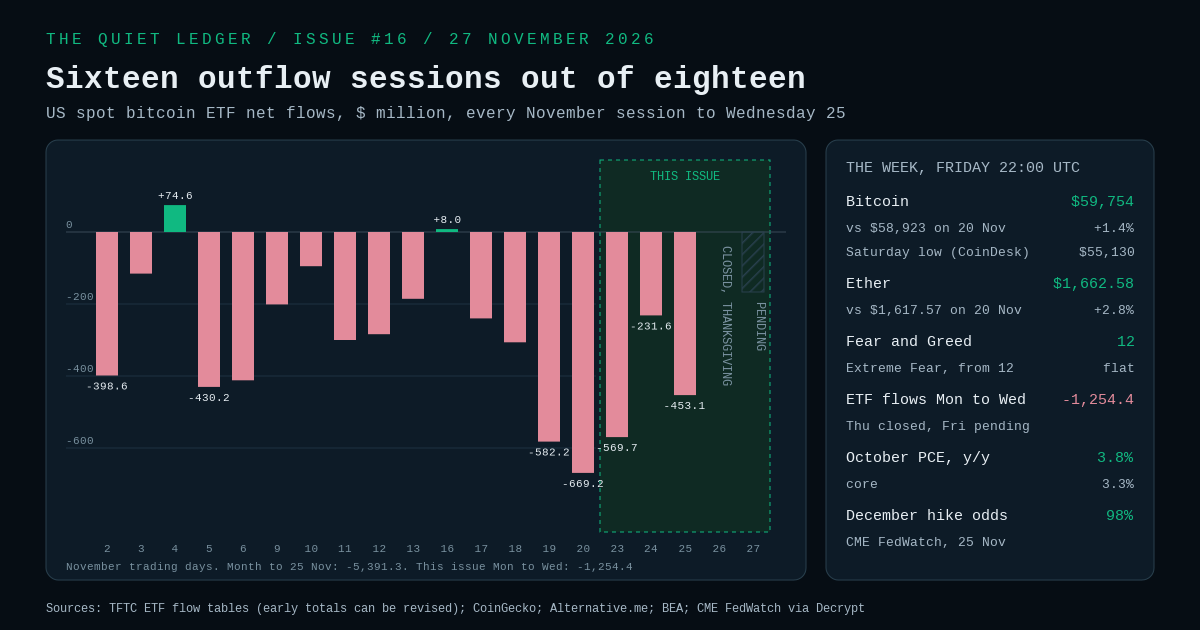
The takeaway: prices ended slightly higher, but fund holders withdrew on every completed session, sentiment stayed in Extreme Fear, and inflation data pushed rate expectations further toward a December hike.
2. This Week in Headlines
Who pays for stolen coins
On Monday the Justice Department filed a civil forfeiture action for more than $1.1 billion of USDC that it says North Korean hackers took from Binance on or about 29 October. The coins were already frozen; forfeiture would give the government title, with any return to victims a separate step. On Thursday Binance said its withdrawal suspension had been fully lifted, four weeks after the theft, though some USDC routes stayed paused for low hot wallet balances or security reasons.
London looks at DeFi through the Binance hack
FCA officials told the Financial Times that DeFi platforms would need authorisation under the UK's coming regime and that UK exchanges could not route retail trades to them, Decrypt reports. It cited how fast stolen Binance funds moved through decentralised exchanges, which cannot freeze them. This is a reported plan; final guidance is due in January 2027 and the regime starts on 25 October 2027.
Crypto as a regulated balance sheet
CFTC staff said on Monday that exchanges, swap venues and clearing houses may count bitcoin, ether and payment stablecoins, after haircuts, toward the resources they must hold to cover 12 months of operating costs. They still do not count toward the separate liquidity requirement.
Kyiv and Madrid set terms
Ukraine's parliament passed bill 10225-d with 271 votes, legalising crypto from 1 July 2027 with an 18 percent income tax plus a 5 percent military levy on gains, and a 5 percent rate in 2027 and 2028 for coins bought before then, Decrypt reports; President Zelensky must still sign it. In Spain, Royal Decree-law 44/2026 lets the financial intelligence unit Sepblac suspend bank, payment and crypto accounts without a court order, for up to five business days according to crypto.news.
Stablecoins move toward the banks
Brazil's exchange operator B3 and six banks, including Itaú Unibanco, Bradesco and Santander, plan Open BRL, a real-pegged token issued by Banco B3, for the first quarter of 2027, CoinDesk reports, citing Valor Econômico. Seoul's draft, below, makes the same choice: bank-majority consortiums would issue won stablecoins first.
Protocols: Glamsterdam gets a test date
Ethereum developers set the Glamsterdam upgrade for the Hoodi test network on 15 December and kept the EIP-8037 gas repricing unchanged, Cointelegraph reports; the Ethereum Foundation's Rahul Kothari called mid-January the earliest viable mainnet date. Our Glamsterdam explainer covers what it can break.
3. The Weekly Deep Dive: what South Korea's Digital Asset Basic Act would change
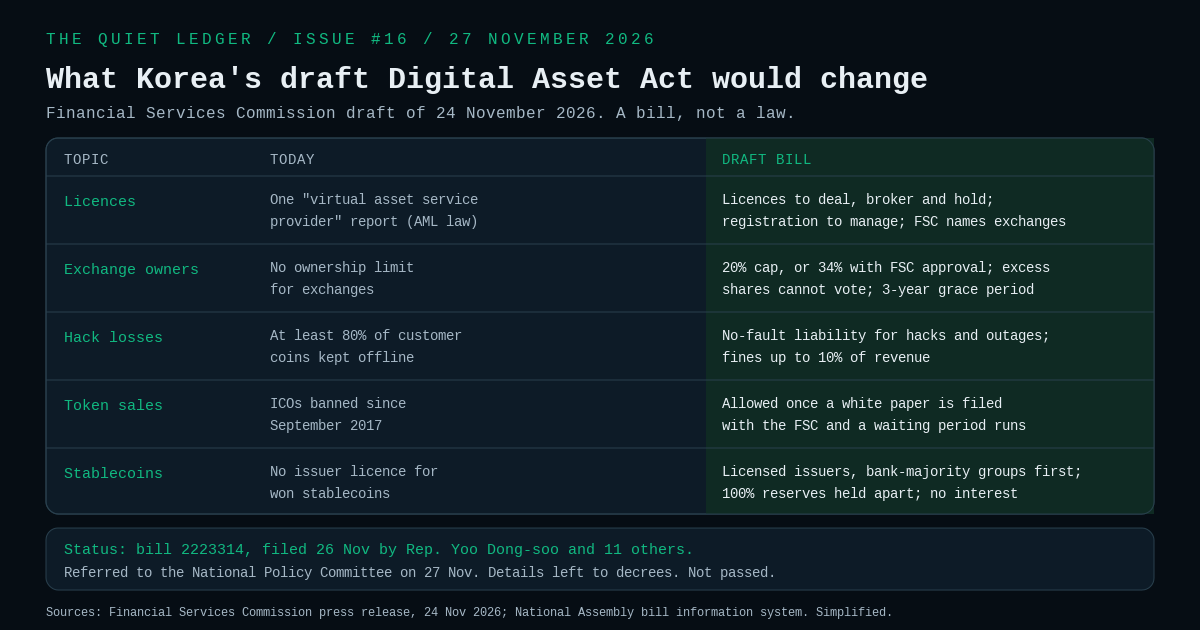
The bill Korean media call the Digital Asset Basic Act is formally the Act on the Innovation of Digital Asset Business and User Protection. The FSC presented the government's draft on Tuesday 24 November. Korea now regulates crypto through two laws: one makes exchanges report and fight money laundering, the other protects user assets and bans market abuse. The draft would replace them with one licensing law covering the industry, its markets and its users.
How it would work
- Licences by function. Dealing, brokerage and custody would need a licence and asset management a registration. The FSC would designate an exchange, or "platform operator", from firms holding the first three.
- Ownership caps. A shareholder's stake in an exchange would be limited to 20 percent, or up to 34 percent with FSC approval, and shares above the limit would carry no vote. Existing exchanges get three years after designation, and smaller ones up to three more.
- No-fault liability. Operators would compensate users for losses from hacking or system failures whether or not they were at fault, and face fines of up to 10 percent of revenue when a breach of security duties caused the incident.
- Legal token sales. Issuers could sell tokens publicly after filing a white paper with the FSC, which can demand corrections, and waiting out a review period. False statements bring damages, fines and criminal liability.
- Stablecoins. Won tokens would be issued by licensed firms, at first consortiums in which banks hold a majority, backed by reserves of at least 100 percent held with banks or trustees, with no interest paid to holders.
Why this week matters
The draft became a bill: Representative Yoo Dong-soo, who chairs the National Assembly's National Policy Committee, and 11 other lawmakers filed it as bill 2223314 on Thursday, and it went to his committee on Friday. The cap also lands on live deals. The Seoul Economic Daily notes that NAVER Financial plans to own all of Dunamu, Upbit's operator, yet could vote only 34 percent, while Binance holds 67.45 percent of GOPAX.
Limits
- It is not law. Committee review, a floor vote and decrees remain, and the same paper reports the act would take effect a year after promulgation.
- No-fault liability covers licensed Korean businesses. It would not cover a DeFi protocol, a self-custody wallet or an offshore exchange.
- The release does not say how losses that start with a customer's own stolen password would be treated.
- The cap does not force a sale; excess shares lose their vote, though an FSC official told the paper that holding them would itself breach the law.
What you can check
- The bill's stage on the National Assembly's bill information system, under number 2223314.
- Your exchange's own disclosures, for any restructuring the cap would prompt.
- Until a law passes, your exchange's current terms, not the draft, decide who pays after a hack.
4. Security and Onchain Radar
A custodian's contact list is a phishing kit. Confirmed: Standard Chartered's Zodia Custody detected attempts to probe its platform on 23 November, took its business-to-business API offline, and the next day found unauthorised access to company details, contact names and email addresses of some clients and staff, it told CoinDesk. It says its investigation has found no unauthorised transactions. For contrast, a confirmed loss: Chainflip's incident report says an attacker registered a validator, exploited a memory-safety flaw in a third-party networking library and extracted key shares, draining about $12.6 million from its Bitcoin and Ethereum vaults on 21 November. The Editorial Desk's reading: no coins left Zodia, but a list of a custodian's clients and their email addresses is exactly what an impersonator needs.
The rules:
- After any provider discloses a data breach, confirm every change of payment details or wallet address by phone, on a number you already hold.
- Never act on a link or attachment in an email that cites the breach.
- When a provider takes an API offline, wait for its restoration notice and reissue your keys rather than reconnecting old ones.
5. From the Academy Library
Compare a statutory duty to repay with a voluntary exchange protection fund, and read how a stablecoin address freeze made the USDC forfeiture possible. Our 26 October issue explains Korea's delayed crypto tax; our tax and regulation guide gives the wider picture. New readers can start at Academy School.
Three useful, non-affiliate tools: the National Assembly's bill information system, to follow bill 2223314; the FSC's press releases (Korean); and the Fed's FOMC calendar.
Dates to keep
- 8 and 9 December: the Federal Reserve meets.
- 15 December: Glamsterdam on the Hoodi test network.
- 23 December: the next US PCE inflation release.
- January 2027: the FCA's final DeFi guidance is expected.
- 1 July 2027: Ukraine's crypto law takes effect, if signed.
Seoul's draft gives the fullest answer yet to who pays when an exchange fails its users: the operator, by law, whatever the cause. What survives committee review, and what the decrees leave out, is the part to watch.
Disclaimer: This publication is for education and information only. It is not financial, investment, legal, tax, or security advice.
Sources and further reading
South Korea's Digital Asset Act
- Financial Services Commission: legislation of the Act on the Innovation of Digital Asset Business and User Protection, 24 November 2026 (Korean)
- National Assembly: bill 2223314, filed 26 November 2026 (Korean)
- Financial Services Commission: Virtual Asset User Protection Act enforcement decree, 80 percent cold storage rule, 25 June 2024 (Korean)
- Seoul Economic Daily: Korea to cap crypto exchange voting rights, 24 November 2026
- CoinDesk: South Korea proposes ending its 2017 ICO ban, 24 November 2026
Stolen funds, enforcement and policy
- US Department of Justice: action to recover more than $1 billion stolen by North Korean actors, 23 November 2026
- Binance: withdrawals recovery work complete, 26 November 2026
- Cointelegraph: Binance completes withdrawal recovery
- Decrypt: UK regulator cites Binance hack as it plans tougher DeFi rules
- CFTC: staff advisory on digital assets and financial resources, 23 November 2026
- Decrypt: Ukraine passes law to legalise and tax crypto from July 2027
- BOE: Royal Decree-law 44/2026, 24 November 2026 (Spanish)
- crypto.news: Spain's Sepblac gains crypto account freeze powers
- CoinDesk: Brazil's stock exchange and major banks plan a real-pegged stablecoin
Protocols and security
- Cointelegraph: Ethereum developers set Glamsterdam's Hoodi rollout for mid-December
- CoinDesk: Zodia Custody suffers data breach exposing client information
- Chainflip: incident report, vault exploit of 21 November 2026, part 1
Markets and macro
- TFTC: US spot bitcoin ETF flows, November 2026
- CoinDesk: bitcoin bounces 9 percent from a two-year low, with CoinGlass liquidation data
- BEA: Personal Income and Outlays, October 2026
- Decrypt: bitcoin sinks on inflation data, with CME FedWatch odds
- Federal Reserve: FOMC meeting calendar
- CoinGecko: bitcoin hourly prices
- CoinGecko: ether hourly prices
- Alternative.me: Fear and Greed Index history