
The Daily Ledger: 16 November 2026
Can Hackers Steal Bitcoin Mining Hashrate? The Luxor Hijack
Can hackers steal bitcoin mining hashrate? Luxor says attackers repointed client miners through its Commander fleet software. Plus a $2.02 billion liquidation weekend and a breach at Coinone's support contractor.
THE DAILY LEDGER
16 November 2026
Attackers redirect client miners through Luxor's Commander software, a weekend sell-off liquidates about $2 billion of positions, and Coinone warns of phishing after a breach at its support contractor.
Reporting window: 15 November 2026, 06:00 UTC to 16 November, 06:00 UTC (07:00 Europe/Stockholm, CET). Data cutoff: 16 November, 06:00 UTC. Prices are CoinGecko 00:00 UTC daily snapshots compared with the previous day's 00:00 UTC snapshot. The Luxor attack reportedly began at about 02:00 UTC on 15 November, before the window opened; Luxor confirmed it inside the window. This issue was added to the archive on 28 November 2026 and uses only information available at the cutoff.
Can hackers steal bitcoin mining hashrate? Yes: whoever controls a miner's settings can point its work at any pool and payout address they choose. On 15 November Luxor confirmed that this happened through its Commander fleet software to just over a dozen client accounts. The clients lost mining rewards for a limited window; the attack changed where machines sent work, not who holds anyone's coins.
1. The Day in Numbers
- Bitcoin: $65,305 at 00:00 UTC, up 1.8 percent against the previous day's 00:00 UTC snapshot of $64,120. CoinGecko daily data.
- Ether: $1,834.53 at 00:00 UTC, up 3.7 percent on the same basis. CoinGecko daily data.
- Fear and Greed: 10, Extreme Fear, unchanged from 10. Alternative.me daily reading, 16 November, 00:00 UTC.
- Liquidations: $2.02 billion from 13:00 UTC Saturday to 13:00 UTC Sunday, $1.68 billion of it from long positions, per CoinGlass hourly data reported by The Block. Tallies built from exchange feeds can be incomplete.
2. Can hackers steal bitcoin mining hashrate?
A mining machine does not decide where its work goes. It connects to a pool with three settings: a server address, a username and a password. On OCEAN, the pool that received the redirected work, the username is simply a bitcoin address, and rewards are paid to it. Change those settings and the machine keeps hashing, for someone else. The pool checks that the work is valid, not who owns the machine.
Large operators rarely change settings one machine at a time. Fleet software such as Commander can apply bulk pool changes across many miners, so one compromised control point reaches every machine it manages.
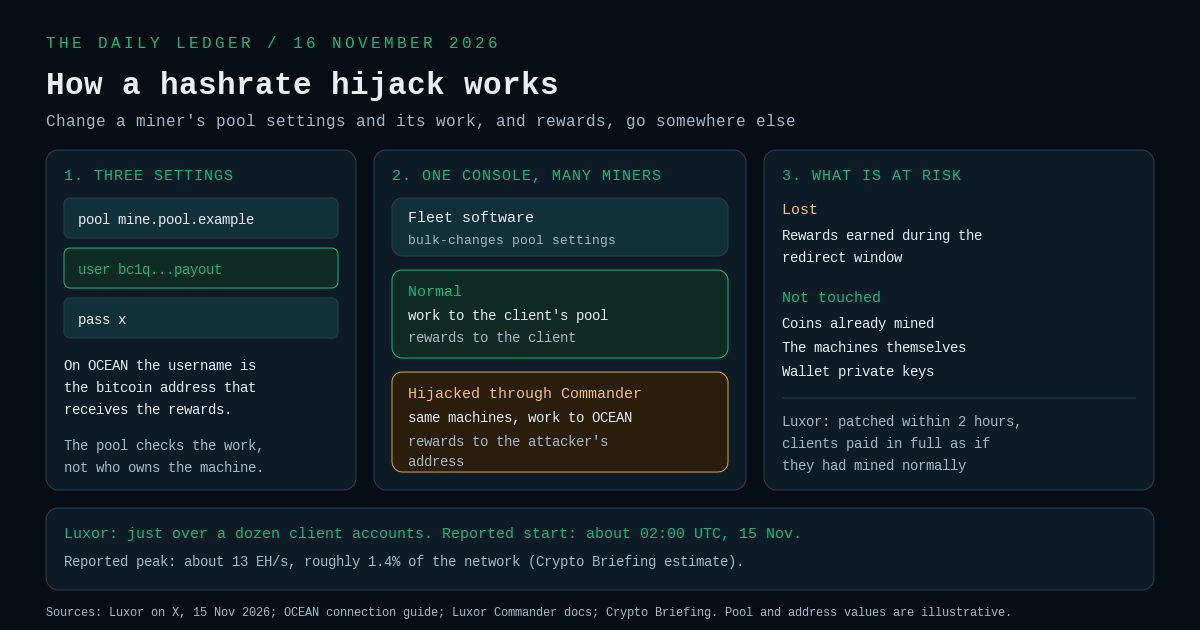
Luxor said its monitoring caught the redirect, Commander was patched within two hours, and every affected client will be paid "as if it had mined normally". It said no data was leaked from its systems. Crypto Briefing estimated a peak of about 13 EH/s, roughly 1.4 percent of all bitcoin mining, and reported that the payout address received about 0.162 BTC; Luxor's statement gave neither figure. Chief executive Nick Hansen called it an AI-enabled attack. Still unknown: how the attackers got in, which Luxor has promised to explain in a post-mortem. Luxor has not accused OCEAN of any wrongdoing.
3. Today's Headlines
Bitcoin touches about $62,000, its lowest since July
Bitcoin fell to about $62,000 over the weekend before recovering to $64,910 by Sunday afternoon US time, The Block reported. Over the week bitcoin lost 14.2 percent, ether 18.2 percent and solana 19.7 percent, after $1.91 billion of net outflows from US spot bitcoin funds over seven straight trading days.
Changpeng Zhao denies that Binance sold
Binance's founder wrote on X, "No, Binance did not sell crypto," rejecting rumours that the exchange sold holdings after its October hack, and said he had used recently received stablecoins to buy crypto, according to The Block. This is his account and has not been independently verified.
Sunday was otherwise quiet. The one development outside the United States, a breach at a South Korean exchange's support contractor, is in the Security Note.
4. Security Note
Coinone said on Sunday that an attacker reached the servers of MetaM, its outsourced customer support contractor, on Thursday 12 November and viewed or extracted support records, Cointelegraph reported. Depending on the customer, those records can include names, phone numbers, bank account and national ID numbers, passwords, and home and wallet addresses. Coinone said customers who never contacted support were unaffected, that its trading and wallet systems run separately, and that it has reported the incident to the authorities. It did not say how many people are affected. The rule: change any password you ever typed into a support chat, and treat any message that quotes your past support conversations as possible phishing. Contact an exchange only through its app or an address you type yourself.
5. From the Academy Library
Our bitcoin mining guide explains hashrate, pools and how rewards are shared, and the lexicon explains liquidation in crypto futures. The 1 November issue covers the Binance theft behind Sunday's rumours. New readers can start at Academy School.
A miner's machines can run perfectly and still be working for someone else. Whoever holds the settings holds the revenue, which is why fleet software deserves the protection usually reserved for wallets.
Disclaimer: This publication is for education and information only. It is not financial, investment, legal, tax, or security advice.
Sources and further reading
- Luxor on X: unauthorized redirect of hashrate through Commander, 15 November 2026
- Crypto Briefing: Luxor CEO warns of AI cyberattacks after mining hijack
- OCEAN: how to connect a miner
- Luxor documentation: Commander
- The Block: CZ denies Binance sold crypto as bitcoin bounces from four-month low near $62,000
- Cointelegraph: Coinone warns of phishing and identity theft after support contractor breach
- CoinGecko: bitcoin daily prices
- CoinGecko: ether daily prices
- Alternative.me: Fear and Greed Index