
The Daily Ledger: 1 November 2026
Why the FBI Publishes Hacker Wallet Addresses
The FBI names North Korea behind the Binance theft and lists 628 addresses: why the FBI publishes hacker wallet addresses and how that differs from a sanction. Plus Binance covers 95 percent and a staking app is drained by requests for zero.
THE DAILY LEDGER
1 November 2026
The FBI names North Korea behind the Binance theft and publishes 628 addresses to block, Binance says it has covered 95 percent of the loss, and a staking app on Core is drained by requests for zero.
Reporting window: 31 October 2026, 06:00 UTC to 1 November, 06:00 UTC (07:00 Europe/Stockholm). Data cutoff: 1 November, 06:00 UTC. Prices are CoinGecko 00:00 UTC daily snapshots compared with the previous day's 00:00 UTC snapshot. This issue was added to the archive on 5 November 2026 and uses only information available at the cutoff.
Why does the FBI publish hacker wallet addresses? So that every exchange, swap service and analytics firm can refuse stolen coins before they are cashed out. On 31 October the FBI named North Korea as responsible for the theft of more than $6 billion from Binance and listed 628 addresses it says hold or have held the proceeds.
1. The Day in Numbers
- Bitcoin: $77,521 at 00:00 UTC, up 0.3 percent against the previous day's 00:00 UTC snapshot of $77,275. CoinGecko daily data.
- Ether: $2,254.13 at 00:00 UTC, up 0.5 percent on the same basis. CoinGecko daily data.
- Fear and Greed: 34, Fear, up 4 points from 30. Alternative.me daily reading, 1 November, 00:00 UTC.
- US spot bitcoin ETFs, October: net outflows of about $515.9 million for the month, after a Friday outflow of $643.2 million, the largest since June, per Farside figures reported by crypto.news. Totals can be revised.
2. Why the FBI publishes hacker wallet addresses
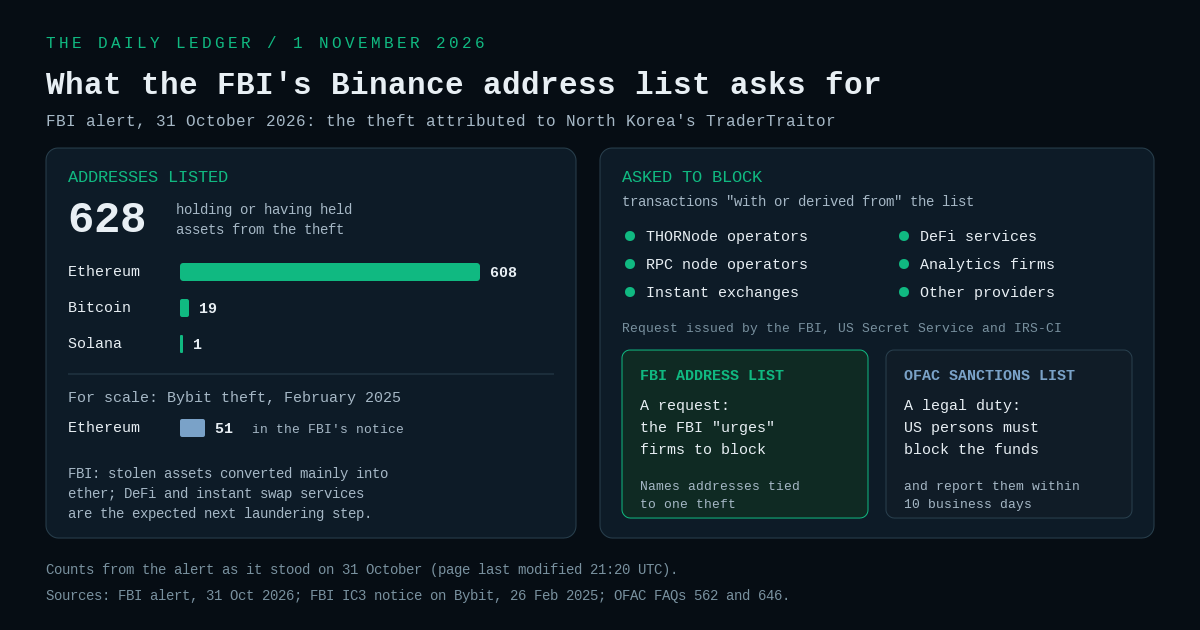
The alert does two things. It attributes the theft to "TraderTraitor", the FBI's name for this North Korean hacking activity, and it lists 608 Ethereum addresses, 19 Bitcoin addresses and one Solana address. With the Secret Service and IRS Criminal Investigation, it urges THORNode operators (who run THORChain, a network for swapping coins across blockchains), RPC node operators, instant exchanges, DeFi services and analytics firms to block transactions "with or derived from" those addresses.
Stolen coins are of little use to thieves until they are swapped and cashed out, and the FBI says the attackers have converted mostly into ether and are expected to use DeFi and instant swap services next. A public list lets any service that screens deposits refuse the coins, even after further hops.
The list is a request, not a sanction. When the Treasury's sanctions office adds an address to its list, US persons holding the funds must block them and report within 10 business days. The FBI list also ages quickly: Chainalysis chief executive Jonathan Levin told CoinDesk the attackers already use "thousands of addresses". After the Bybit theft in 2025, the FBI's notice listed 51 Ethereum addresses. Still unknown: how much has been blocked, and how the breach happened.
3. Today's Headlines
Binance covers 95 percent and reopens in phases
Binance said on 31 October it had replaced 90 percent of the stolen assets, using part of its SAFU emergency fund (held by a custodian regulated in Abu Dhabi), part of its futures insurance fund and its own treasury. At 04:11 UTC on Sunday its fourth update put coverage at about 95 percent and scheduled the first phase of withdrawals for 06:00 to 09:00 UTC. Replacing is not recovering: Binance is buying replacement tokens on the market.
Ether funds lose $1.61 billion in October
US spot ether funds lost $155.7 million on Friday and about $1.61 billion over the month, while BlackRock's bitcoin fund IBIT still took in $932.1 million in October, per the same Farside tally.
United Kingdom: a snatched phone, then the crypto apps
After two men befriended a man in a Hackney bar and learned his passcode, his unlocked phone was taken in August and about $9,500 of crypto left his wallet and exchange apps within an hour, CoinDesk reported. The Metropolitan Police says London phone theft is at a four-year low.
4. Security Note
At 09:29 UTC on 31 October one transaction drained about 97 million CORE, worth about $1.47 million, from b14g, a Bitcoin staking app on the Core blockchain. Bitquery's on-chain analysis shows the attacker asking to withdraw zero CORE 99 times from 91 orders it never funded. Core's staking code reads zero as "everything", and b14g passed the requests on. b14g says exchanges froze about 9 million CORE and staked bitcoin was unaffected; Core DAO says its network worked normally. The rule: staking through an app puts your coins in that app's contract, so its bugs are your risk. Keep there only what you could afford to lose, and after an incident act only on the project's own announcements, never on "claim" links in replies.
5. From the Academy Library
Read whether stolen crypto can be traced and recovered, what an exchange protection fund is, and Issue #12 on how the Binance wallet was emptied. New readers can start at Academy School.
A published address list does not return a single coin. It narrows the exits.
Disclaimer: This publication is for education and information only. It is not financial, investment, legal, tax, or security advice.
Sources and further reading
- FBI: North Korea responsible for $6 billion+ Binance attack, 31 October 2026
- FBI IC3: North Korea responsible for $1.5 billion Bybit hack, 26 February 2025
- OFAC FAQ 562: digital currency addresses on the SDN List
- OFAC FAQ 646: how to block digital currency
- THORChain documentation
- CoinDesk: FBI confirms North Korea's role in the Binance hack
- Binance: Security Incident Update #3, 90% of stolen assets replenished, 31 October 2026
- Binance: Recovery Update #4, withdrawals resume in phases, 1 November 2026
- crypto.news (Farside data): bitcoin ETFs shed $643 million on 30 October
- CoinDesk: a stolen iPhone and London's crypto theft problem
- Metropolitan Police: phone thefts hit four-year low, 8 October 2026
- Bitquery: b14g hack, 97M CORE taken by asking to withdraw zero
- b14g: security update, 31 October 2026
- Core DAO: statement on the b14g exploit, 31 October 2026
- CoinGecko: bitcoin daily price snapshots
- CoinGecko: ether daily price snapshots
- Alternative.me: Fear and Greed Index history