
The Daily Ledger: 17 November 2026
Is exploiting MEV bots illegal? The Peraire-Bueno acquittal
Is exploiting MEV bots illegal? A federal judge acquitted the Peraire-Bueno brothers of wire fraud over a $25 million Ethereum exploit. Plus Custodia's Supreme Court loss and a leaked API key at Lighter.
THE DAILY LEDGER
17 November 2026
A federal judge acquits the Peraire-Bueno brothers of wire fraud over a $25 million Ethereum exploit, the Supreme Court turns away Custodia Bank, and a leaked API key drains accounts at Lighter.
Reporting window: 16 November 2026, 06:00 UTC to 17 November, 06:00 UTC (07:00 Europe/Stockholm, CET). Data cutoff: 17 November, 06:00 UTC. Prices are CoinGecko 00:00 UTC daily snapshots compared with the previous day's 00:00 UTC snapshot. This issue was added to the archive on 28 November 2026 and uses only information available at the cutoff.
Is exploiting MEV bots illegal? A ruling on 16 November answers a narrower question: one notorious exploit was not wire fraud. Judge Jessica Clarke of the US District Court for the Southern District of New York acquitted Anton and James Peraire-Bueno of wire fraud, wire fraud conspiracy and money laundering conspiracy over about $25 million taken from Ethereum trading bots in April 2023, because prosecutors never proved a material misrepresentation.
1. The Day in Numbers
- Bitcoin: $64,841 at 00:00 UTC, down 0.7 percent against the previous day's 00:00 UTC snapshot of $65,305. CoinGecko daily data.
- Ether: $1,819.45 at 00:00 UTC, down 0.8 percent on the same basis. CoinGecko daily data.
- Fear and Greed: 12, Extreme Fear, up 2 points from 10. Alternative.me daily reading, 17 November, 00:00 UTC.
- Bitcoin over seven days: down 13.9 percent from $75,267 at 00:00 UTC on 10 November.
2. Is exploiting MEV bots illegal? What the court decided
MEV, or maximal extractable value, is the profit available from choosing the order of transactions in a block. Sandwich bots earn it by buying just before a user's trade and selling just after. The court's opinion describes how the brothers' code, "Omakase", turned that habit on the bots. It posted eight lure trades built to look profitable to specific bots. When their validator was due to propose a block, it signed the Ultrasound relay's block header with two fields set to zero. A bug in the relay code checked the signature but not those fields, so the relay revealed the bots' hidden bundles. The validator then proposed a second block that swapped the lures for sales, and the bots took the losses.
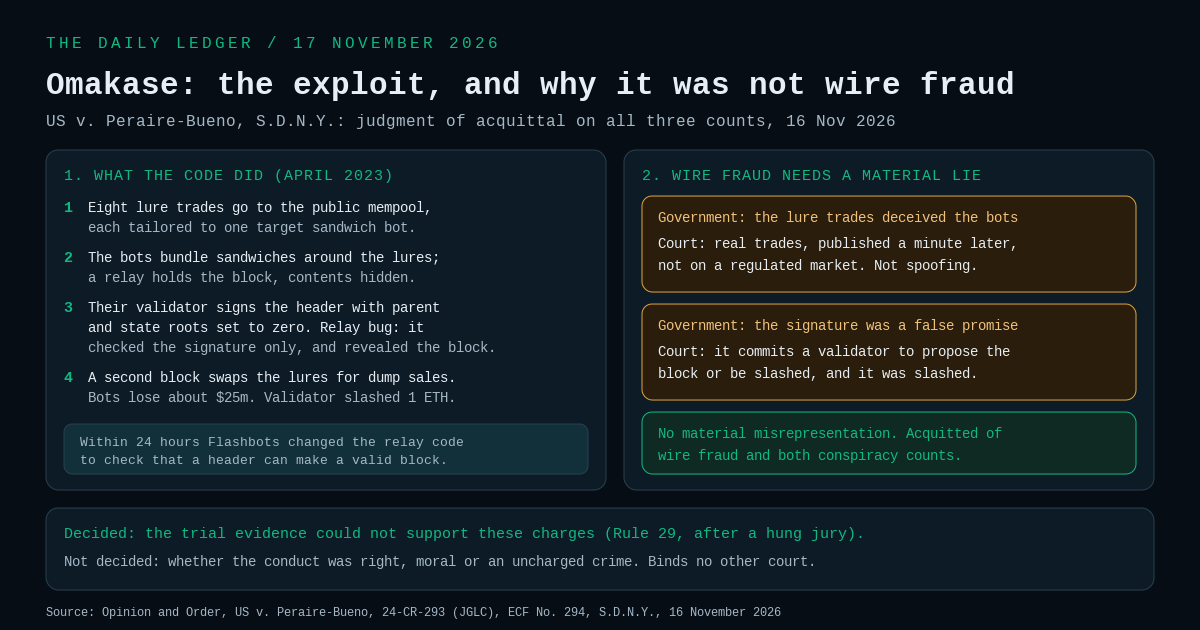
Wire fraud requires a scheme to obtain money through a material misrepresentation. Prosecutors called the lure trades and the "false signature" lies; the court disagreed. The lure trades were real and were published within a minute, and unlike spoofing they were not placed "on a regulated market with rules prohibiting this conduct." A validator's signature commits it to propose the block or be slashed, and this one was slashed. Ethereum, the opinion says, is "a trustless, highly adversarial environment with no terms of use." With no wire fraud, both conspiracy counts fell.
What the acquittal does not establish matters as much. The question, Judge Clarke wrote, "is not whether the Peraire-Buenos' conduct was right or moral, or even whether it violated uncharged crimes." It is one district court's ruling and binds no other court. As it follows a hung jury in 2025, the Supreme Court's Martin Linen Supply decision bars a government appeal. The Block reported no comment from prosecutors.
3. Today's Headlines
Supreme Court leaves Custodia's master-account loss in place
The Court denied review of Custodia Bank v. Federal Reserve Board (No. 26-62) on 16 November. That leaves standing a Tenth Circuit ruling that the Fed has discretion to refuse a master account, a bank's direct link to Fed payment services.
Singapore and the US: tokenised dollars at any hour
DBS and Kinexys by J.P. Morgan launched instant transfers of US dollar tokenised deposits between Singapore and US accounts, weekends included. Ant International is the first client. Transfers to ordinary bank accounts still pause for three hours each Saturday.
Brazil: a central banker's warning, not a rule
The central bank's foreign exchange chief, Gerson Romantini, reportedly told a closed industry session on 13 November that converting reais into stablecoins for cross-border payments could be laundering, The Paypers reported. No new rule followed.
4. Security Note
Perpetual futures exchange Lighter paused withdrawals on 16 November and blamed a leaked API key for one trader's account, not its contracts, Bankless reported. A researcher's unconfirmed estimate puts losses at about $15.5 million; the attacker withdrew $10.39 million at 10:11 UTC, nearly an hour before Lighter's first post. By that researcher's account, the key could not send funds to others, but it could create a pool from the victim's account and move money into it. The rule: treat any trading key as able to empty the account. Grant the narrowest permissions, bind keys to fixed IP addresses and revoke unused ones.
5. From the Academy Library
Our Web3 infrastructure guide explains block builders, relays and MEV in depth. New readers can start at Academy School.
An acquittal answers the question a prosecutor asked. Whether code that outwits other code should be a crime is a separate question, and it remains open.
Disclaimer: This publication is for education and information only. It is not financial, investment, legal, tax, or security advice.
Sources and further reading
- Opinion and Order, United States v. Peraire-Bueno, 24-CR-293 (JGLC), S.D.N.Y., ECF No. 294, 16 November 2026
- The Block: Peraire-Bueno brothers acquitted in Ethereum MEV wire fraud case
- United States v. Martin Linen Supply Co., 430 U.S. 564 (1977)
- Supreme Court docket 26-62: Custodia Bank v. Federal Reserve Board
- DBS: DBS and Kinexys by J.P. Morgan launch 24/7 cross-border tokenised deposit transfers, 16 November 2026
- The Paypers: Brazil's central bank reportedly links stablecoin swaps to laundering
- Bankless: Lighter pauses withdrawals after leaked API key drain
- CoinGecko: bitcoin daily price snapshots
- CoinGecko: ether daily price snapshots
- Alternative.me: Fear and Greed Index history