
Master Guide
Web3 Infrastructure: RPC, Oracles, Indexers and MEV
Trace Web3 infrastructure from RPC requests to confirmed receipts. Check stale prices, oracle dependencies, indexer labels and transaction ordering.
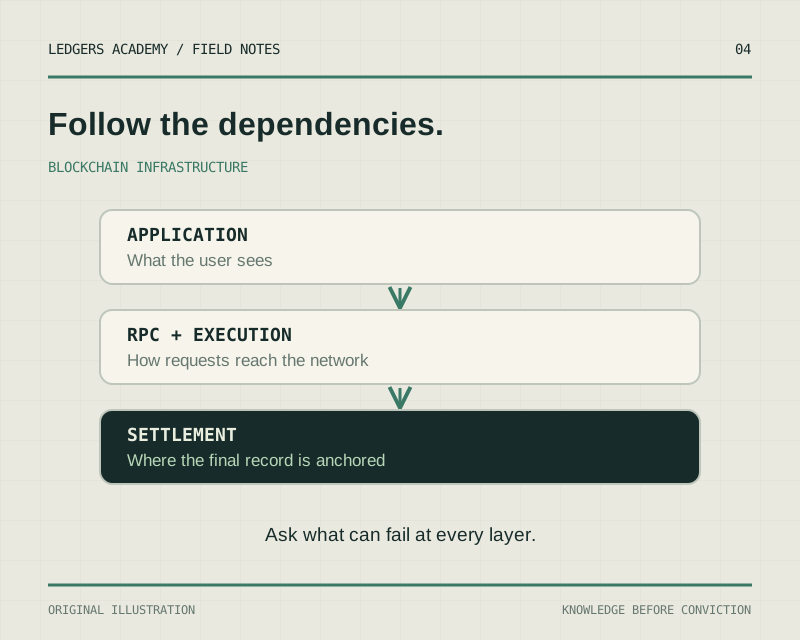
Web3 infrastructure is the collection of services that connects an application to blockchain state and outside information. RPC nodes, indexers, oracles and transaction-routing services serve different roles. A failure can look like a lost balance, a bad quote or an unavailable button even when the underlying chain is running.
Updated 3 October 2026 · By Adam · Examples below are original educational scenarios, not live market data or product tests.
Web3 infrastructure: follow a single request
When a wallet asks for a balance, an RPC service answers a protocol request about chain state. An indexer organises events into convenient histories or labels. An oracle brings selected external information into contracts. None of those is automatically the same as the wallet's signing key or the chain's consensus.
Ethereum's oracle overview explains the boundary between onchain execution and external data. Chainlink's feed-selection guidance identifies market-pricing risks and stresses that application risk settings still matter. A recognised brand does not make every asset feed appropriate for every purpose.
Check freshness before trusting a number
Worked example: a cached price in a borrowing app
Imagine ten collateral tokens were last priced at $100 each. An app displays $1,000 collateral, but the market price has fallen to $80 and the quote is stale. Actual marked value would be $800. With an illustrative 75% liquidation threshold and $600 debt, health factor changes from 1.25 to 1.00.
The token quantity never changed. The uncertainty sits in the valuation input. Record quote timestamp, chain, feed address, decimals and the application's response to stale data. A UI updating its clock is not evidence that the underlying price updated.
Distinguish an RPC outage from missing assets
- Confirm the selected network and account address.
- Check the transaction hash and status through an independent source.
- Compare block heights and timestamps; one endpoint may lag.
- Check token contract and decimal precision before treating a displayed number as a balance.
- Change to a documented endpoint if necessary, considering its privacy and rate-limit policy.
Do not enter a recovery phrase into a “wallet synchronisation” page to fix an RPC error. Reading a balance does not require a signing secret. A malicious endpoint may mislead your interface or observe requests even though it cannot directly sign for your wallet.
Indexers make claims that need provenance
Worked example: the same transfer counted twice
A dashboard imports a transaction from an exchange export and an indexed wallet history. If it counts both as independent withdrawals, apparent outflow doubles. Deduplicate using transaction identifiers and account context; keep provenance so a corrected indexer label does not silently rewrite your notes.
Separate “contract emitted an event” from “the dashboard assigned an owner label”. Events can be inspected in the chain record; a label may be a provider's inference. Different indexers can legitimately disagree about the latter.
Transaction ordering changes execution
MEV includes value associated with including, excluding or ordering transactions. Arbitrage and harmful sandwiching have different effects on users. Ethereum's MEV documentation describes the ecosystem. A private route can change who sees a pending transaction, while creating another service dependency; investigate its guarantees and failure behaviour.
For a DEX swap, connect each layer: interface quote → RPC state → asset and oracle inputs where used → signing request → transaction route → confirmed receipt. Use the oracle entry and DEX guide to inspect that chain of evidence. Record what your fallback displays when a service cannot return fresh data.
Sources and verification
Primary references checked on 3 October 2026. Protocol settings and local rules can change; verify the linked version before acting.
Knowledge check
Apply the example before checking the answer.
Question 1 of 3Does a refreshed UI clock prove a price quote is fresh?
Question 2 of 3What is the example health factor at an $80 token price?
Question 3 of 3Does fixing an RPC error require giving a website your seed phrase?