
Master Guide
Blockchain Architecture: Layer 1, Layer 2 and Exit Risk
Understand blockchain architecture, rollup verification and data availability. Compare complete journey costs and check how a Layer 2 withdrawal works.
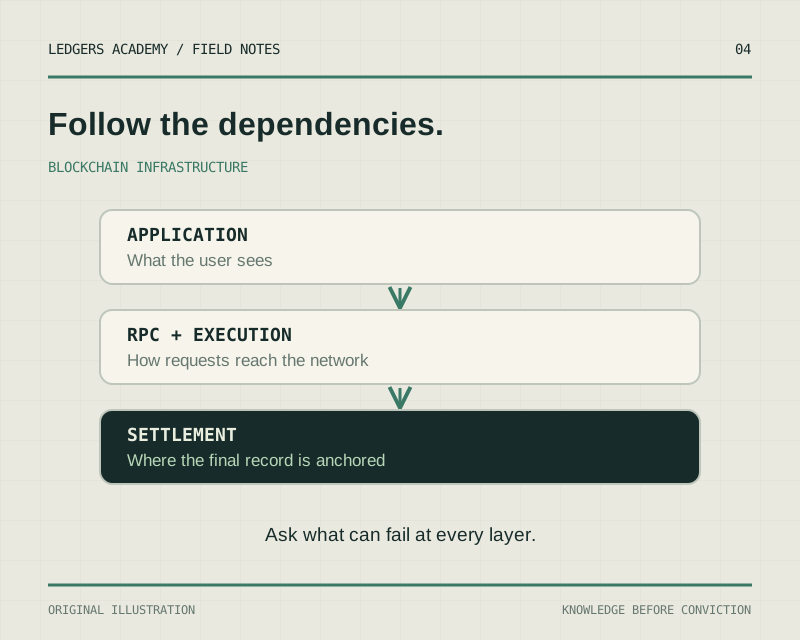
Blockchain architecture describes how a network orders transactions, executes them, makes their data available and resolves disputes. Layer 1, Layer 2 and modular are useful categories, but they do not by themselves tell you how safely you can withdraw. This guide turns the labels into concrete questions.
Updated 3 October 2026 · By Adam · Examples below are original educational scenarios, not live market data or product tests.
Blockchain architecture: four jobs to separate
- Execution: applying a transaction to account or contract state.
- Ordering and consensus: agreeing on the sequence participants recognise.
- Data availability: making the information needed for verification obtainable.
- Settlement: deciding which state is accepted and how disputes or exits work.
A chain may combine these jobs, or rely on other systems for some of them. Ethereum's scaling overview distinguishes rollups from sidechains. A sidechain uses its own consensus rules; a connection to Ethereum is not the same as inheriting all Ethereum security properties.
Rollups: verification is a process
An optimistic rollup accepts proposed state updates subject to a challenge mechanism. A zero-knowledge rollup uses validity proofs for state transitions. Those descriptions omit deployment details such as upgrade keys, proof-system maturity, data location and exit mechanisms. Ethereum documents optimistic rollup operation and the role of challenge periods.
A cryptographic proof and available data answer different questions. A proof can establish a valid transition under its rules; users still need data to reconstruct positions and exercise certain exits. The data-availability guide explains why that distinction matters.
Compare the cost of an entire journey
Worked example: a cheap swap with an expensive exit
Assume a hypothetical rollup charges $2 to enter, $0.05 for each of ten transactions, and $3 for the chosen exit route. Total cost is $2 + $0.50 + $3 = $5.50. An alternative charging $0.40 for each transaction with no bridge journey costs $4 for ten operations. The cheapest individual transaction did not produce the cheapest complete journey.
At 100 transactions the same assumptions give $10 on the rollup and $40 on the alternative. Break-even is where 5 + 0.05n = 0.40n, or about 14.29 transactions. Since the count is whole, the rollup becomes cheaper at 15. These prices are invented and constant for teaching; real fees, asset routes and waiting times vary.
Check what happens when the operator stops
| Dependency | Evidence to find | Failure question |
|---|---|---|
| Sequencer | Forced-inclusion procedure | Can a user transact if the operator censors them? |
| Proof system | Live verifier and challenge configuration | Who can contest or prevent an incorrect update? |
| Data | Publication location and retention requirements | Can users reconstruct what they need for an exit? |
| Administration | Upgrade powers and notice period | Can rules change before a user leaves? |
Look for deployed contracts and current documentation, not a roadmap stating that protections will be added later. A fast bridge may introduce a separate liquidity provider or signing committee; distinguish it from the protocol's canonical withdrawal path.
Test the user path without overstating the result
Record the exact network, asset contract, bridge route, cost and time for a small deposit and withdrawal. Keep native gas on the destination chain. A successful test establishes that the chosen path worked under those conditions; it does not verify every emergency exit or prove decentralisation.
Read the sequencer explainer and bridge entry, then compare the dependency map with the infrastructure guide. The useful question is what you must trust to complete your intended action.
Sources and verification
Primary references checked on 3 October 2026. Protocol settings and local rules can change; verify the linked version before acting.
Knowledge check
Apply the example before checking the answer.
Question 1 of 3Is an Ethereum-compatible sidechain automatically secured like a rollup?
Question 2 of 3At what whole transaction count is the hypothetical rollup cheaper?
Question 3 of 3Does a validity proof make data availability irrelevant?