
The Quiet Ledger: Issue #13 | 6 November 2026
How a Crypto Exchange Replenishes Stolen Funds
How does a crypto exchange replenish stolen funds? Binance replaced 98 percent of $6.34 billion from SAFU, an insurance fund and its treasury, and proved it with a 44-token snapshot. Plus a Treasury order against MEXC and an election rally gone in a day.
THE QUIET LEDGER
Issue #13 | Saturday 31 October to Friday 6 November 2026
A week in which an exchange made its customers whole and kept the bill: Binance replaced 98 percent of the stolen assets from its own funds, the US Treasury cut MEXC off from American banks, and bitcoin gave back an election rally in a day
Reporting window Saturday 31 October to Friday 6 November 2026, continuing from Issue #12's cutoff at 22:00 UTC on Friday 30 October. Data cutoff 22:00 UTC on Friday 6 November (23:00 Europe/Stockholm, CET). Prices are CoinGecko 00:00 UTC snapshots unless stated; weekly changes compare the 00:00 UTC snapshots of Friday 30 October and Friday 6 November. Friday's ETF session is pending. This issue was added to the archive on 7 November 2026 and uses only information available at the cutoff.
How does a crypto exchange replenish stolen funds? It buys the same coins again with its own money, puts them in the wallets that back customer balances, and then proves they are there. Binance spent the week doing exactly that: by Wednesday it said about 98 percent of the $6.34 billion of assets affected on 29 October had been replaced, and on Friday morning it said the proof for a new 44-token snapshot was ready. The customer shortfall closed within a week; the cost now sits on Binance's balance sheet and in an emergency fund half its former size. Markets, meanwhile, appeared to take their cue from Washington and Wall Street rather than from Binance.
1. The Macro Pulse
- Bitcoin: $76,006 at 00:00 UTC on Friday, down 2.4 percent from $77,839 a week earlier, and $75,844 at the 22:00 UTC cutoff, down 1.0 percent from Issue #12's cutoff reading. It stood at $80,443 at 00:00 UTC on Thursday after the projected Democratic sweep, then fell with the Nasdaq; Friday's low was $74,722 on Coinbase, around its lowest level since 21 August.
- Ether: $2,235.77 at 00:00 UTC, down 0.6 percent from $2,249.48, and $2,238.36 at the cutoff, flat on the week.
- Fear and Greed: 28, Fear, from 30 a week earlier, after swinging between 26 on Tuesday and 50 on Thursday.
- US spot ETFs: last Friday's session, pending in Issue #12, closed at $643.3 million out. This week's four completed sessions took another $869.8 million out of bitcoin funds, with only Wednesday positive, and $271.9 million out of ether funds. Friday is pending.
- Rates: US payrolls rose by 165,000 in October with unemployment at 4.1 percent, and futures-implied odds of a December Fed hike rose from 66.9 to 76.8 percent, per CME FedWatch. The Bank of England raised Bank Rate to 4 percent on Thursday, by 8 votes to 1.
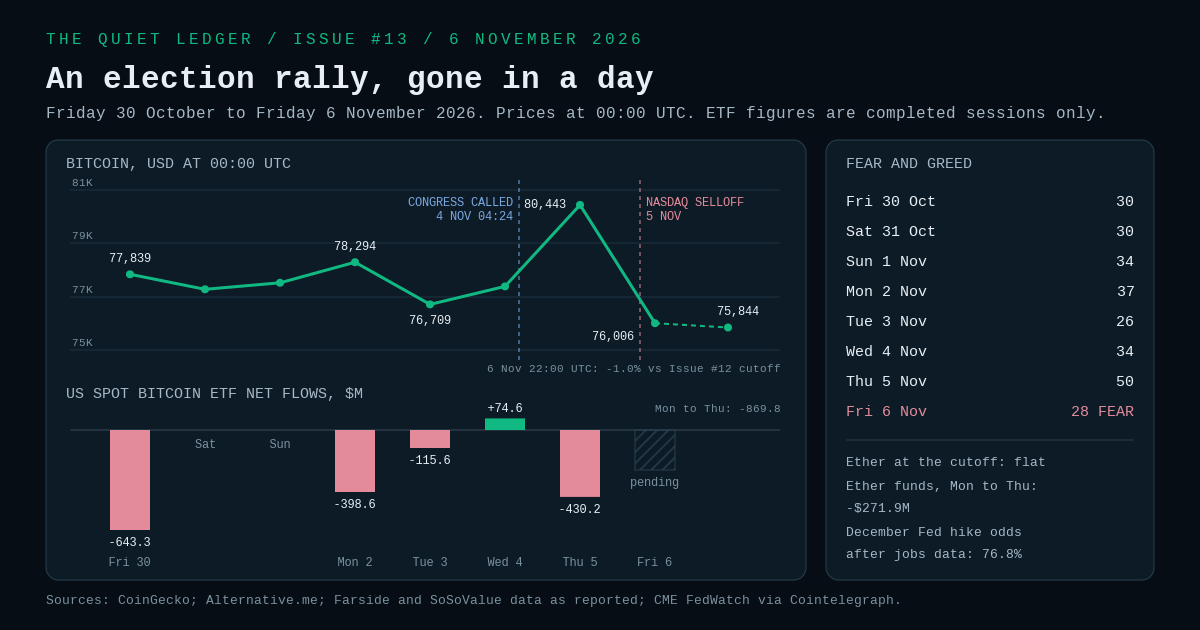
The takeaway: fund holders withdrew on four of five completed sessions. Bitcoin fell with tech stocks on Thursday but missed their Friday rebound as hike odds rose. Binance was not visibly the driver: it reported hourly deposits exceeding withdrawals again by 03:00 UTC on Tuesday.
2. This Week in Headlines
Washington after the vote
French Hill, the CLARITY Act's sponsor, won re-election but loses the House Financial Services gavel in January. Congress.gov shows no action on the bill since the failed Senate vote of 15 September, leaving the lame duck as its only route this Congress (our 4 November issue explains why). Separately, FinCEN and the Fed withdrew a proposal to apply the travel rule, which makes identifying details accompany a transfer, more widely to crypto.
Treasury cuts MEXC off from US banks
On Friday FinCEN ordered US financial institutions to stop processing transfers to or from MEXC Global, which it says handled at least $16 billion of illicit transactions from May 2021 to May 2026, including nearly $1.5 billion tied to Russian sanctions evasion. The order takes effect 30 days after publication in the Federal Register. It does not sanction customers; it removes the exchange's access to dollar banking.
South Korea pushes coins offline
The Financial Services Commission called exchanges to an emergency meeting on 2 November and asked them to keep more customer coins in cold wallets (kept offline). On Friday GOPAX halted withdrawals and then trading after a hacking threat by email and moved most hot wallet assets offline; it said no attack had taken place. Korean exchanges must already keep 80 percent offline, and GOPAX was near that floor, Cointelegraph reports.
Russia and Greece set terms
The Bank of Russia approved bitcoin, ether and USDT for ordinary investors from 17 November, capped at ₽300,000 a year per intermediary and only after a test; the Moscow Exchange plans to open trading on 1 December. Greece's parliament passed a 10 percent tax on crypto gains from January 2027, with a €500 annual exemption, Oikonomikos Tachydromos reports.
Protocols: one fork done, one undecided
Zcash's NU7 upgrade activated at block 3,543,405 at 02:34 UTC on Friday, cutting the target time between blocks from 75 to 25 seconds; ZecStats counts about 12,224 ZEC left unspendable in the old Sprout pool. Polygon's proposal to return 70.49 million blocked POL to Binance and Polymarket by hard fork had no posted outcome by the cutoff.
3. The Weekly Deep Dive: how a crypto exchange replenishes stolen funds
When coins are stolen from an exchange's own wallet, customer balances do not change; the backing does. The exchange owes the same amount but holds less. Replenishing fills that gap with the same tokens, from the company's own resources, so every balance is again matched one for one. It is not recovery: the stolen coins stay with the thief unless frozen or seized.
How it works
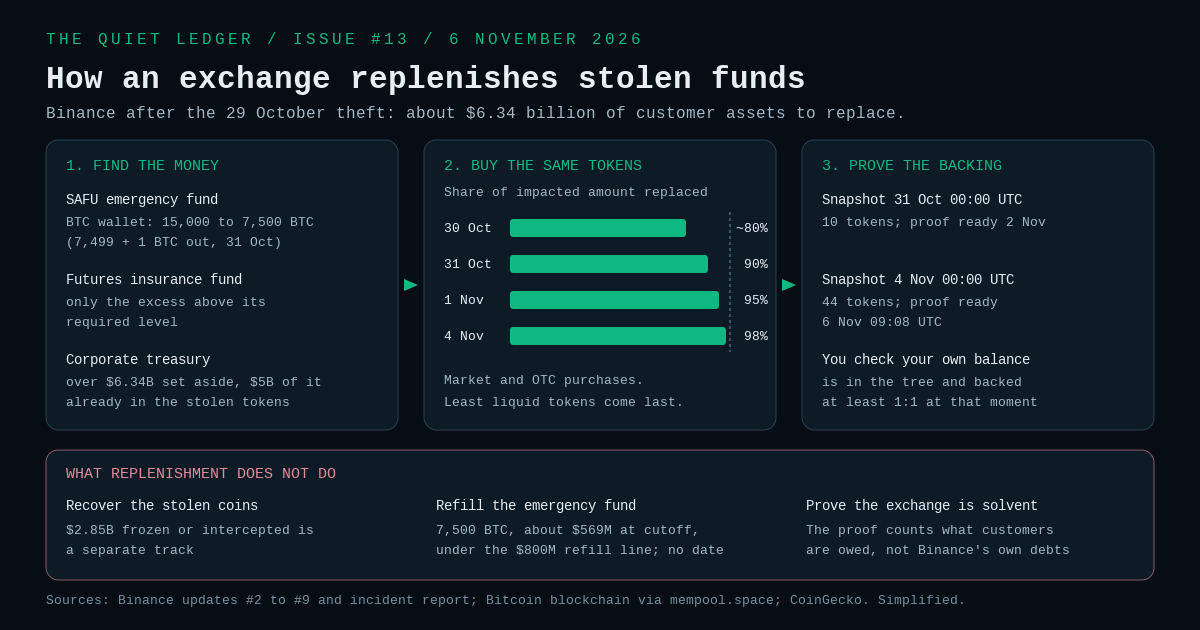
Binance named three sources in its third update: part of SAFU, its emergency fund for users; part of its futures insurance fund, which covers losses when liquidated positions cannot be closed in time; and its corporate treasury. By 30 October it had set aside more than $6.34 billion, $5 billion of it already in the stolen tokens, so about 80 percent was covered within a day, its second update says. The rest is bought through the market and over the counter, the most liquid tokens first: 90 percent by 31 October, 95 by 1 November and 98 by 4 November, with the last 2 percent slower because those tokens trade thinly. Then comes the proof: a proof of reserves snapshot covering ten tokens on 31 October and one covering 44 on 4 November, whose proof Binance said was ready on Friday.
What the week exposed
Binance publishes SAFU's bitcoin address, and on 31 October 1 BTC and then 7,499 BTC left it, leaving 7,500 BTC, about $569 million at the cutoff. Binance's rule is to top SAFU back up to $1 billion if price falls take it below $800 million; the rule sets no deadline after a payout. Binance has committed to refilling it, without a date, and says it took only the futures fund's excess above its required level.
Limits
- The promise rests on the company. No deposit insurance scheme or regulator guarantees the payout, as our entry on exchange protection funds explains.
- The percentages measure the impacted amount, not each token. Holders of the last, thinly traded tokens are the ones still waiting.
- The proof shows customer balances backed at one moment. It does not count Binance's own debts, so it is not a solvency test.
- Recovery runs separately. Binance says about $2.85 billion was frozen or intercepted; with customers already covered, anything returned would, on the Editorial Desk's reading, offset Binance's cost.
What you can check
- Whether your token is in the latest snapshot, and your own balance through the verifier on the exchange's own proof of reserves page.
- The emergency fund's published address on a block explorer.
- Withdrawal status for your token and network on the exchange's status page. Binance aims to reopen six more tokens, and every token on networks already restored, by the end of next week.
4. Security and Onchain Radar
The quiet weeks before a theft. Confirmed: Binance says its attackers first compromised staff devices in June and September but reached wallet operations only on 20 October, nine days before the theft, a spokesperson said. SignalPlus, an options trading tool that connects to exchanges through API keys, says an attack early on 4 November began with a compromised Telegram account of a vendor contact; losses were under $82,000 and will be repaid in full, and the affected accounts lacked IP whitelisting (keys limited to approved internet addresses). Binance removed every SignalPlus-linked key. Analysis and attribution: the Security Alliance (SEAL) counts six weeks of undetected access at LayerZero, six at Bitget and eight at Binance, intrusions it attributes to North Korea's TraderTraitor group. SignalPlus's entry point, a fake Microsoft Teams invitation, is Cointelegraph's account; nobody has attributed that attack.
The rules:
- An API key for a trading tool should allow trading only, never withdrawals, and be restricted to the tool's IP addresses.
- If a connected tool reports a breach, revoke its keys yourself in the exchange.
- A meeting link, "update" or file sent by a known contact through chat deserves a check on a second channel before you open it.
- Binance says it will bear the losses. Any message offering compensation, a recovery claim or "priority" withdrawals is a scam.
5. From the Academy Library
Read what happens when an exchange goes bankrupt, the case replenishment is meant to prevent, and how a stablecoin address freeze stopped part of this theft. Our 3 November issue walks through Binance's zero-knowledge proof, and Issue #12 explains how the wallet was emptied. New readers can start at Academy School.
Three useful, non-affiliate tools: mempool.space, to inspect a fund address; Congress.gov, to follow the CLARITY Act; and the Fed's FOMC calendar.
Dates to keep
- End of next week: Binance's target for reopening withdrawals of the remaining tokens on restored networks.
- 17 November: Russian retail access to bitcoin, ether and USDT begins.
- 8 and 9 December: the next Federal Reserve meeting.
- 3 January 2027: the new Congress takes office, and unfinished bills lapse.
Replenishment worked as designed: customers can check that their coins are backed, and the loss sits with the company that held them. It cannot make the next theft cheaper, and an emergency fund at half strength is the open item.
Disclaimer: This publication is for education and information only. It is not financial, investment, legal, tax, or security advice.
Sources and further reading
Binance's replenishment and proof of reserves
- Binance: Security Incident Update #2, 30 October 2026
- Binance: Recovery Update #3, 90% replenished, sources of funds and SAFU FAQ, 31 October 2026
- Binance: Recovery Update #4, 95% covered and withdrawals resume in phases, 1 November 2026
- Binance: Recovery Update #7, 98% replenished and 44-token snapshot, 4 November 2026
- Binance: Recovery Update #9, withdrawals for more assets, 6 November 2026
- Binance: zero-knowledge proof for the latest snapshot ready, 6 November 2026
- Binance: remaining withdrawals targeted by the end of next week, 6 November 2026
- Binance: hourly deposits exceed withdrawals, 3 November 2026
- Binance: initial findings and response update, 3 November 2026
- mempool.space: Binance SAFU bitcoin address
- Cointelegraph: Binance taps half its SAFU bitcoin holdings
Security
- SEAL: TraderTraitor vs Contagious Interview, 5 November 2026
- Cointelegraph: Binance hackers had an eight-week intrusion window, with Binance's timeline
- SignalPlus: incident statement, 5 November 2026
- Binance: SignalPlus API keys removed, 5 November 2026
- Cointelegraph: Binance and Deribit revoke SignalPlus API keys
Regulation and policy
- US Treasury: Operation Economic Outcast severs MEXC Global's access to the US financial system, 6 November 2026
- FinCEN: withdrawal of proposed recordkeeping and travel rule changes, 6 November 2026
- Congress.gov: H.R. 3633, CLARITY Act, all actions
- Cointelegraph: French Hill wins re-election but set to lose House chair
- Financial Services Commission (via KDI): emergency meeting on the Binance hack, 2 November 2026 (Korean)
- Kyunghyang Shinmun: GOPAX suspends withdrawals and trading after hacking threat, 6 November 2026 (Korean)
- Cointelegraph: GOPAX halts trading to move assets to cold storage
- Bank of Russia: cryptocurrencies for non-qualified investors, 6 November 2026
- Moscow Exchange: digital currency market launch, 2 November 2026 (Russian)
- Oikonomikos Tachydromos: 10% tax on crypto gains (Greek)
Protocols
- Blockchair: Zcash block 3,543,405, mined 02:34:02 UTC on 6 November
- ZIP 259: NU7 deployment
- ZecStats: NU7 tracker
- Polygon forum: recovery of funds held in blocked addresses
Markets and macro
- TFTC: US spot bitcoin ETF flows, November 2026 (Farside data)
- TokenPost: spot bitcoin and ether ETFs lose $530.1 million on 5 November
- TokenPost (SoSoValue data): spot bitcoin ETF flows, 30 October
- Bureau of Labor Statistics: Employment Situation, October 2026
- Cointelegraph: bitcoin dips under $75,000, with CME FedWatch odds
- Bank of England: Monetary Policy Summary, November 2026
- Coinbase Exchange: BTC-USD hourly candles, 5 and 6 November
- CoinGecko: bitcoin daily snapshots
- CoinGecko: ether daily snapshots
- Alternative.me: Fear and Greed Index history