
The Daily Ledger: 3 November 2026
Binance's Zero-Knowledge Proof of Reserves, Explained
Binance completed a zero-knowledge proof of reserves for ten tokens after its hot wallet drain: what the Merkle tree and zk-SNARK prove and what a snapshot cannot. Plus new SEC staff FAQs, a $46 million breach at Mercado Bitcoin and Liquid's restored peg.
THE DAILY LEDGER
3 November 2026
Binance completes a zero-knowledge proof of reserves for ten tokens, SEC staff add three answers on classifying crypto assets, and Brazil's largest exchange confirms a $46 million breach.
Reporting window: 2 November 2026, 06:00 UTC to 3 November, 06:00 UTC (07:00 Europe/Stockholm). Data cutoff: 3 November, 06:00 UTC. Prices are CoinGecko 00:00 UTC daily snapshots compared with the previous day's 00:00 UTC snapshot. This issue was added to the archive on 5 November 2026 and uses only information available at the cutoff.
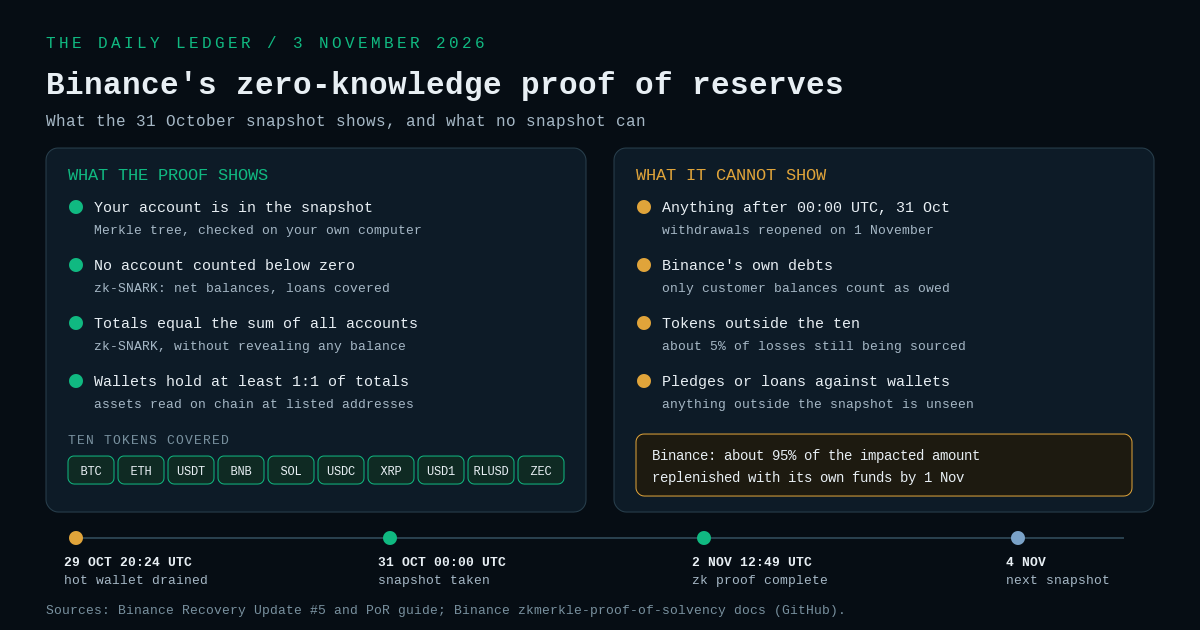
What does a zero-knowledge proof of reserves prove? That every customer balance in an exchange's snapshot was counted, none below zero, and that the exchange's wallets hold at least what it owes, without revealing any balance. On 2 November Binance said such a proof was complete for a snapshot taken at 00:00 UTC on 31 October, about 28 hours after its hot wallet was drained.
1. The Day in Numbers
- Bitcoin: $76,709 at 00:00 UTC, down 2.0 percent against the previous day's 00:00 UTC snapshot of $78,294. CoinGecko daily data.
- Ether: $2,250.22 at 00:00 UTC, down 1.0 percent on the same basis. CoinGecko daily data.
- Fear and Greed: 26, Fear, down 11 points from 37. Alternative.me daily reading, 3 November, 00:00 UTC.
- US spot bitcoin ETFs, Monday 2 November: a net outflow of $399 million, with $405 million leaving BlackRock's IBIT, per SoSoValue data reported by Odaily. Ether funds lost $140 million, a sixth straight day of outflows. Completed session; early totals can be revised.
2. What Binance's zero-knowledge proof of reserves shows, and what it cannot
A proof of reserves has two halves. The assets are public: Binance lists wallet addresses it says it controls, and anyone can read their balances on chain. The liabilities, every customer's balance, are private. Each account goes into a Merkle tree, a structure that rolls millions of entries into one fingerprint, so you can confirm your own was included. A zk-SNARK (a short cryptographic proof that a calculation was done correctly, checkable without seeing its inputs) then shows that no account's net balance is negative, that loans are covered by collateral, and that the declared totals equal the sum of all accounts, as its open-source circuit design sets out. Against the wallets, Binance says BTC, ETH, USDT, BNB, SOL, USDC, XRP, USD1, RLUSD and ZEC are each backed at least 1:1.
The limits matter this week. The proof is one moment, and withdrawals have reopened since. It counts customer balances, not Binance's own debts. Binance says it replenished the stolen assets with its own funds, but about 5 percent of the losses, in less liquid tokens outside the ten, was still being bought. Its guide warns the report "may not match your current asset count". A snapshot with more tokens follows on 4 November; its proof should take 40 to 50 hours.
3. Today's Headlines
SEC staff explain when a crypto network has no central party
The SEC's Division of Corporation Finance added three answers to its crypto asset FAQ on 2 November. Unaffiliated participants in broad-based governance generally are not a "central party" unless they agree to act together, and "functional" and "decentralized" are distinct concepts. These are staff views with no legal force.
Brazil: Mercado Bitcoin confirms a $46 million breach
Brazil's largest exchange paused deposits and withdrawals after an incident it contained "in one of our systems"; Arkham data put the assets involved at about $46.3 million, The Block reports. It says customers were unaffected; Tether froze more than 4.5 million USDT linked to the attack.
Liquid's bitcoin peg is whole again
The Liquid Federation says its bitcoin reserves are fully restored, so every L-BTC is again backed 1:1, after the flaw that let 4,000 unbacked L-BTC be redeemed in September. Node operators can verify the reserves themselves.
Strategy buys 811 bitcoin, and more of its own stock
Strategy bought 811 BTC for $65.5 million in the week to 1 November, taking its holdings to 849,327 BTC, and spent $208.2 million repurchasing its STRC preferred shares.
4. Security Note
Binance warned that scammers are impersonating it through messages, emails and small transfers carrying a note, offering "priority processing" or a move into a "Binance vault". It will never, it says, point you to an unofficial proof of reserves site, and checking the new proof means downloading a verifier. The rule: get the verifier only from Binance's own proof of reserves page or official GitHub repository, run it on a computer you trust, and treat any site asking you to log in or connect a wallet to "check your reserves" as phishing.
5. From the Academy Library
Our lexicon explains what a proof of reserves audit can and cannot prove. New readers can start at Academy School.
Americans vote today, on the date federal law sets, with all 435 House seats on the ballot; no results fall inside this window. A proof of reserves is a photograph: worth checking, and worth dating.
Disclaimer: This publication is for education and information only. It is not financial, investment, legal, tax, or security advice.
Sources and further reading
- Binance: Security Incident Recovery Update #5, 31 October PoR snapshot now fully verifiable, 2 November 2026
- Binance: proof of reserves page
- Binance: how to verify proof of reserves
- Binance on GitHub: proof of solvency circuit design
- Binance: security reminder on scams as withdrawals resume, 2 November 2026
- SEC Division of Corporation Finance: frequently asked questions on crypto assets, updated 2 November 2026
- The Block: Mercado Bitcoin hit by $46 million security breach, 2 November 2026
- Liquid Federation: bitcoin reserves fully restored
- SEC: Strategy Inc. Form 8-K, 2 November 2026
- Odaily (SoSoValue data): spot bitcoin ETF flows, 2 November
- Odaily (SoSoValue data): spot ether ETF flows, 2 November
- 2 U.S. Code section 7: time of election
- USAGov: midterm elections
- CoinGecko: bitcoin daily price snapshots
- CoinGecko: ether daily price snapshots
- Alternative.me: Fear and Greed Index history