
The Quiet Ledger: Issue #14 | 13 November 2026
Why Is Stablecoin Supply Shrinking?
Stablecoin supply fell $14.2 billion in 30 days as holders redeemed for dollars and bitcoin broke below $69,000. Plus Coinbase's trust charter, DTCC on Solana and North Korea's fake video calls.
THE QUIET LEDGER
Issue #14 | Saturday 7 November to Friday 13 November 2026
A week in which money left crypto while Wall Street kept building its rails: stablecoin supply fell at the fastest pace since June 2022 and bitcoin broke below $69,000, yet Coinbase won a national trust charter and the NYSE and DTCC chose blockchain ledgers
Reporting window Saturday 7 November to Friday 13 November 2026, continuing from Issue #13's cutoff at 22:00 UTC on Friday 6 November. Data cutoff 22:00 UTC on Friday 13 November (23:00 Europe/Stockholm, CET). Weekly changes compare CoinGecko hourly readings at 22:00 UTC on Friday 6 and Friday 13 November. Friday's ETF session is pending. No Daily Ledger is published on Fridays, so stories from 06:00 UTC on Thursday 12 November onward appear here first. This issue was added to the archive on 28 November 2026 and uses only information available at the cutoff.
Why is stablecoin supply shrinking? Because more holders are handing tokens back to their issuers for dollars than are buying new ones, and this autumn the gap has been the widest in more than four years. Bitcoin funds paid out on every completed session, and bitcoin lost almost a tenth of its value. Yet the same week a crypto exchange won a federal trust charter and the plumbing of US stock markets chose blockchain ledgers. Money left the market; the institutions building around it did not.
1. The Macro Pulse
- Bitcoin: $68,337 at the 22:00 UTC cutoff, down 9.9 percent from $75,844 a week earlier. It fell below $69,000 in the 03:00 UTC hour on Friday, trading under $70,000 for the first time since August, and touched $67,555 on Coinbase two hours later. About $1.5 billion of leveraged positions, mostly bets on rising prices, were liquidated in 24 hours, per CoinGlass data cited by ForkLog.
- Ether: $1,926.92 at the cutoff, down 13.9 percent from $2,238.36.
- Fear and Greed: 20, Extreme Fear on Friday, from 28 a week earlier.
- US spot ETFs: last Friday's session, pending in Issue #13, closed at $411.9 million out of bitcoin funds. All four completed sessions this week were outflows too, $880.0 million in total, while ether funds lost about $401 million, per SoSoValue data. Friday is pending.
- Rates: US consumer prices rose 0.4 percent in October, with core prices up 0.3 percent for a third month. CME FedWatch then priced an 84.7 percent chance of a December hike and a 15.3 percent chance of a half-point move, InvestmentNews reported. On Thursday Jensen Huang resigned as Nvidia's chief executive, effective immediately.
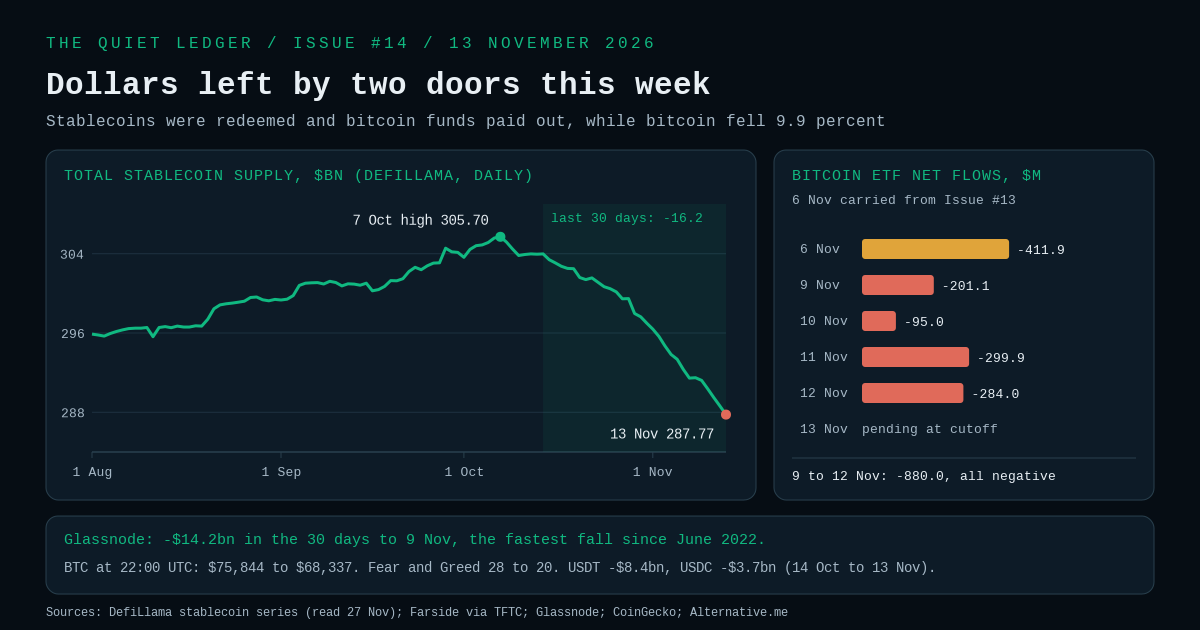
The takeaway: fund holders and stablecoin holders both redeemed, the latter faster than at any time since 2022, so Friday's selling met little new money. The data describe a withdrawal; they do not say when it stops.
2. This Week in Headlines
Wall Street picks its ledgers
Coinbase said on Monday that the OCC had given final approval to Coinbase National Trust Company, following Circle in July and Ripple in October. It brings Coinbase's custody business under federal oversight; Coinbase has said it will not take retail deposits. The same day Ava Labs said Avalanche technology will provide the core ledger for the clearing firm behind a planned NYSE-affiliated trading venue for tokenised securities, designed for round-the-clock trading and subject to regulatory approval. On Thursday DTCC, whose depository held $114 trillion of securities in 2025, said its new tokenisation service will connect to Solana in the second half of 2027.
Stablecoins move into banks and card networks
Goldman Sachs, Citigroup, Santander and Deutsche Bank are among banks committing about $270 million to Project Faro, a bank-backed dollar stablecoin aimed at the first half of 2027. Visa now lets eligible partners settle on its network in USDPT, Western Union's token issued by Anchorage Digital Bank. Neither explains the contraction, but both show banks building stablecoin rails of their own.
Index providers and Washington
MSCI confirmed that Strategy, Metaplanet and Upexi will leave its indexes after the close on 30 November; JPMorgan had estimated about $2.8 billion of resulting sales. The White House nominated two SEC commissioners and two CFTC commissioners who worked on the CLARITY Act; the SEC has two of five seats filled and the CFTC one. FinCEN's order cutting MEXC Global off from US banks takes effect on 10 December.
Asia tightens the taps
South Korea's Financial Services Commission will issue a no-action letter, a promise not to penalise, so exchanges can block deposits and withdrawals when a hack is only suspected; operators without round-the-clock monitoring may process transfers only in staffed hours. Thailand's SEC proposed capping each customer's stablecoin deposits and withdrawals at 5 million baht per platform per day, about $148,000, and only to wallets in the customer's own name; comments close on 26 November.
Europe changes hands
Gemini sold its UK and European businesses to Singapore payments firm KAST for under $10 million, according to a person familiar with the deal; buyers had sought its licences. Deutsche Bank switched on crypto custody for institutional clients from Frankfurt.
3. The Weekly Deep Dive: why is stablecoin supply shrinking?
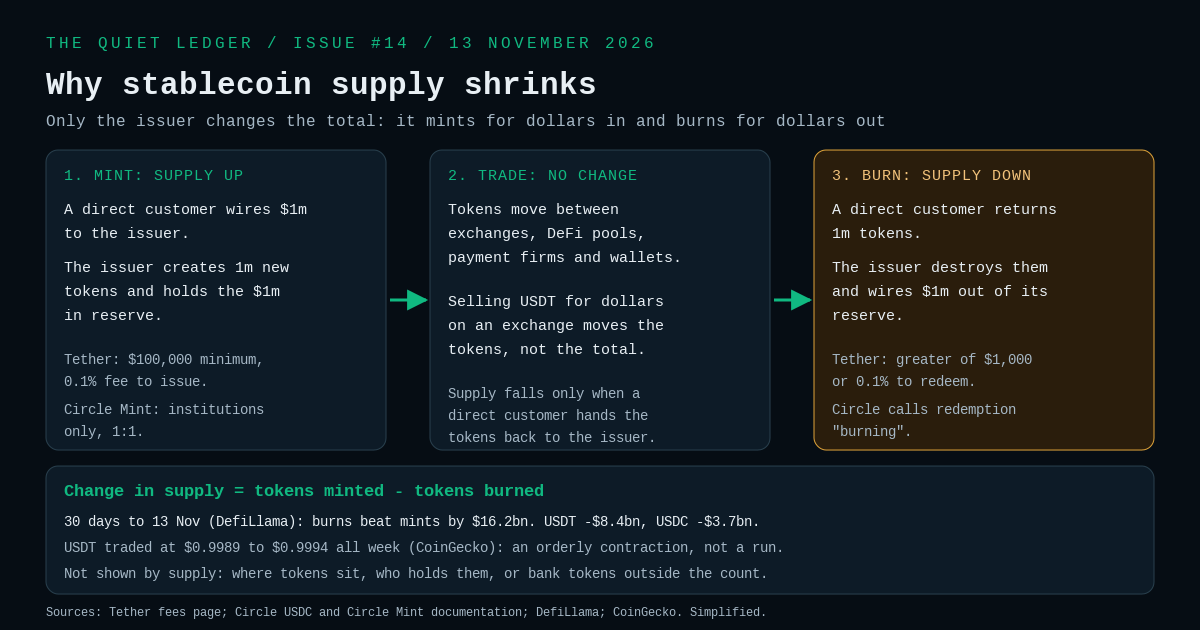
Stablecoin supply is the number of tokens in existence, each a claim on an issuer for one dollar. It changes in only two ways. When a customer with a direct account sends dollars, the issuer mints new tokens; when such a customer hands tokens back, the issuer destroys, or burns, them and pays out dollars. Trading between holders changes nothing. Supply shrinks when redemptions outrun issuance.
How it works
Direct access is wholesale. Tether requires $100,000 to issue or redeem and charges the greater of $1,000 or 0.1 percent to redeem. Circle's mint and redemption service is not open to individuals, and its tokens mint and redeem one for one. So selling USDT on an exchange leaves the total unchanged until a trading firm holding the surplus returns it to Tether.
Why this week exposed it
Glassnode's weekly report said supply fell $14.2 billion in the 30 days to 9 November, the fastest contraction since June 2022, weeks after the TerraUSD collapse, leaving "less fuel for a rally". DefiLlama's wider count shows the slide continuing: $303.98 billion on 14 October, $287.77 billion on 13 November. USDT accounted for $8.4 billion of that and USDC for $3.7 billion. The Editorial Desk's reading: with two-year Treasury yields near 4.75 percent, per Glassnode, a token paying nothing is an expensive place to wait, and closed leveraged trades free collateral to cash out.
Limits
- Supply counts claims outstanding, not buying power: many tokens sit with treasuries, payment firms and DeFi, not exchanges.
- Trackers differ: Glassnode's count, as reported by Decrypt, put the total just under $280 billion, DefiLlama's near $291 billion on the same date. Compare changes within one source.
- Shrinking is not breaking. USDT traded between $0.9989 and $0.9994 all week, so redemptions were orderly. Our guide on how stablecoins hold a dollar explains the peg itself.
- It is not a timer. Glassnode treats renewed growth as the first sign of new money, a condition to watch rather than a forecast. Dollars moving into bank tokens, such as a tokenised deposit, would not appear here.
What you can check
- Daily supply by issuer on DefiLlama's stablecoin data.
- Issuer figures on Circle's transparency page and Tether's.
- Whether your stablecoin still trades at a dollar on several venues: a contraction is not a run.
4. Security and Onchain Radar
The video call that was never a meeting. Confirmed: on Thursday the Justice Department said it disrupted FaceStealer, a North Korean scheme that has taken more than $400 million in 18 months. Attackers invite targets to video meetings from accounts they have already stolen, record the target's webcam, and play recordings of people the target knows or AI deepfakes of well-known crypto figures. Then they fake an audio fault and offer a "fix" that installs malware; thefts can follow months later. In the same release, the department said it had court authority to seize or restrain more than $1.2 billion of the over $6 billion stolen from Binance on 29 October, with more than $2.7 billion frozen in all. It differs from the fake job interview scam: no coding test, just trust in a familiar face.
Also confirmed: Trezor found extra circuit boards in three Safe 5 wallets sold by former reseller CryptoBilis between 20 August and 23 September; they copied recovery words from the screen and sent them out over a mobile network. Firmware 2.13.1 blocks the implants found so far but cannot protect a seed already captured. No customer losses have been reported, and Trezor has cut its reseller network by about 80 percent.
The rules:
- Confirm an unexpected meeting invitation with the sender on a second channel you already use.
- Never install an update, plug-in or "fix" offered during a call. Leave, then update from the official app.
- Keep your camera off until you know who is on the call.
- Buy hardware wallets from the maker. If yours came from CryptoBilis, move funds to a new wallet with a new seed.
5. From the Academy Library
See how ETF creation and redemption works, how a stablecoin address freeze helped hold back part of the Binance theft, and how to spot a counterfeit hardware wallet. Issue #13 explains how Binance replaced the stolen assets, and this week's dailies cover meme-coin laundering and the Across domain hijack. New readers can start at Academy School.
Three useful, non-affiliate tools: DefiLlama's stablecoin data, for supply by day; Circle's transparency page, for USDC reserves; and the Fed's FOMC calendar.
Dates to keep
- 26 November: comments close on Thailand's stablecoin transfer cap.
- 30 November: MSCI removes Strategy, Metaplanet and Upexi at the close.
- 8 and 9 December: the next Federal Reserve meeting.
- 10 December: FinCEN's MEXC order takes effect.
A shrinking stablecoin float is the market's cash going home, not its cash disappearing. The same week showed the alternatives being built: charters, card networks and bank-run tokens.
Disclaimer: This publication is for education and information only. It is not financial, investment, legal, tax, or security advice.
Sources and further reading
Stablecoin supply and mechanics
- Glassnode: The Week Onchain, week 45, 2026
- Decrypt: stablecoin drain and ETF outflows leave bitcoin running on empty, 11 November 2026
- DefiLlama: total stablecoin supply data
- DefiLlama: USDT supply data
- DefiLlama: USDC supply data
- Tether: fees and minimums
- Tether: transparency
- Circle: how minting works
- Circle: USDC
- Circle: transparency
- CoinGecko: USDT hourly prices, 6 to 13 November
Institutions and market structure
- Decrypt: Coinbase joins Circle and Ripple with final OCC approval, 9 November 2026
- Ava Labs: Avalanche to serve as core ledger technology for NYSE-affiliated tokenised securities platform, 9 November 2026
- DTCC: tokenization service to connect with Solana, 12 November 2026
- Decrypt: global banks commit $270 million to Project Faro, 10 November 2026
- Decrypt: Visa adds Anchorage-issued USDPT for settlement, 12 November 2026
- Cointelegraph: MSCI confirms Strategy's removal from indexes, 12 November 2026
- CoinDesk: Gemini sells UK and European operations to KAST, 12 November 2026
- Bitcoin Magazine: Deutsche Bank custody goes live, 11 November 2026
Regulation and policy
- Cointelegraph: SEC and CFTC nominations, 13 November 2026
- Federal Register: special measure against MEXC Global, published 10 November, effective 10 December 2026
- Financial Services Commission: virtual asset industry security measures, 12 November 2026 (Korean)
- The Block: Thailand seeks daily stablecoin cap, 13 November 2026
Security
- US Department of Justice: actions to disrupt North Korea's theft of cryptocurrency, 12 November 2026
- Trezor: our CryptoBilis investigation, 12 November 2026
Markets and macro
- TFTC: US spot bitcoin ETF flows, November 2026 (Farside data)
- The Block: daily bitcoin and ether ETF flows for the week (SoSoValue data)
- ForkLog: bitcoin falls below $70,000 for the first time since August, 13 November 2026
- Coinbase Exchange: BTC-USD hourly candles, 6 to 13 November
- Bureau of Labor Statistics: Consumer Price Index, October 2026
- InvestmentNews: October CPI and CME FedWatch odds, 10 November 2026
- Nvidia: CEO transition, Form 8-K exhibit, 12 November 2026
- CoinGecko: bitcoin hourly prices
- CoinGecko: ether hourly prices
- Alternative.me: Fear and Greed Index history