
The Daily Ledger: 10 November 2026
How Hackers Launder Stolen Crypto With Meme Coins
How do hackers launder stolen crypto with meme coins? Elliptic traces six throwaway NEAR tokens that moved Binance-theft funds. Plus Coinbase's final trust charter and the NYSE picks Avalanche.
THE DAILY LEDGER
10 November 2026
Elliptic shows Binance-theft launderers minting throwaway meme coins on NEAR, Coinbase wins its final national trust charter, and the NYSE picks Avalanche technology for a tokenised-securities venue.
Reporting window: 9 November 2026, 06:00 UTC to 10 November, 06:00 UTC (07:00 Europe/Stockholm, CET). Data cutoff: 10 November, 06:00 UTC. Prices are CoinGecko 00:00 UTC daily snapshots compared with the previous day's 00:00 UTC snapshot. This issue was added to the archive on 28 November 2026 and uses only information available at the cutoff.
How do hackers launder stolen crypto with meme coins? They create a worthless token, open a trading pool for it, buy it with stolen funds from one set of wallets and sell it back from another, so no coins pass directly between the two. On 9 November Elliptic showed North Korea's launderers doing exactly this on NEAR with part of the 29 October Binance theft.
1. The Day in Numbers
- Bitcoin: $75,267 at 00:00 UTC, up 0.7 percent against the previous day's 00:00 UTC snapshot of $74,740. CoinGecko daily data.
- Ether: $2,132.14 at 00:00 UTC, up 0.4 percent on the same basis. CoinGecko daily data.
- Fear and Greed: 32, Fear, up 3 points from 29. Alternative.me daily reading, 10 November, 00:00 UTC.
- Bitcoin's range in the window: a low of $73,828 at 08:00 UTC on 9 November and a high of $75,465 at 16:00 UTC, per CoinGecko hourly data. Hourly readings miss moves between the hours.
2. How hackers launder stolen crypto with meme coins
Elliptic counts six new tokens on NEAR, each paired with NEAR in its own liquidity pool: a smart contract on a decentralised exchange that lets anyone swap one asset for the other. The first, FUK, appeared at 00:25 UTC on 5 November and the last, SINU, at 10:06 UTC on 7 November. Each cost about 25 NEAR (around $90) to create.
Buying wallets, funded with about 117,000 stolen NEAR (around $430,000), paid into the pools. Separate collecting wallets sold the tokens back and withdrew almost the same amount, much of it into stablecoins or a cross-chain bridge. With the pool in between, the collectors look like traders taking a profit. Every token was traded heavily within hours, then abandoned; none traded after 8 November.
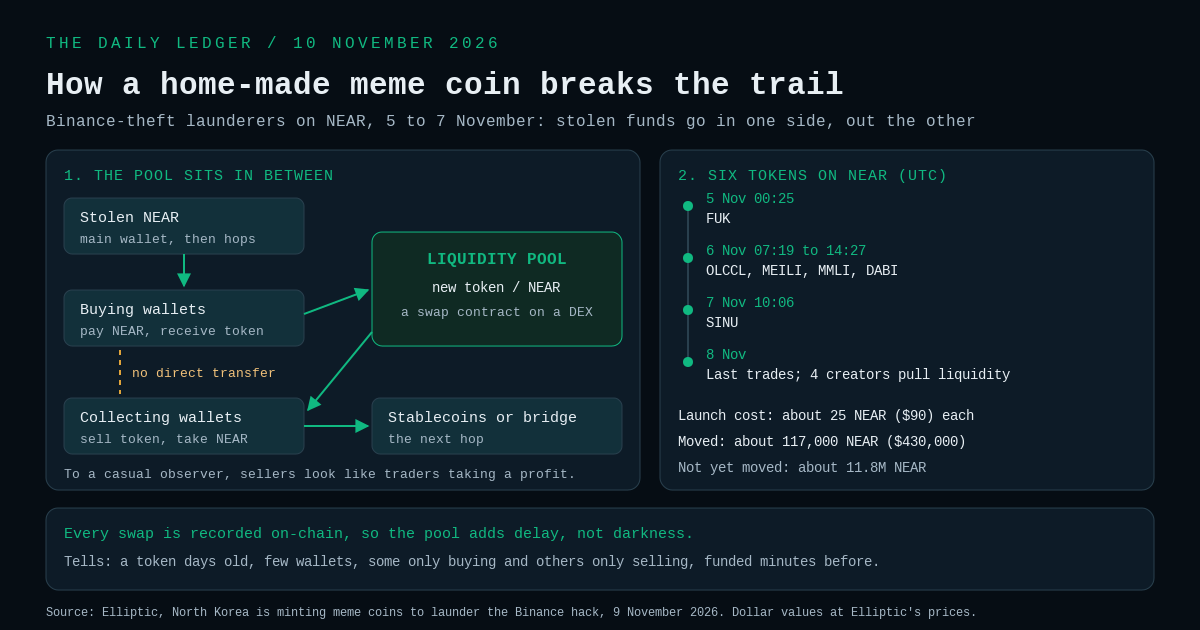
The trail is still public. Elliptic says the launderers' wallets made every sale of all six tokens, five token creators were funded by a wallet selling the previous token 2 to 13 minutes before launch, and the NEAR going in matched the NEAR coming out. "The technique slows investigators down rather than hiding the funds," it wrote. The same trick moved at least $24 million after the Bybit theft in 2025. About $2.85 billion of the Binance haul is frozen, Bitcoin Magazine reported, citing Elliptic. Still unknown: how many other throwaway tokens are in use.
3. Today's Headlines
Coinbase wins its final national trust charter
The Office of the Comptroller of the Currency gave final approval to Coinbase's national trust bank, Crypto Briefing reported at 10:05 UTC on 9 November, after conditional approval in April. A national trust bank does custody and fiduciary work under federal supervision; it cannot take ordinary deposits or make loans.
The NYSE picks Avalanche for its tokenised-stock ledger
Ava Labs said Avalanche will supply the core ledger for the clearing firm of an NYSE-affiliated venue for tokenised securities. It will run on dedicated infrastructure, and the NYSE says it needs to control who takes part. Round-the-clock trading and settlement depend on regulatory approval.
European Union: a call for tokenisation standard-setters
The ECB, the European Commission and ESMA invited wholesale market firms to join a European Tokenisation Standards Group, which will write common standards for tokenised finance. Industry will chair it and the authorities will observe. Applications close on 27 November.
4. Security Note
Brazil's Mercado Bitcoin began reopening accounts in read-only mode on 9 November, a week after an estimated $48.6 million left its wallets across 11 blockchains, FinanceFeeds reported, citing Bitquery. Trading and withdrawals stay frozen. The exchange says more than 33 percent of the diverted assets has been blocked and it is covering the rest with company funds. Customers must create new credentials in the app before funds can move. The rule: after any exchange breach, reset credentials only in the official app or a site you typed yourself, never through an emailed or messaged link, and treat any fee to "unlock" a withdrawal as a scam.
5. From the Academy Library
Our lexicon explains whether stolen crypto can be traced and recovered and how wash trading works, the same trade-with-yourself pattern put to a different use. The 1 November issue covers why the FBI publishes hacker wallet addresses. New readers can start at Academy School.
A throwaway token buys launderers hours, not invisibility. The chain still records what went in and what came out.
Disclaimer: This publication is for education and information only. It is not financial, investment, legal, tax, or security advice.
Sources and further reading
- Elliptic: North Korea is minting meme coins to launder the Binance hack, 9 November 2026
- Bitcoin Magazine: North Korea minting meme coins to launder Binance loot, 9 November 2026
- Crypto Briefing: Coinbase wins final OCC approval for national trust bank charter
- Ava Labs: Avalanche to serve as core ledger technology for NYSE-affiliated tokenised securities platform
- European Commission: EU seeks nominations for stakeholder group on tokenisation standards, 9 November 2026
- FinanceFeeds: Mercado Bitcoin restores account access but withdrawals remain frozen
- CoinGecko: bitcoin daily price snapshots
- CoinGecko: ether daily price snapshots
- CoinGecko: bitcoin hourly prices
- Alternative.me: Fear and Greed Index history