
The Daily Ledger: 11 November 2026
What Is a Crypto Domain Hijack? How It Drains Wallets
Attackers took over Across Protocol's web address through its registrar and served a fake app that drained about $350,000 through signed approvals. Plus FinCEN's MEXC start date, the ECB on the digital euro and an LNbits emergency patch.
THE DAILY LEDGER
11 November 2026
Attackers take over Across Protocol's web address through its registrar and drain about $350,000 with a fake app, FinCEN's MEXC order gets a start date, and the ECB presses for a digital euro law this year.
Reporting window: 10 November 2026, 06:00 UTC to 11 November, 06:00 UTC (07:00 Europe/Stockholm, CET). Data cutoff: 11 November, 06:00 UTC. Prices are CoinGecko 00:00 UTC daily snapshots compared with the previous day's 00:00 UTC snapshot. This issue was added to the archive on 28 November 2026 and uses only information available at the cutoff.
What is a crypto domain hijack, and how does it drain wallets? It is a takeover of a project's web address rather than its code: the attacker points the real name at a fake site, and visitors sign away their own tokens. That happened to the cross-chain bridge Across Protocol on 10 November, and no smart contract had to be broken for it to work.
1. The Day in Numbers
- Bitcoin: $73,721 at 00:00 UTC, down 2.1 percent against the previous day's 00:00 UTC snapshot of $75,267. CoinGecko daily data.
- Ether: $2,050.34 at 00:00 UTC, down 3.8 percent from $2,132.14 on the same basis. CoinGecko daily data.
- Fear and Greed: 29, Fear, down 3 points from 32. Alternative.me daily reading, 11 November, 00:00 UTC.
- Across phishing losses: about $350,000 across six chains, an estimate GoPlus Security posted at 04:34 UTC on 11 November. Across has not published its own total.
2. What is a crypto domain hijack and how does it drain wallets?
A domain name is only a pointer. The registrar, the company that rents out the name, holds the account that decides which servers answer for it. Whoever controls that account controls where across.to leads.
At about 18:45 UTC, Across says, a social engineering attack on its registrar, Namecheap, gave an attacker that control. The real address then served a fake app. According to GoPlus, it asked visitors for three kinds of permission: a standard token approval, an EIP-2612 permit (an approval given by signed message instead of a transaction) or a Permit2 authorisation. Each names the attacker as a spender, who can then pull the tokens out with a transfer call. Nothing was hacked on-chain: victims granted access.
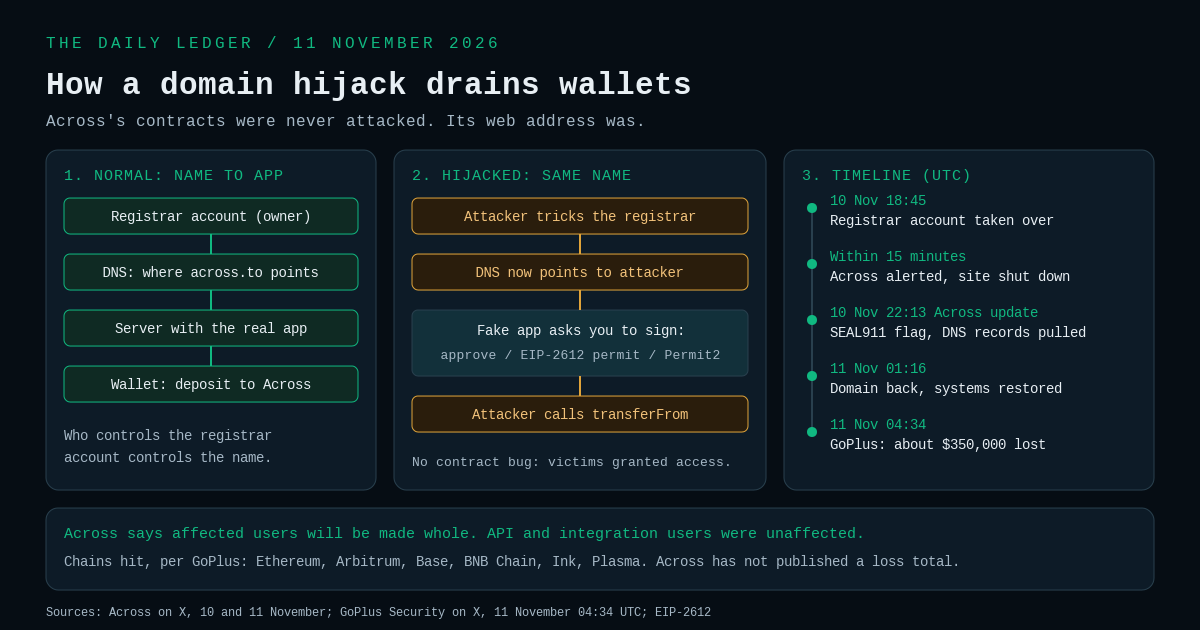
Across says it was alerted within 15 minutes and shut the site down; SEAL911 flagged the domain to major wallets and Cloudflare removed its DNS records. At 01:16 UTC Across said the domain was back and affected users would be made whole. Still unknown: how many people signed, Across's own loss figure and how Namecheap was deceived. A post-mortem is promised.
3. Today's Headlines
MEXC order takes effect on 10 December
FinCEN's order naming MEXC Global a primary money laundering concern was published in the Federal Register on 10 November, so its ban on certain transmittals of funds involving the exchange applies from 10 December. On 8 November we noted the 30-day clock had not visibly started. It now has.
European Union: the ECB wants the digital euro law this year
ECB board member Piero Cipollone told the European Parliament's economic committee that a swift deal would allow adoption by year-end. An issuance date can be set only after adoption, he said, and "a delay in adoption could instead postpone the introduction of the digital euro." A pilot with 36 payment providers starts in the second half of 2027.
Banks pool about $270 million for a joint stablecoin
Goldman Sachs, Citigroup, Santander and Deutsche Bank are among banks committing about $270 million to fund five years of Project Faro, a planned dollar stablecoin aiming for the first half of 2027, Decrypt reported, citing Bloomberg. JPMorgan is not listed, and there is no chief executive, final name or token yet.
4. Security Note
LNbits, open-source software that runs Lightning wallets for many users on one server, shipped version 1.7.0 at 17:09 UTC on 10 November as an urgent security update after weekend attacks. Its guidance says funds on earlier versions "are at risk of being stolen." One tipping-bot operator lost about 2.29 million sats on 8 November, Bitcoin Magazine reported; the flaw and total losses are undisclosed. The rule: a patch does not evict an intruder. Operators who suspect compromise should rebuild on a fresh server, reset every wallet key and replace funding-source credentials. Anyone using someone else's instance should keep only small balances there.
5. From the Academy Library
The lexicon explains token approvals and wallet drainers and why blind signing is risky, and our wallet security checklist shows how to check a spender before you approve. New readers can start at Academy School.
In a domain hijack the address bar looks right, so a bookmark offers no protection. What protects you is reading which address a signature names as spender, and taking a wallet warning seriously.
Disclaimer: This publication is for education and information only. It is not financial, investment, legal, tax, or security advice.
Sources and further reading
- Across on X: domain down after a social engineering attack on Namecheap, 10 November 2026, 22:13 UTC
- Across on X: domain back under control, systems restored, 11 November 2026, 01:16 UTC
- GoPlus Security on X: Across phishing losses and signature types, 11 November 2026, 04:34 UTC
- EIP-2612: permit extension for signed approvals
- Federal Register: special measure prohibiting the transmittal of funds involving MEXC Global, 10 November 2026
- ECB: Piero Cipollone, cash and the digital euro, statement to the ECON committee, 10 November 2026
- Decrypt: global banks commit $270 million to a joint stablecoin
- LNbits v1.7.0 release notes
- LNbits: 1.7.0 security update guidance
- Bitcoin Magazine: LNbits releases 1.7.0 after 8 November attacks
- CoinGecko: bitcoin daily price snapshots
- CoinGecko: ether daily price snapshots
- Alternative.me: Fear and Greed Index history