
The Daily Ledger: 8 November 2026
What Is the Reth State Root Bug?
The Reth state root bug could make nodes calculate the wrong summary of a blockchain. No exploit is reported, but Base, BNB Chain and OP Stack networks patched.
THE DAILY LEDGER
8 November 2026
A bug in shared Ethereum software sends several networks through a patch cycle, Web3Auth names its Keplr recovery wallets, and USDC moves under direct EU supervision this week.
Reporting window: 7 November 2026, 09:18 UTC to 8 November, 16:58 UTC (17:58 Europe/Stockholm, CET). Data cutoff: 8 November, 16:58 UTC. Prices are live CoinGecko readings at the cutoff. The Reth patches shipped on 5 and 6 November and have not been covered in an earlier issue.
The Reth state root bug was a flaw in widely shared Ethereum software that could make a node calculate the wrong summary of a blockchain's data. No exploit or loss of funds has been reported, but patches went out across several Ethereum-style networks on 5 and 6 November. It is a clear example of how one code path can reach many chains at once.
1. The Day in Numbers
- Bitcoin: $75,690 at 16:57 UTC, flat over 24 hours. CoinGecko.
- Ether: $2,226.01 at 16:57 UTC, down 0.3 percent over 24 hours. CoinGecko.
- Fear and Greed: 28, Fear, up from 25 a day earlier. Alternative.me, 8 November, 00:00 UTC.
- Bitcoin dominance: 60.0 percent of total crypto market value at 16:49 UTC. CoinGecko. A rolling figure.
2. The Reth state root bug, explained
Reth is an execution client: software that runs transactions and tracks every balance and contract. After each block, a client condenses all of that data into one hash, the state root, a fingerprint of the whole ledger. Honest nodes should all reach the same fingerprint, so a mismatch makes a node treat a block as invalid.
Georgios Konstantopoulos, chief technology officer at Reth's developer Paradigm, said Reth's legacy calculator had an edge case: for certain contract storage layouts, a carefully crafted transaction could produce the wrong root. Its block builder used that path on lower-end hardware and OP Stack chains. The fix merged on 3 November and Reth v2.10.0 rates the upgrade high priority.
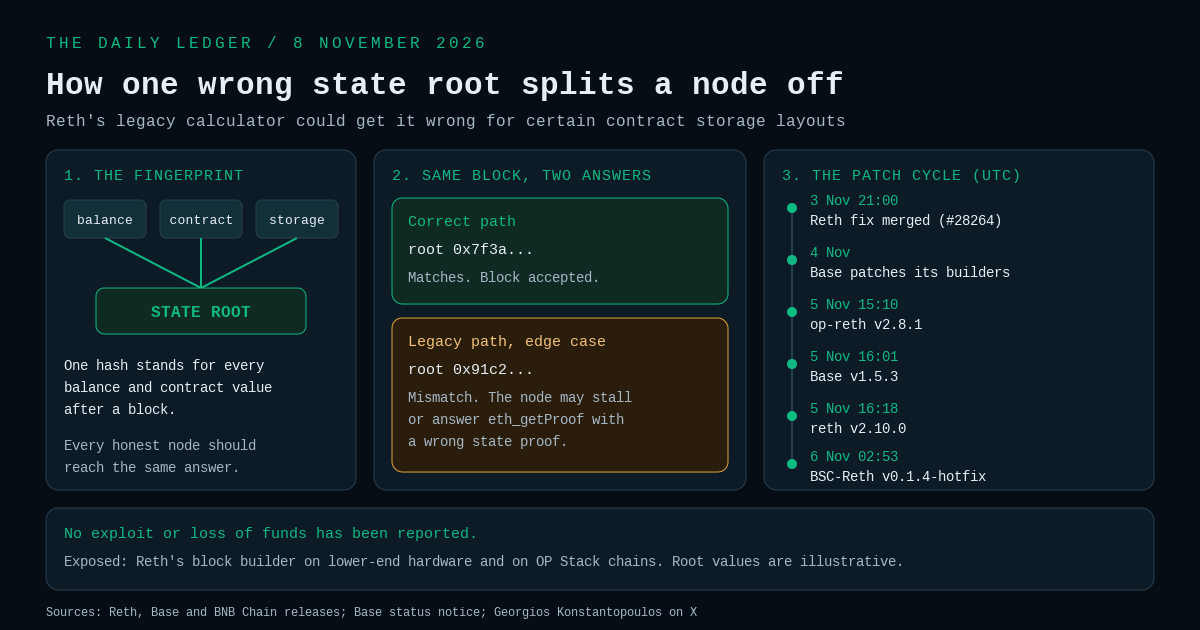
Blockaid called it "a correctness bug, not an exploit": unpatched nodes may stall or return wrong state proofs. Base says it recomputed its root, found it correct, and that an independent implementation checks every root. Konstantopoulos says withdrawals and bridges were not at risk, yet LayerZero paused some routes and Gauntlet closed new deposits to its V1 vaults as precautions. Still unknown: the full range of vulnerable versions, and whether LayerZero has resumed every route. Ordinary users have nothing to install; node operators do.
3. Today's Headlines
USDC moves under direct EU supervision on 12 November
The European Banking Authority takes over supervision of USDC's own funds, reserve assets, liquidity and recovery plans on Thursday. France's ACPR keeps governance and related areas. USDC is the first e-money token the EU has classed as significant.
MEXC's 30-day clock has not visibly started
FinCEN's order takes effect 30 days after Federal Register publication. A search of the register at the cutoff showed no such notice yet.
Dollar stablecoin supply keeps shrinking
Dollar-pegged stablecoins total $292.35 billion, down from $301.60 billion on 28 October, DefiLlama data show. The latest reading is for an incomplete day, and the data do not say why supply fell.
4. Security Note
On 8 November Web3Auth said it has been moving assets from affected Keplr accounts into recovery wallets, and Keplr published the verified addresses. Web3Auth disputes a $6.01 million theft estimate, saying some flagged transfers were rescues. Final losses are unpublished. The rule, from Keplr: if you signed up with Google or Apple, send no new funds to that account, move remaining liquid assets to a recovery-phrase or hardware wallet, and ignore any message offering "recovery".
5. From the Academy Library
Our Web3 infrastructure guide explains the node and RPC layer behind this story, and the lexicon covers rollup sequencers and cross-chain bridges. New readers can start at Academy School.
Shared code spreads a fix quickly, and a flaw just as quickly. A second implementation checking the same answer is what keeps a bug like this one small.
Disclaimer: This publication is for education and information only. It is not financial, investment, legal, tax, or security advice.
Sources and further reading
- Georgios Konstantopoulos on X: PSA on the Reth and OP Reth releases, 5 November 2026
- Reth pull request 28264: tighten iterator seek boundary
- Reth v2.10.0 release notes
- op-reth v2.8.1 release notes
- Base v1.5.3 release notes
- BSC-Reth v0.1.4-hotfix release notes
- Base status: v1.5.3 fixes potential state root mismatch
- The Defiant, via KuCoin: Blockaid warns Reth bug can produce incorrect state proofs
- Unchained: Base says users unaffected as Reth and Base ship fixes
- European Banking Authority: USDC classified as first significant e-money token, 14 October 2026
- FinCEN: section 9714 order on MEXC Global
- Federal Register: search for MEXC
- DefiLlama: total stablecoin supply data
- Web3Auth on X: update on Keplr asset recovery, 8 November 2026
- Keplr on X: verified recovery addresses, 8 November 2026
- Keplr on X: what this means for Keplr users, 7 November 2026
- Crypto Briefing: Web3Auth disputes $6.01 million Keplr theft estimate
- CoinGecko: bitcoin and ether prices
- CoinGecko: global market data
- Alternative.me: Fear and Greed Index