
The Daily Ledger: 18 November 2026
How Russia's 300,000 Ruble Retail Crypto Limit Works
Russia's retail crypto rules took effect on 17 November: how the 300,000 ruble yearly cap per intermediary, the knowledge test and the payment ban work. Plus the FSB's 2027 stablecoin focus and France's MiCA requests.
THE DAILY LEDGER
18 November 2026
Russia's retail crypto rules take effect with a 300,000 ruble yearly cap per intermediary, the Financial Stability Board puts global stablecoins on its 2027 agenda, and France asks Brussels to tighten MiCA.
Reporting window: 17 November 2026, 06:00 UTC to 18 November, 06:00 UTC (07:00 Europe/Stockholm, CET). Data cutoff: 18 November, 06:00 UTC. Prices are CoinGecko 00:00 UTC daily snapshots compared with the previous day's 00:00 UTC snapshot. The Russian rules took effect on 17 November, Moscow time (UTC+3). This issue was added to the archive on 28 November 2026 and uses only information available at the cutoff.
Since 17 November, Russians who are not qualified investors can legally buy bitcoin, ether and USDT, but only through a broker, trust manager or crypto exchange office, only after passing a test, and only up to 300,000 rubles a year through each intermediary. That, in one sentence, is how Russia's 300,000 ruble crypto limit for retail investors works. Russia's largest exchange, the Moscow Exchange, has not opened crypto trading yet.
1. The Day in Numbers
- Bitcoin: $64,889 at 00:00 UTC, up 0.1 percent against the previous day's 00:00 UTC snapshot of $64,841. CoinGecko daily data.
- Ether: $1,822.96 at 00:00 UTC, up 0.2 percent on the same basis. CoinGecko daily data.
- Fear and Greed: 11, Extreme Fear, down 1 point from 12. Alternative.me daily reading, 18 November, 00:00 UTC.
- The cap in dollars: about $3,636. That is 300,000 rubles at the Bank of Russia's official rate for 17 November (82.5143 rubles per dollar), or roughly 0.056 bitcoin at the 00:00 UTC price.
2. How Russia's 300,000 ruble crypto limit for retail investors works
The rule is Bank of Russia Ordinance 7441-U, signed on 11 September, registered by the Justice Ministry on 30 October and made under Federal Law 282-FZ of 4 August, Russia's first full crypto law. Non-qualified investors, the ordinary retail category Russia already uses for securities, may buy only the three assets on the Bank's list. The Bank says it chose them on market value, daily trading volume and at least five years of price history on foreign venues.
The cap is kept by each intermediary. The ordinance defines it as the ruble sum of purchase costs through that broker in a calendar year, and sets the ceiling at 300,000 rubles. Sales are not subtracted, so selling does not free up room. Every investor, qualified or not, must pass a test and read a risk warning before trading. Qualified investors can buy any crypto asset with no cap.
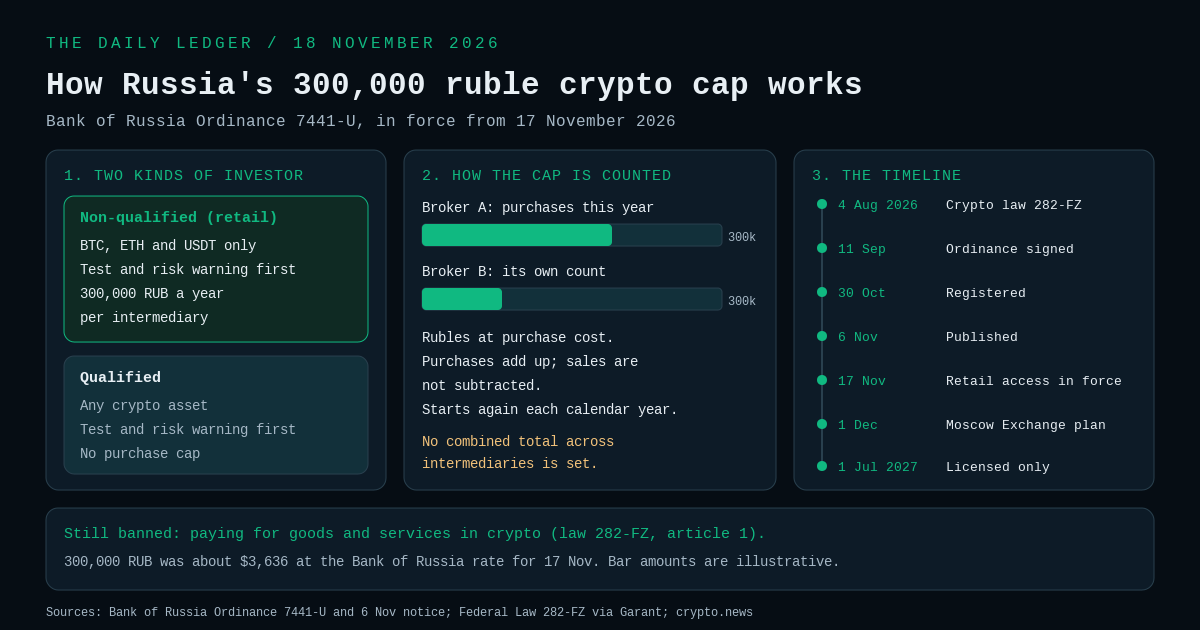
Paying for goods and services in crypto stays banned. Article 1 of the law keeps that prohibition, with exceptions such as foreign-trade contracts, the legal publisher Garant explains. The Moscow Exchange plans to start on 1 December, crypto.news reports. Still unknown: the test's content, and whether using two brokers doubles the cap. Neither the ordinance nor the Bank's notice addresses that case.
3. Today's Headlines
Basel: global stablecoins on the FSB's 2027 list
The Financial Stability Board, which coordinates financial regulation for the G20, met in Basel on 16 and 17 November and named global stablecoins among its 2027 priorities, alongside AI and nonbank finance. It also discussed a stock-take of how national rules interact across borders.
France asks Brussels to tighten MiCA
France's financial-sector advisory committee, the CCSF, asked the European Commission for clearer lending and staking disclosures, explicit consent before a provider stakes client coins, stronger ESMA powers against unauthorised non-EU platforms and strict limits on promoting the riskiest tokens. These are recommendations for a possible MiCA revision, not rules.
World Bank to explore USDC disbursements
The World Bank Group will explore sending development funds in USDC, with Citi supplying bank connections and Circle the stablecoin infrastructure. No timeline was given.
Kalshi drops Trump word markets
Kalshi ended markets on whether President Trump would say particular words after the CFTC asked it to, Al Jazeera reports. Markets on other public figures continue.
4. Security Note
Coinbase says its AI systems stopped about 91 percent of attempted transfers, $4.7 million, headed to a YouTube livestream that copied Tesla's broadcast, used a deepfake of Elon Musk and showed wallet addresses and a QR code promising to double any crypto sent, The Block reports. More than 500,000 people watched, and hundreds of Coinbase customers tried to send funds within about two hours. The rule: no genuine giveaway asks you to send crypto first. A stream that shows an address and promises to send back more is a scam, and a sent transfer cannot be recalled.
5. From the Academy Library
Our crypto tax and regulation guide covers licensing and investor rules, and the geopolitics and CBDC guide covers how states shape crypto access. Issue #13 reported the Bank of Russia's announcement. New readers can start at Academy School.
Russia has opened a legal door to bitcoin with a meter attached. The open question is whether that meter is read broker by broker or person by person.
Disclaimer: This publication is for education and information only. It is not financial, investment, legal, tax, or security advice.
Sources and further reading
- Bank of Russia Ordinance 7441-U of 11 September 2026 (Russian, PDF)
- Bank of Russia: cryptocurrencies for non-qualified investors, 6 November 2026
- Bank of Russia: official exchange rates for 17 November 2026
- Garant: the crypto law 282-FZ, new rules for investors and business (Russian)
- crypto.news: Russia opens bitcoin, ether and USDT to retail investors, 17 November 2026
- Financial Stability Board: FSB sets out its priorities for 2027, 17 November 2026
- Banque de France: CCSF recommendations to protect crypto holders, 17 November 2026 (French)
- World Bank Group: explores regulated stablecoins to modernize payments, 17 November 2026
- Al Jazeera: Kalshi halts Trump speech bets after CFTC order
- The Block: Coinbase AI defence stops a deepfake Elon Musk scam
- CoinGecko: bitcoin daily prices
- CoinGecko: ether daily prices
- Alternative.me: Fear and Greed Index