
The Quiet Ledger: Issue #11 | 23 October 2026
Can Stablecoins Pay Interest?
Can stablecoins pay interest? The OCC's final GENIUS Act rule keeps the issuer ban, while SoFi's tokenised deposit pays 4.40 percent. Plus a $636 million bitcoin ETF outflow, HSBC's RedCoin and the Initia bridge exploit.
THE QUIET LEDGER
Issue #11 | Saturday 17 October to Friday 23 October 2026
A week in which the digital dollar split into legal species while the price answered to oil: the OCC kept the stablecoin interest ban in its final GENIUS Act rule, and SoFi launched a tokenised deposit that pays interest
Reporting window Saturday 17 October to Friday 23 October 2026, continuing from Issue #10's cutoff at 15:45 UTC on Friday 16 October. Data cutoff 22:00 UTC on Friday 23 October (00:00 Saturday 24 October, Europe/Stockholm). Prices are CoinGecko 00:00 UTC snapshots unless stated; weekly changes compare the 00:00 UTC snapshots of Friday 16 October and Friday 23 October, and separately the 22:00 UTC reading on Friday with the 16 October snapshot. US fund flows cover the four completed sessions from Monday 19 to Thursday 22 October; Friday's session is pending. Friday 16 October, pending in Issue #10, closed with bitcoin funds down $82.4 million and ether funds down $69.7 million. This issue was published late on 23 October 2026, together with the Daily Ledger issues for 17 to 22 October, and covers the week to 23 October; it uses only information available at the cutoff.
Can stablecoins pay interest? In the United States the issuer cannot, and on Wednesday the Office of the Comptroller of the Currency kept that ban intact in its final GENIUS Act rule while dropping a proposed presumption against rewards paid through partners. Within two days SoFi launched a tokenised deposit paying 4.40 percent and HSBC a Hong Kong dollar stablecoin for everyday payments, which shows where the American line now runs: interest belongs to deposits and funds, not to payment stablecoins. Our reading: the digital dollar is sorting into legal species with different promises, while the price answered to oil and technology shares.
1. The Macro Pulse
- Bitcoin: $81,328 at 00:00 UTC on Friday, down about 1.0 percent from $82,156 a week earlier, and $81,305 at the 22:00 UTC cutoff. Thursday's low was about $80,840.
- Ether: $2,386.48 at 00:00 UTC, down about 2.2 percent from $2,439.96, and $2,397.22 at the cutoff.
- Fear and Greed: 50, Neutral, down from 63 a week earlier, after reaching 68, Greed, on Thursday's reading.
- US spot ETFs, four completed sessions: bitcoin funds took in about $439 million net. Monday's $526.6 million and Wednesday's $524.8 million were followed by a $635.6 million outflow on Thursday, the largest single day since 25 June by SoSoValue's count. Ether funds lost about $225 million, $110.6 million of it on Thursday. Friday is pending.
- Oil, shares and rates: Brent crude rose 2.6 percent to $111.66 on Thursday as AI-linked shares fell, and on Friday reached about $116, its highest since March. Liquidations, the forced closing of leveraged positions, reached $336 million in 24 hours to Friday noon UTC, $281 million of them bets on higher prices. The 10-year Treasury yield ended the week at 5.00 percent, from 5.09.
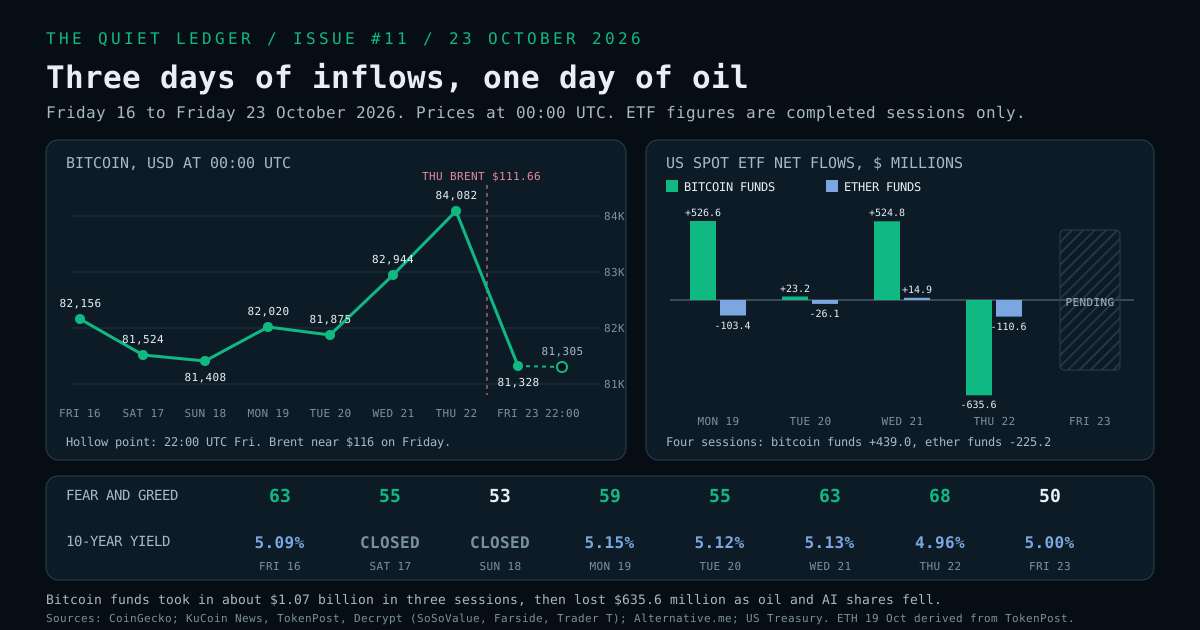
The takeaway: fund buyers returned for three sessions and left in one, and bitcoin finished within about one percent of where it began. Market coverage tied the selling to oil and doubts about AI spending, not to crypto's own news.
2. This Week in Headlines
The dollar on chains, in several legal forms
The OCC's final rule for the stablecoin issuers it supervises takes effect on 18 January 2027: redemption within two business days, at least 5 percent of reserves in cash and no automatic pause in a run, as our 22 October Daily Ledger explained. JPMorgan put its JPM Coin deposit token on Ethereum, still for approved institutional clients only.
Outside the US, HSBC launched RedCoin, a Hong Kong dollar stablecoin licensed by the HKMA, to more than 3.3 million users of its PayMe payments app. Singapore's central bank said the central banks of Malaysia and Thailand had joined its BLOOM initiative, which works on settling tokenised deposits and stablecoins across borders.
Who may serve whom
Bitget gave users in Russia, Belarus and Kazakhstan until 21 October to close positions and withdraw; our 18 October issue explains what such an exit means. In Kazakhstan, the financial regulator announced on Tuesday that the AIFC Court had ordered Google and Apple to restrict apps of six unlicensed platforms, Coinbase among them. Ireland's central bank fined Coinbase Ireland EUR 3,252,618 for leaving its customer safeguarding account underfunded for long periods; the High Court must still confirm it.
Switzerland's FINMA approved the country's first retail fund holding bitcoin directly; BIT Asset Management says its fund will list on SIX in November. In Washington, comments on the SEC's proposed token safe harbor closed on 20 October, and on Friday the SEC's examiners listed tokenisation among their 2027 priorities, which puts tokenised products in front of examiners, not only policymakers.
Protocols
Solana's Alpenglow consensus went live on Wednesday; its developer Anza says finality falls from 12.8 seconds to about 150 milliseconds, a claim not yet independently measured. Ethereum developers postponed Glamsterdam on the Hoodi test network after the auditor ChainSecurity found gas changes that could make some contract failures permanent. Bitcoin Core will now ship fixes quickly for bugs that AI tools can easily find, instead of holding them under embargo.
3. The Weekly Deep Dive: can stablecoins pay interest?
Not from the issuer. Section 4(a)(11) of the GENIUS Act bars any permitted or foreign issuer from paying holders "any form of interest or yield (whether in cash, tokens, or other consideration) solely in connection with the holding, use, or retention" of a payment stablecoin. The same Act says stablecoins are not federally insured and forbids claiming otherwise. The issuer keeps the income from its reserves; the holder gets a claim to one dollar.
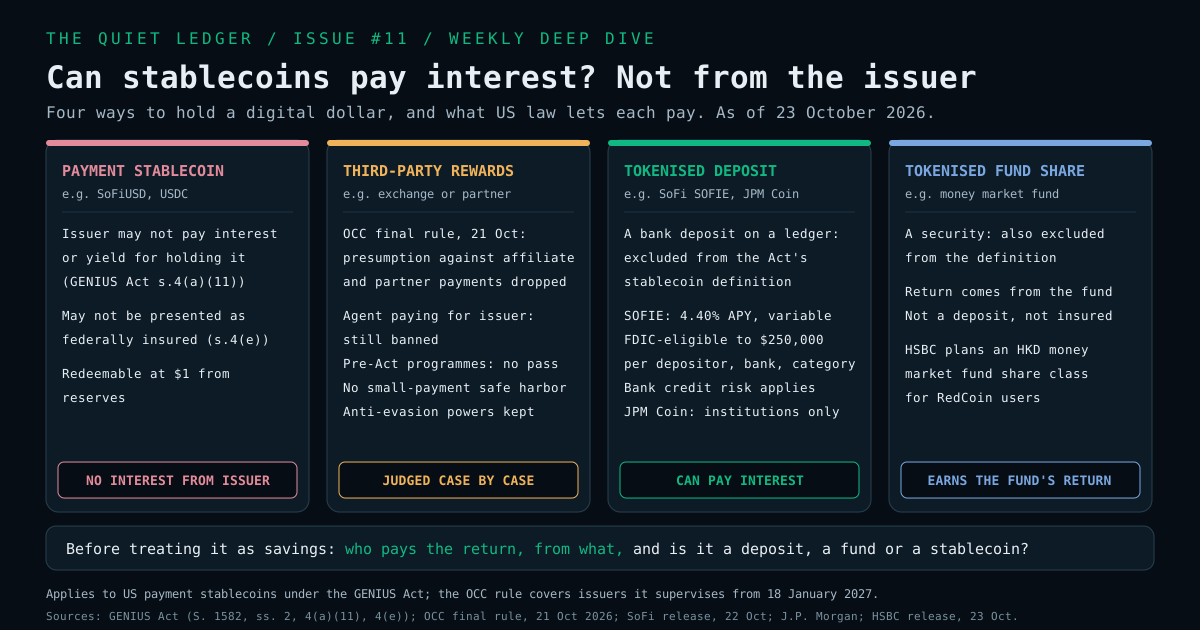
Where the stablecoin interest ban stops
The Act's definition of a payment stablecoin excludes a bank deposit, "including a deposit recorded using distributed ledger technology", and excludes securities. That leaves two doors open. A tokenised deposit is a bank deposit on a ledger and can pay interest: SoFi's SOFIE, launched on Thursday, pays a variable 4.40 percent, is eligible for FDIC insurance and, SoFi says, "is not a payment stablecoin". Holders can convert it one for one into SoFiUSD, SoFi's stablecoin, which is the version that moves to outside wallets and, as a stablecoin, is not insured. A tokenised money market fund share is a security that earns the fund's return; in Hong Kong, HSBC plans to let RedCoin users subscribe to a new share class of its money market fund.
Rewards paid by someone else
The grey zone is rewards from an exchange or partner rather than the issuer. The OCC had proposed to presume a breach whenever an issuer pays an affiliate or partner that in turn pays holders. Its final rule drops that presumption but warns that payments by an agent on the issuer's behalf remain banned, that rewards programmes predating the Act get no exemption, that there is no small-payment safe harbor, and that it keeps its anti-evasion powers. Payments for genuine services generally fall outside it; each case turns on its facts.
Limits and what you can check
The OCC rule covers only issuers it supervises, from 18 January 2027. Each form trades something away. A deposit token carries the bank's credit risk, is insured only up to $250,000 per depositor, per bank, per ownership category, and often cannot leave the bank's platform. A stablecoin pays holders nothing but is backed by segregated reserves, as our deposit token comparison sets out. A platform reward is that platform's promise and can change. Before treating any digital dollar as savings, check who pays the return, from what, and whether the product calls itself a deposit, a fund share or a stablecoin.
4. Security and Onchain Radar
This week's incidents show that one weak component is enough. On Friday Initia halted its chain and rollups at 15:41:30 UTC after a security incident. D2 Finance traced the attack: one transaction minted 2,000,000 AUSD with no backing, and 153 seconds later a valid cross-chain message released 1.4 million real AUSD from a bridge on Ethereum. With 105 ETH and 1.08 million USDC also taken, the haul became about 1,135.5 ETH, roughly $2.73 million. In D2's reading, the bridge could check that tokens were burned on Initia, not that they had ever been backed.
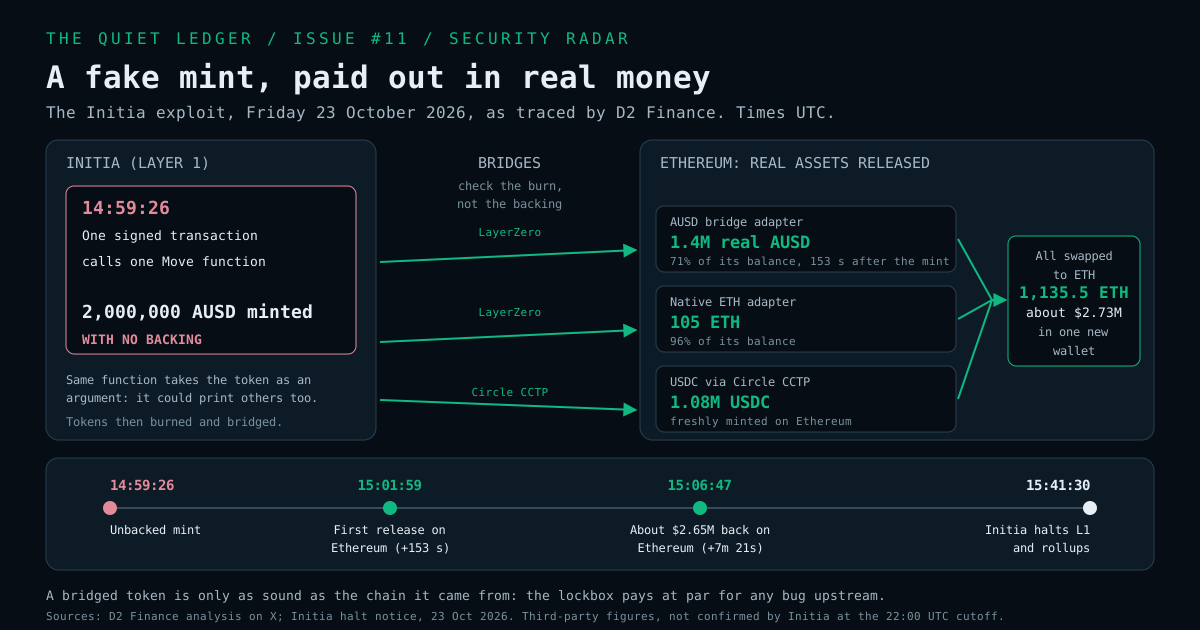
Confirmed: the halt. Not confirmed: the loss and the cause, which Initia had not stated at the cutoff. Overnight on 17 to 18 October, an attacker drained 1,404 Qubic wallets of about 2.94 trillion QU, roughly $1.3 million. Qubic's web wallet made seeds with a predictable random number generator, which SlowMist showed could be reconstructed. About 87.1 percent of the stolen QU is frozen on chain and the rest at MEXC; Qubic's claims site is open until 1 May 2027. The leaking Fearless Wallet extension, in our 22 October issue, is the same class of failure.
The rules:
- A recovery phrase made or exposed by faulty software stays unsafe after an update: move funds to a new one.
- A bridged token is only as sound as both chains and the bridge between them.
- Genuine recovery sites never ask for your recovery phrase or a fee.
- When a chain halts, trust only its official channels.
5. From the Academy Library
Reserves are covered in how stablecoins hold a dollar, and this week's exploit mechanics in cross-chain bridges explained. For a leaked recovery phrase, see the wallet security checklist; for the wider rulebook, our crypto tax and regulatory guide. New readers can start at Academy School.
Three useful, non-affiliate tools: the OCC's final rule text; the FDIC's BankFind, to confirm a bank is insured; and the HKMA's register of licensed stablecoin issuers.
Dates to keep
- 27 and 28 October: the Federal Reserve meets. Strategy's special stockholder meeting on its STRC dividend is on 28 October.
- 11 November: MSCI's final list of non-operating companies.
- 18 January 2027: the OCC's GENIUS Act rule takes effect.
- 1 May 2027: Qubic's claims window closes.
A dollar on a blockchain can be a deposit, a fund share or a stablecoin, and this week the rules for each grew clearer. The token can look identical in a wallet; the promise behind it, and whether it pays, is what differs.
Disclaimer: This publication is for education and information only. It is not financial, investment, legal, tax, or security advice.
Sources and further reading
Stablecoins, deposits and the interest ban
- GovInfo: GENIUS Act, enrolled bill text (S. 1582)
- OCC: final rule to implement the GENIUS Act, News Release 2026-92, 21 October 2026
- OCC: GENIUS Act final rule text, including the yield prohibition discussion (PDF)
- SoFi: SoFi Earn (SOFIE), a national bank-issued tokenized deposit for consumers, 22 October 2026
- Decrypt: SoFi launches a tokenized deposit that earns 4.4%
- J.P. Morgan: JPM Coin live on Ethereum, 19 October 2026
- HSBC: HSBC RedCoin launches today, 23 October 2026
- HKMA: register of licensed stablecoin issuers
- MAS: Bank Negara Malaysia and Bank of Thailand join BLOOM, 23 October 2026
- FDIC: BankFind
Regulation, exchanges and protocols
- Interfax: Bitget ends service in Russia, Kazakhstan and Belarus (Russian)
- Cointelegraph: Kazakhstan court limits Coinbase, BingX and four others
- Central Bank of Ireland: enforcement action against Coinbase Ireland, 22 October 2026
- FINMA: Switzerland's first Bitcoin ETF approved, 20 October 2026
- Cointelegraph: Switzerland's first retail spot Bitcoin ETF targets November launch
- SEC: Fiscal Year 2027 examination priorities, 23 October 2026
- Anza: Alpenglow is live on Solana, 21 October 2026
- Decrypt: Ethereum delays the Glamsterdam testnet fork over gas security flaws
- Decrypt: Bitcoin Core rewrites its security policy
- SEC EDGAR: Strategy Form 8-K on the STRC dividend and special meeting, 15 October 2026
Security
- Initia: network halted due to a security incident, 23 October 2026
- D2 Finance: analysis of the Initia exploit
- Cointelegraph: Initia halts its blockchain after an exploit
- Crypto Briefing: Qubic halts mainnet after a wallet drain empties 1,404 accounts
- Crypto Briefing: SlowMist traces the Qubic theft to weak randomness
- Qubic: fund reclaim site for the weak-seed incident
Markets and macro
- KuCoin News: bitcoin ETF flows, 19 October, 20 October and 21 October
- Decrypt: bitcoin ETFs bleed $636 million, 22 October session
- Cointelegraph: bitcoin ETFs lose $635 million as October flows turn negative
- TokenPost: ether ETF flows, 20 October and 21 and 22 October
- TokenPost: spot bitcoin ETF flows, 16 October and spot ether ETF flows, 16 October
- Decrypt: oil climbs above $111 as AI stocks slide
- Cointelegraph: Brent crude hits its highest level since March
- Cointelegraph: bitcoin consolidates after a 3% loss; liquidations
- US Treasury: daily par yield curve rates, 2026
- Federal Reserve: FOMC meeting calendar
- CoinGecko: daily price snapshots used in the charts above
- Alternative.me: Fear and Greed Index