
The Daily Ledger: 20 October 2026
Deposit Token vs Stablecoin: JPM Coin Comes to Ethereum
JPMorgan puts its JPM Coin deposit token on Ethereum: how a deposit token differs from a stablecoin. Plus $527 million into bitcoin ETFs, Mastercard's stablecoin screening and a fake airdrop alert.
THE DAILY LEDGER
20 October 2026
JPMorgan brings its JPM Coin deposit token to Ethereum, US spot bitcoin ETFs take in $527 million, and Revolut wins a Gibraltar crypto licence.
Reporting window: 19 October 2026, 06:00 UTC to 20 October, 06:00 UTC (08:00 Europe/Stockholm). Data cutoff: 20 October, 06:00 UTC. Prices are CoinGecko 00:00 UTC daily snapshots compared with the previous day's 00:00 UTC snapshot. This issue was added to the archive on 23 October 2026 and uses only information available at the cutoff.
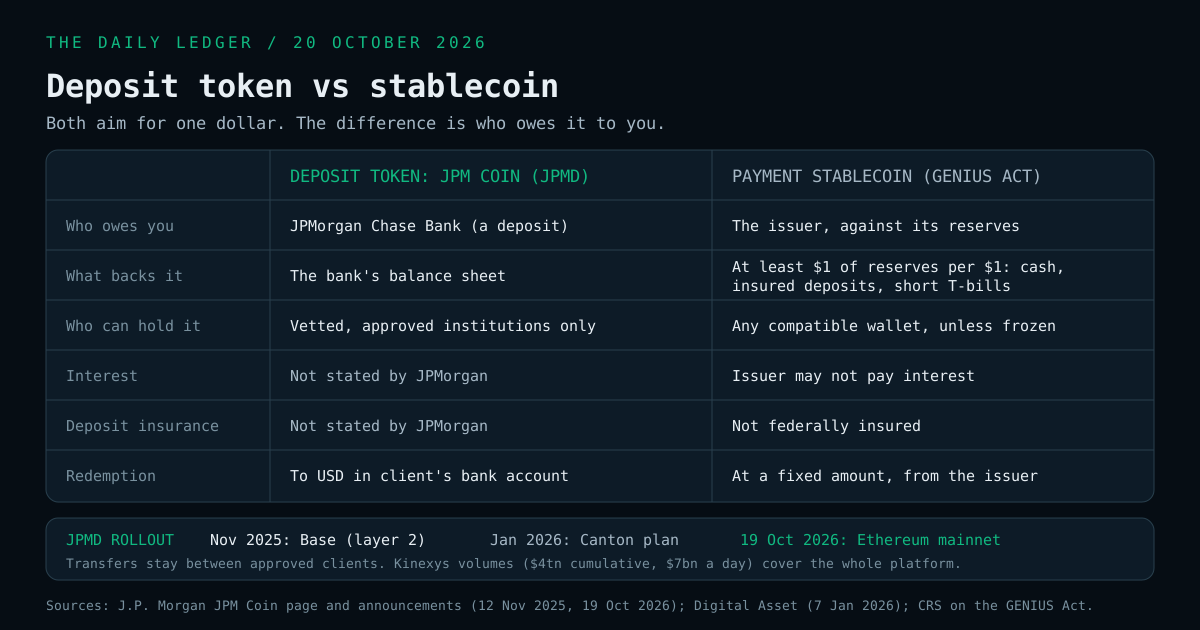
Deposit token vs stablecoin stopped being a theoretical comparison on 19 October, when JPMorgan's Kinexys unit put JPM Coin live on Ethereum's main network. The short answer: a deposit token is a bank deposit recorded on a blockchain, so the bank itself owes you the money, while a stablecoin is a claim on an issuer that holds a separate pool of reserves. Both aim for one dollar; the promise behind it differs.
1. The Day in Numbers
- Bitcoin: $81,875 at 00:00 UTC, down 0.2 percent against the previous day's 00:00 UTC snapshot of $82,020. CoinGecko daily data.
- Ether: $2,405.92 at 00:00 UTC, down 0.1 percent on the same basis.
- Fear and Greed: 55, Greed, down 4 points from 59. Alternative.me daily reading, 20 October, 00:00 UTC.
- US spot bitcoin ETFs, Monday 19 October: a net inflow of $526.6 million. BlackRock's IBIT took in $665.2 million, offsetting outflows from Fidelity and Grayscale funds, per Trader T data reported by TechFlow. Completed session.
2. Deposit token vs stablecoin: what is the difference?
JPMorgan's JPM Coin page describes the token (ticker JPMD) as a bank-issued deposit token, "not a cryptocurrency or a stablecoin", backed by dollar deposits held in J.P. Morgan accounts. Holding it is like holding a bank balance: you carry the bank's credit risk, and the money sits on its balance sheet. Only vetted, approved institutional clients can hold it, and they can redeem it for dollars at any time.
A US payment stablecoin is different. Under the GENIUS Act, the issuer must hold at least one dollar of permitted reserves, such as cash, insured bank deposits or short-dated Treasury bills, for every dollar issued, may not pay holders interest, and the tokens are not federally insured, as the Congressional Research Service summarises. Most dollar stablecoins move between any compatible wallet unless the issuer freezes an address.
JPMD has run on Base, Coinbase's layer 2, since November 2025. Still unknown is how much circulates on public chains: the $4 trillion cumulative and $7 billion daily volumes JPMorgan quotes cover all of Kinexys, not the token. Nor does JPMorgan say whether deposit insurance applies.
3. Today's Headlines
Mastercard screens stablecoin payments before they settle
At Money20/20 in Las Vegas, Mastercard unveiled Stablecoin Security, an API that scores a stablecoin payment for fraud, scam and sanctions risk before it settles. It launches in North America, with worldwide availability expected in 2027.
Revolut wins a Gibraltar crypto licence
The Gibraltar Financial Services Commission granted a Distributed Ledger Technology provider licence to Revolut Global Digital Assets, a new subsidiary for markets beyond the UK and the EEA. No countries or dates were named.
Strategy spends more on buybacks than on bitcoin
Strategy's filing on 19 October showed 267 BTC bought for $22.1 million from 12 to 18 October, taking holdings to 848,517 BTC, against $193.1 million spent buying back STRC preferred stock. Its buyback authorisation rose to $3 billion.
4. Security Note
Xaman_FDNT, an X account linked to the Xaman wallet's foundation, announced a live XRP Ledger airdrop and told users to claim tokens. Former Ripple CTO David Schwartz warned it was a compromised or scam account, and it was suspended within hours, DigitalToday reported early on 20 October. No cause was confirmed and no losses were reported. The rule: treat any "claim now" airdrop post as hostile until the project confirms it on a site you type in yourself, and never sign anything to claim free tokens; that signature is how wallet drainers work.
5. From the Academy Library
For the reserve side, read how stablecoins hold a dollar. Our 15 October issue shows how Europe now supervises USDC's reserves. New readers can start at Academy School.
A deposit token and a stablecoin can look identical in a wallet. The difference appears only when you ask who owes you the dollar, and what stands behind that promise.
Disclaimer: This publication is for education and information only. It is not financial, investment, legal, tax, or security advice.
Sources and further reading
- J.P. Morgan: Kinexys brings JPM Coin deposit token to Ethereum, 19 October 2026
- J.P. Morgan: JPM Coin product page and FAQ
- J.P. Morgan: JPM Coin available for institutional clients on Base, 12 November 2025
- Digital Asset and Kinexys: plan to bring JPMD to the Canton Network, 7 January 2026
- Ledger Insights: JPM Coin arrives on Ethereum
- Cointelegraph: JPMorgan expands JPM Coin to Ethereum for institutions
- Congressional Research Service: overview of the GENIUS Act of 2025
- Decrypt: Mastercard brings its fraud-fighting tools to stablecoin payments
- Cointelegraph: Revolut secures Gibraltar crypto licence
- SEC: Strategy Inc. Form 8-K, 19 October 2026
- DigitalToday: Xaman-linked account flagged as compromised or scam, suspended
- KuCoin News (TechFlow): spot bitcoin ETF flows, 19 October
- CoinGecko: bitcoin daily price snapshots
- CoinGecko: ether daily price snapshots
- Alternative.me: Fear and Greed Index history