
The Daily Ledger: 21 October 2026
When Does a Crypto Token Stop Being a Security? The SEC Safe Harbor
When does a crypto token stop being a security? The SEC's comment window on Regulation Crypto Assets closed on 20 October. Plus Switzerland's first retail bitcoin ETF, Utah sues Kalshi and Kazakhstan orders app-store blocks.
THE DAILY LEDGER
21 October 2026
The SEC's comment period on its crypto offering rules closes, Switzerland approves its first retail bitcoin ETF, and Utah sues Kalshi in state court.
Reporting window: 20 October 2026, 06:00 UTC to 21 October, 06:00 UTC (08:00 Europe/Stockholm). Data cutoff: 21 October, 06:00 UTC. Prices are CoinGecko 00:00 UTC daily snapshots compared with the previous day's 00:00 UTC snapshot. This issue was added to the archive on 23 October 2026 and uses only information available at the cutoff.
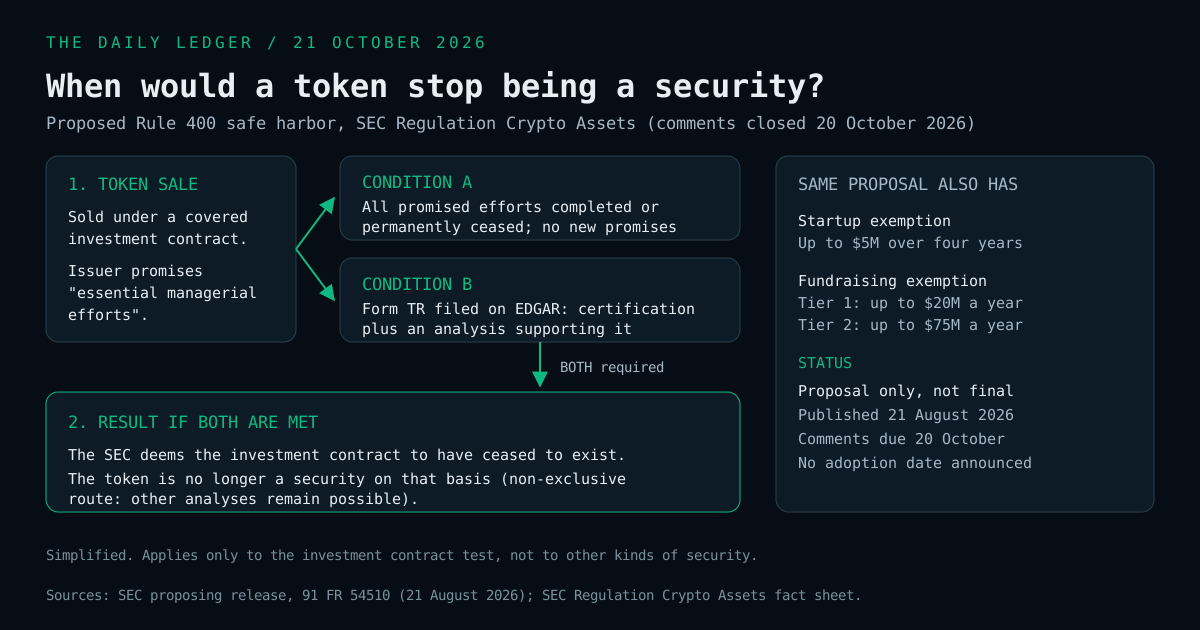
When does a crypto token stop being a security? Under the SEC's proposed Regulation Crypto Assets, when the issuer has finished or permanently abandoned the managerial work it promised buyers, and says so in a public filing. The comment period closed on Tuesday 20 October, with Coinbase and Uniswap Labs among the final-day filers. Nothing is final yet.
1. The Day in Numbers
- Bitcoin: $82,944 at 00:00 UTC, up 1.3 percent against the previous day's 00:00 UTC snapshot of $81,875. CoinGecko daily data.
- Ether: $2,446.49 at 00:00 UTC, up 1.7 percent on the same basis.
- Fear and Greed: 63, Greed, up 8 points from 55. Alternative.me daily reading, 21 October, 00:00 UTC.
- US spot ETFs, Tuesday 20 October: bitcoin funds took in a net $23.2 million and ether funds lost $26.1 million, per Coinomedia via KuCoin News (provider not named). Completed session.
2. When does a crypto token stop being a security?
US law treats many token sales as investment contracts: money put into a common enterprise expecting profit from someone else's efforts. The token is the subject of that contract, not the contract itself, so the question is when the promised efforts run out.
The proposal answers with Rule 400, a conditional safe harbor (a rule that guarantees an outcome if its conditions are met). According to the SEC's fact sheet, the issuer must have completed or permanently ceased all the essential managerial efforts it promised, and be making no new promises. It must also file a Form TR on EDGAR, the SEC's filing system, certifying this with a supporting analysis. The SEC would then treat the investment contract as ended, and the token would stop being a security on that basis.
The package also offers token-sale exemptions of up to $5 million over four years and up to $75 million a year. The safe harbor is non-exclusive, so other routes remain open. Unknown: how far the final text will change, and when.
3. Today's Headlines
Switzerland approves its first retail bitcoin ETF
FINMA approved the first exchange-traded fund open to retail investors that holds bitcoin directly. It waived the usual diversification rules, citing bitcoin's long trading history and high volume, and did not name the provider.
Utah sues Kalshi in state court
Attorney General Derek Brown sued Kalshi and affiliated companies in Utah's Third District Court, calling its event contracts illegal gambling and seeking restitution of up to $60 million. Kalshi says it is federally regulated.
Kazakhstan orders app stores to block six platforms
The Astana regulator AFSA announced court injunctions barring Coinbase, HTX, BingX and three others from unlicensed services in the Astana International Financial Centre, with Google and Apple required to restrict their apps.
Stablecoins keep moving after hours
A Coinbase-commissioned report by The Block Research put third-quarter stablecoin transfer activity at $891 billion, with 73 percent of screened volume outside US banking hours.
4. Security Note
Evergreen reminder: no new incident in this window met our sourcing standard. If these rules are adopted, promoters will quote their SEC filings. A filing is not an endorsement. In 2018 the SEC halted the Blockvest token sale, which falsely claimed SEC approval. The rule: treat "SEC approved" in a token pitch as a red flag, and find any filing on EDGAR yourself.
5. From the Academy Library
Our crypto tax and regulatory guide covers securities law, how to read tokenomics shows what a team still controls, and ETF creation and redemption explains how funds like Switzerland's work. New readers can start at Academy School.
A token's legal status may soon turn on what its issuer stops promising. The promises are worth reading.
Disclaimer: This publication is for education and information only. It is not financial, investment, legal, tax, or security advice.
Sources and further reading
- Federal Register: Regulation Crypto Assets, proposed rule, 21 August 2026 (comments due 20 October)
- SEC: Regulation Crypto Assets fact sheet
- SEC: press release 2026-76, 18 August 2026
- SEC: public comments on file S7-2026-27
- FINMA: first Bitcoin ETF approved, 20 October 2026
- ABC News 4: Utah Attorney General sues Kalshi, 20 October 2026
- AFSA: AIFC Court injunctions against unlicensed crypto platforms
- Cointelegraph: Kazakhstan court limits Coinbase, BingX and four others
- The Block Research for Coinbase: The Always-On Dollar
- Cointelegraph: stablecoins move $400M an hour
- SEC: emergency action halts Blockvest ICO, 11 October 2018
- KuCoin News (Coinomedia): spot ETF flows, 20 October
- CoinGecko: bitcoin daily price snapshots
- CoinGecko: ether daily price snapshots
- Alternative.me: Fear and Greed Index history