
The Daily Ledger: 22 October 2026
GENIUS Act Stablecoin Redemption Rules
The OCC finalises its GENIUS Act rule: stablecoin issuers must redeem within two business days and no longer get an automatic run pause. Plus Solana's Alpenglow and a Fearless Wallet key leak.
THE DAILY LEDGER
22 October 2026
The OCC finalises its GENIUS Act rule for stablecoin issuers, Solana replaces its consensus protocol, and bitcoin funds take in $525 million in a day.
Reporting window: 21 October 2026, 06:00 UTC to 22 October, 06:00 UTC (08:00 Europe/Stockholm). Data cutoff: 22 October, 06:00 UTC. Prices are CoinGecko 00:00 UTC daily snapshots compared with the previous day's 00:00 UTC snapshot. This issue was added to the archive on 23 October 2026 and uses only information available at the cutoff.
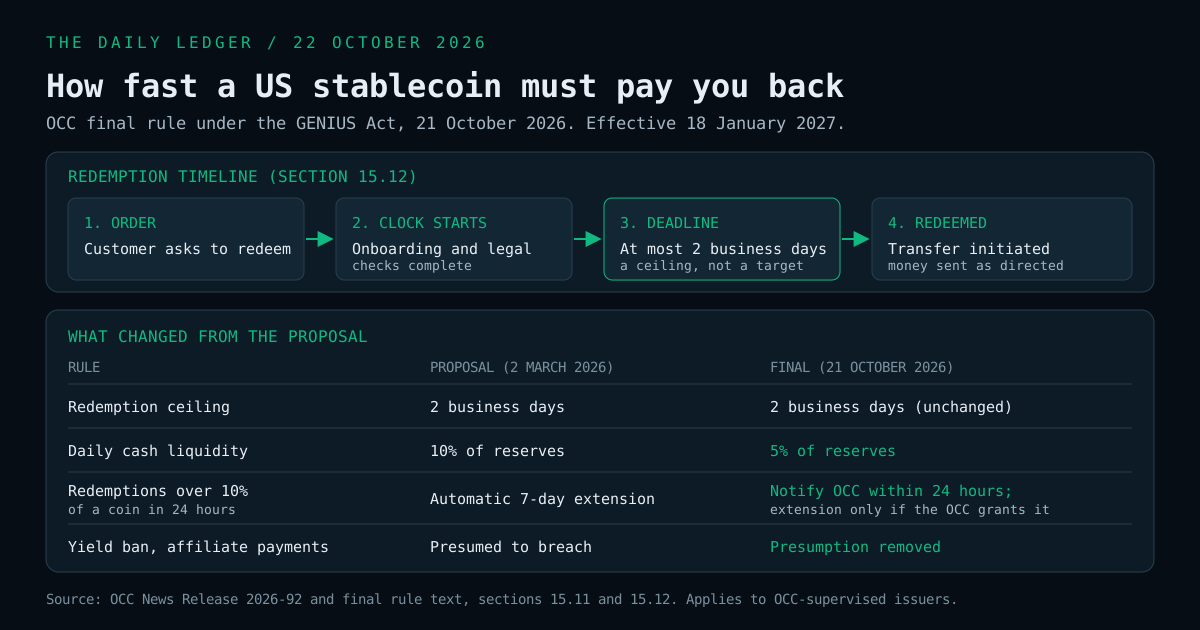
What are the GENIUS Act stablecoin redemption rules? Under the final rule the OCC issued on 21 October, an issuer it supervises must pay out within two business days, keep at least 5 percent of reserves in cash on demand, and tell the regulator within 24 hours if redemption requests top 10 percent of a coin in a day. A proposed automatic seven-day delay during runs was dropped. The rule takes effect on 18 January 2027.
1. The Day in Numbers
- Bitcoin: $84,082 at 00:00 UTC, up 1.4 percent against the previous day's 00:00 UTC snapshot of $82,944. CoinGecko daily data.
- Ether: $2,472.68 at 00:00 UTC, up 1.1 percent on the same basis.
- Fear and Greed: 68, Greed, up 5 points from 63. Alternative.me daily reading, 22 October, 00:00 UTC.
- US spot ETFs, Wednesday 21 October: bitcoin funds took in a net $524.8 million; ether funds added $14.9 million, per Farside data reported by MarsBit. Completed session.
2. GENIUS Act stablecoin redemption rules, explained
The GENIUS Act, signed in July 2025, left the detail to regulators. The OCC's rule covers the national banks, subsidiaries and nonbank federal issuers it supervises.
Under section 15.12 of the rule text, the clock starts once a customer has placed a redemption order and passed onboarding checks. Redemption counts once the issuer sends the money. Reserves must equal or exceed every coin outstanding, with a monthly composition report examined by an accounting firm.
The biggest change from the March proposal concerns runs. The draft would have stretched the deadline to seven calendar days automatically once redemptions passed 10 percent in 24 hours. Commenters warned that a known trigger could itself cause a run. The OCC agreed: an extension now needs a request and its approval, which it expects to be rare. It also cut daily cash liquidity from 10 percent to 5 percent and dropped a presumption that affiliate payments break the yield ban. Anti-money laundering rules are still to come.
3. Today's Headlines
Solana switches on Alpenglow
Solana's new consensus protocol went live at slot 459,653,000 at about 14:00 UTC, replacing TowerBFT. Anza, the developer, says finality falls from 12.8 seconds to about 150 milliseconds; no independent measurement existed at the cutoff.
Italy dismantles a "hidden bank" for organised crime
Italy's Guardia di Finanza arrested 30 people, alleging that about 68 million euros was laundered abroad through cryptocurrency and transfers. Arrests also took place in Spain and Switzerland; these are allegations, not convictions.
Bitcoin funds extend their inflow run
Wednesday's $524.8 million came after $527 million on Monday, the funds' biggest day since 22 September, as a rebound in technology shares lifted appetite for risk.
4. Security Note
On 21 October the Polkadot Community Foundation warned that versions 3.0.1, 3.0.3, 3.0.4 and 3.0.5 of the third-party Fearless Wallet browser extension sent users' private keys to an attacker's server on unlock, at times between February 2025 and 10 October 2026. Eight users have reported unauthorised transfers totalling 17,286 DOT that may be linked. The rule: a leaked key stays leaked. Reinstalling or changing the password does not help; create a new key elsewhere and move funds. Our wallet security checklist explains how to respond to leaked keys.
5. From the Academy Library
Our explainer on how stablecoins hold a dollar covers the reserves behind redemption, and the crypto tax and regulatory guide places the GENIUS Act in context. New readers can start at Academy School.
A stablecoin is a promise to pay a dollar back. The OCC has now set how fast that promise must be kept, without an automatic pause.
Disclaimer: This publication is for education and information only. It is not financial, investment, legal, tax, or security advice.
Sources and further reading
- OCC: final rule to implement the GENIUS Act, News Release 2026-92, 21 October 2026
- OCC: GENIUS Act final rule text (PDF)
- Anza: Alpenglow is live on Solana, 21 October 2026
- Open: Guardia di Finanza uncovers organised crime "hidden bank" (Italian)
- Polkadot Community Foundation: Fearless Wallet browser extension security notice
- The Motley Fool: Bitcoin rebounds on tech rally, 21 October
- KuCoin News (MarsBit): spot ETF flows, 21 October
- CoinGecko: bitcoin daily price snapshots
- CoinGecko: ether daily price snapshots
- Alternative.me: Fear and Greed Index history