
The Daily Ledger: 18 October 2026
What Happens When a Crypto Exchange Stops Serving Your Country
Bitget gives users in Russia, Belarus and Kazakhstan until 21 October to close positions and withdraw. What happens when a crypto exchange stops serving your country, plus the IMF's Bangkok meeting and the Fed's blackout.
THE DAILY LEDGER
18 October 2026
Bitget sets exit deadlines for users in Russia, Belarus and Kazakhstan, IMF members back a digital finance blueprint in Bangkok, and the Fed goes quiet before its 27 and 28 October meeting.
Reporting window: 17 October 2026, 06:00 UTC to 18 October, 06:00 UTC (08:00 Europe/Stockholm). Data cutoff: 18 October, 06:00 UTC, one hour before Bitget's trading restriction was due to begin. Prices are CoinGecko 00:00 UTC daily snapshots compared with the previous day's 00:00 UTC snapshot; ETF figures cover the completed Friday 16 October session. This issue was added to the archive on 23 October 2026 and uses only information available at the cutoff.
What happens when a crypto exchange stops serving your country? Usually a staged wind-down: the exchange amends its terms, new trading stops, and a deadline follows for closing positions and withdrawing. On Saturday, Bitget's exit from Russia, Belarus and Kazakhstan showed how short that runway can be.
1. The Day in Numbers
- Bitcoin: $81,408 at 00:00 UTC, down 0.1 percent against the previous day's 00:00 UTC snapshot of $81,524. CoinGecko daily data.
- Ether: $2,400.31 at 00:00 UTC, down 0.8 percent on the same basis.
- Fear and Greed: 53, Neutral, down 2 points from 55. Alternative.me daily reading, 18 October, 00:00 UTC.
- Bitcoin trading volume: $14.2 billion in the 24 hours to 00:00 UTC, half the previous day's $28.3 billion. CoinGecko's rolling estimate; weekend trading is usually thin.
- US spot ETFs, Friday 16 October: bitcoin funds saw a net outflow of $82.4 million, mostly IBIT, per SoSoValue data, and ether funds $69.7 million. Completed session.
2. What happens when a crypto exchange stops serving your country?
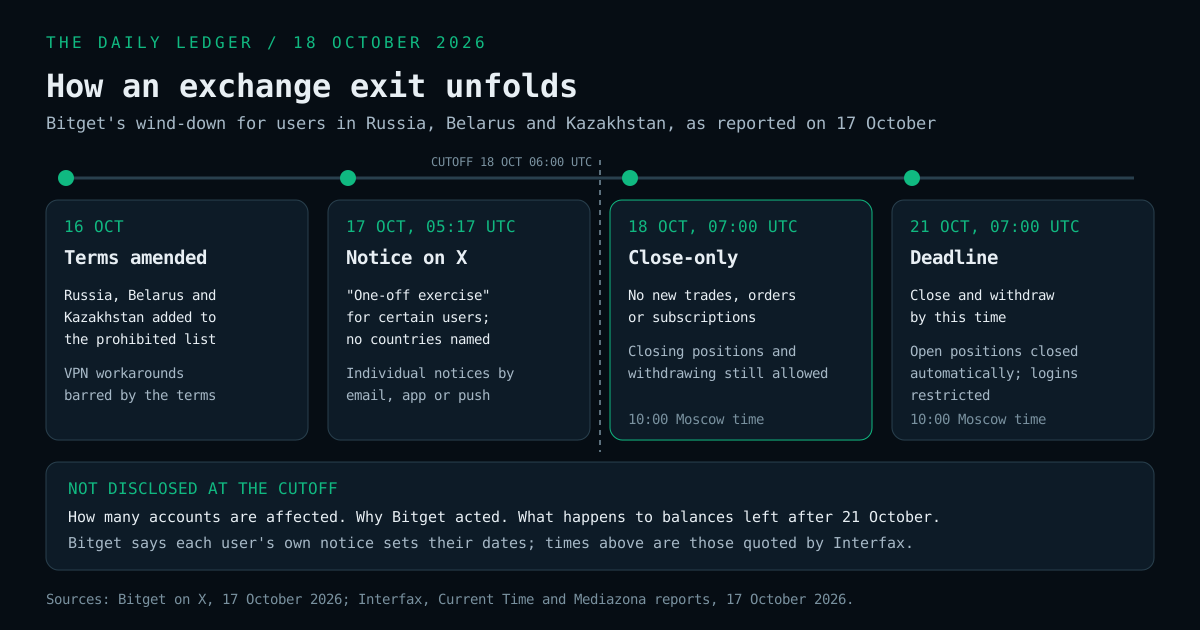
Bitget's terms of use, amended on 16 October, add Russia, Belarus and Kazakhstan to its prohibited jurisdictions, Interfax reported on Saturday morning. At 05:17 UTC Bitget said on X that it would discontinue services for certain users as "a one-off exercise", without naming countries; affected users get individual notices.
The notices quoted by Interfax follow the usual sequence. From 10:00 Moscow time on 18 October (07:00 UTC), affected users cannot open trades, place orders or subscribe to products, but can still close positions and withdraw. By 10:00 Moscow time on 21 October they must close every position and withdraw their assets. After that, open positions are closed automatically and logins are restricted. The terms also bar using a VPN to evade the ban, Mediazona noted.
The coins are not seized. But an automatic closure fills at whatever price the market offers, and a balance left behind becomes a support case rather than a withdrawal. Bitget has not said how many accounts are affected, why, or what happens to assets left after 21 October. Current Time notes that Bitget had stayed in Russia after rivals such as Binance left.
3. Today's Headlines
IMF members welcome a "Bangkok Blueprint"
At the IMF's steering committee in Bangkok on Saturday, chair Minister Aljadaan of Saudi Arabia said members welcome the Bangkok Blueprint "to help strengthen digital finance safeguards", along with cyber resilience and international efforts against digital fraud, according to the chair's statement. It does not mention crypto or stablecoins.
The Fed goes quiet before its meeting
The Federal Reserve's blackout period for its 27 and 28 October meeting runs from Saturday 17 October to Thursday 29 October. Under the Fed's communications policy, officials largely stop public comment on policy from the second Saturday before a meeting until the day after it.
A token burn on Tron
Lending protocol JustLend DAO said on Saturday it had burned 170,723,144 JST on 16 October, its fifth buyback and burn. Burned tokens go to an address nobody controls; supply shrinks, but the protocol's earnings do not change.
4. Security Note
An evergreen reminder, prompted by the lead story. Bitget's own post warned of phishing links and impersonation accounts. Exits are what scammers imitate: "withdraw before Wednesday" sounds routine when a real deadline exists. The rule: never act on a link in an email, text or direct message. Open the app or a bookmarked address yourself and find the notice there; support never needs your recovery phrase or two-factor code. Send a small test amount before moving the rest. Our cold storage guide covers the destination.
5. From the Academy Library
An orderly exit is not a failure: compare what happens when an exchange goes bankrupt, and our 13 October letter on regulators blocking offshore exchanges. New readers can start at Academy School.
An exchange balance is a claim on someone else's books, and the operator decides where it does business. Plan the exit route before a deadline arrives.
Disclaimer: This publication is for education and information only. It is not financial, investment, legal, tax, or security advice.
Sources and further reading
- Bitget on X: discontinuing services for certain users, 17 October 2026
- Interfax: Bitget restricts users from Russia, Kazakhstan and Belarus, 17 October 2026 (Russian)
- Current Time: Bitget stops working with Russia, Belarus and Kazakhstan, 17 October 2026 (Russian)
- Mediazona: Bitget bans operations for users from Russia, Belarus and Kazakhstan, 17 October 2026 (Russian)
- Mirage News: IMFC Chair's Statement, 54th meeting (IMF press release 26/340), 17 October 2026
- Federal Reserve Bank of St. Louis: FOMC blackout periods
- Federal Reserve: FOMC blackout calendar and policy wording (PDF)
- JustLend DAO on X: fifth JST buyback and burn completed, 17 October 2026
- TokenPost, SoSoValue data: spot bitcoin ETF flows, 16 October
- Crypto Briefing: bitcoin and ether ETF outflows, 16 October
- CoinGecko: bitcoin daily price and volume snapshots
- CoinGecko: ether daily price snapshots
- Alternative.me: Fear and Greed Index history