
The Daily Ledger: 7 November 2026
Are Social Login Crypto Wallets Safe?
Are social login crypto wallets safe? Keplr paused Google and Apple login after unauthorized transactions on some accounts, as Web3Auth paused its embedded wallet service. Plus Treasury moves to cut off MEXC and Zcash's NU7 goes live.
THE DAILY LEDGER
7 November 2026
Keplr pauses Google and Apple login after unauthorized transactions, the US Treasury moves to cut MEXC off from American banks, and Russia opens bitcoin purchases to ordinary investors from 17 November.
Reporting window: 5 November 2026, 19:31 UTC to 7 November, 09:18 UTC (10:18 Europe/Stockholm, CET). There was no Friday issue, so the window spans two days. Data cutoff: 7 November, 09:18 UTC. Prices are live CoinGecko readings at the cutoff.
Are social login crypto wallets safe? They are built so no single company holds your whole key, but they add parties you must trust: your Google or Apple account, and the service that unlocks part of your key when you sign in. That second link has just had a security incident. On 7 November Keplr reported unauthorized transactions on some accounts created with Google or Apple login and paused both options.
1. The Day in Numbers
- Bitcoin: $76,099 at 09:17 UTC, flat (down 0.03 percent) over 24 hours. CoinGecko.
- Ether: $2,246.02 at 09:17 UTC, up 0.2 percent over 24 hours. CoinGecko.
- Fear and Greed: 25, Extreme Fear, down from 28 a day earlier and 50 on Thursday. Alternative.me, 7 November, 00:00 UTC.
- US spot bitcoin ETFs, Friday 6 November: a net outflow of $411.9 million, $403 million of it from BlackRock's IBIT, per Farside data reported by crypto.news; the week's outflow was $1.28 billion. Completed session; early totals can be revised. There is no session this weekend.
2. Are social login crypto wallets safe? What Keplr's pause shows
A social login wallet, also called a seedless or embedded wallet, replaces the recovery phrase with a sign-in. Keplr's Google login runs through Web3Auth, its help centre says. Web3Auth, now sold as MetaMask Embedded Wallets, documents the design: the private key is split into shares, and in a typical setup any two of three rebuild it. Your Google or Apple login unlocks one share through Web3Auth's node network, one sits on your device and one is a backup. The app sets the threshold.
By the documentation, neither Google nor Web3Auth can rebuild your key alone. In practice your safety rests on your login account, the provider's network and the app's configuration. A recovery phrase removes those dependencies and puts the whole burden on you.
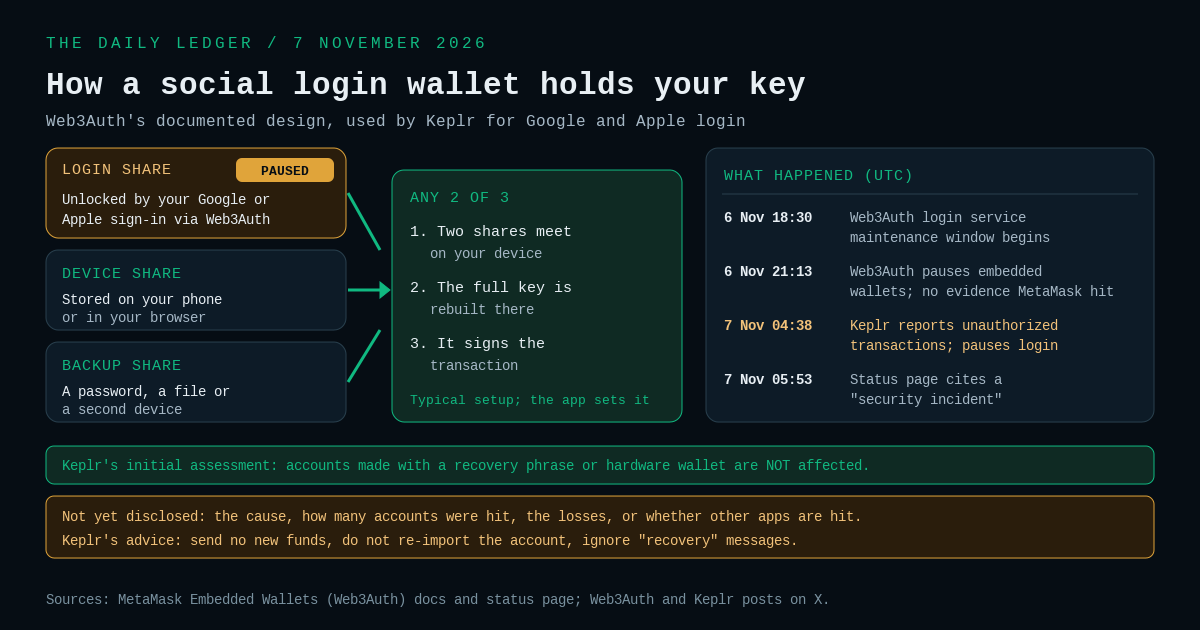
Web3Auth's status page lists its login service in maintenance from 18:30 UTC on 6 November "due to a security incident". At 21:13 UTC Web3Auth said it had paused the embedded wallet service and found no evidence that MetaMask users were affected. On its initial assessment, Keplr says accounts made with a recovery phrase or hardware wallet are not affected. Still unknown: the cause, how many accounts were hit, the losses and whether other apps are exposed. Keplr's advice: send no new funds, do not re-import the account and trust only updates from its official account.
3. Today's Headlines
Treasury moves to cut MEXC off from US banks
FinCEN issued an order barring US financial institutions from any transfer of funds to or from MEXC Global. Treasury says the exchange facilitated at least $16 billion in illicit transactions from May 2021 to May 2026, including about $1.5 billion tied to Russian sanctions evasion. The order takes effect 30 days after it appears in the Federal Register.
Russia: ordinary investors can buy bitcoin from 17 November
The Bank of Russia named bitcoin, ether and USDT as the only cryptocurrencies non-qualified investors may buy, capped at 300,000 rubles a year per intermediary and only after a knowledge test.
Zcash's NU7 is live; Polygon's fork is undecided
NU7 activated at block 3,543,405 at 02:34 UTC on 6 November, matching ZIP 259. Blocks have since averaged about 26 seconds, down from a 75-second target, Blockchair data show. Polygon's recovery fork thread has had no new posts since 5 November and no governance outcome has been posted; our 5 November issue explains the proposal.
4. Security Note
Bitquery traced at least $4.06 million in USDT drained from 365 TRON addresses between 5 October and 4 November. Its totals are floors, and it tied only one theft to an iPhone. Trust Wallet warned on 6 November that the DarkSword and Coruna exploit kits target iPhones on older iOS versions and hunt for recovery phrases saved in photos and notes. The rule: install the latest iOS your device supports, or turn on Lockdown Mode if you cannot, and never keep a recovery phrase or private key in a screenshot or notes app.
5. From the Academy Library
Our lexicon entry on MPC wallets explains how key shares work together, and the cold storage guide covers the hardware wallet route Keplr says was unaffected. New readers can start at Academy School.
A wallet without a recovery phrase still has a key. What changes is who helps you reach it, and what happens when they stop.
Disclaimer: This publication is for education and information only. It is not financial, investment, legal, tax, or security advice.
Sources and further reading
- Keplr on X: unauthorized transactions on Google and Apple login accounts, 7 November 2026
- Web3Auth on X: embedded wallet service paused, 6 November 2026
- Web3Auth status page: login service maintenance
- MetaMask Embedded Wallets (formerly Web3Auth): infrastructure and key shares
- Keplr help centre: view your private key
- US Treasury: Operation Economic Outcast severs MEXC Global's access to the US financial system
- FinCEN: section 9714 order on MEXC Global
- Bank of Russia: cryptocurrency for non-qualified investors, 6 November 2026 (Russian)
- Blockchair: Zcash block 3,543,405
- Blockchair: Zcash network statistics
- ZIP 259: NU7 deployment
- Polygon forum: recovery of funds held in blocked addresses
- Bitquery: iPhone wallet drains of TRON USDT
- Trust Wallet: update iOS to protect your wallet, 6 November 2026
- crypto.news: bitcoin and ether ETFs lose $1.65 billion in a week
- CoinGecko: bitcoin and ether prices
- Alternative.me: Fear and Greed Index