
The Daily Ledger: 5 November 2026
Can a Hard Fork Recover Stolen Crypto?
Can a hard fork recover stolen crypto? Polygon weighs rewriting five blocked balances to return 70.49 million POL to Binance and Polymarket. Plus bitcoin follows a Nasdaq rout below $76,000 and the Bank of England raises rates to 4 percent.
THE DAILY LEDGER
5 November 2026
Polygon weighs a hard fork to hand 70 million blocked POL back to Binance and Polymarket, bitcoin follows a Nasdaq rout below $76,000, and the Bank of England raises Bank Rate to 4 percent.
Reporting window: 4 November 2026, 06:00 UTC to 5 November, 19:31 UTC (20:31 Europe/Stockholm, CET). Data cutoff: 5 November, 19:31 UTC. Prices are live CoinGecko readings at the cutoff.
Can a hard fork recover stolen crypto? Yes, but only if nearly everyone who runs the network agrees to change its rules, which is why it is rare. On 4 November a Polygon Labs contributor proposed one: a single change that would empty five blocked attacker addresses holding about 70.49 million POL and credit the same amounts to Binance and Polymarket.
1. The Day in Numbers
- Bitcoin: $75,949 at 19:31 UTC, down 5.3 percent over 24 hours. CoinGecko.
- Ether: $2,248.13 at 19:31 UTC, down 7.2 percent over 24 hours. CoinGecko.
- Fear and Greed: 50, Neutral, up from 34 (Fear). Alternative.me, 5 November, 00:00 UTC, before Thursday's selloff.
- US spot bitcoin ETFs, Wednesday 4 November: a net inflow of $74.6 million after three days of outflows, per Farside data reported by LiveBitcoinNews. Completed session; early totals can be revised. Thursday's session is still open.
- Liquidations: more than $1 billion of leveraged positions, mostly bets on rising prices, closed in the 24 hours to 16:43 UTC, per CoinGlass data cited by CoinDesk. A rolling figure, not a daily close.
2. How a hard fork to recover stolen crypto would work
On 29 and 30 October, stolen POL (the token that pays fees on Polygon PoS) reached five addresses after separate incidents at Polymarket and Binance. Polygon's four block producers put those addresses on a block list, so their transactions are refused. That stops the money but cannot return it: under normal rules, only a private key moves a balance.
A hard fork changes the rules, and every node must run the new software. Under the draft, at an activation block called F, before any transaction runs, each listed balance is set to zero and credited to a recovery address: about 46.63 million POL to Binance and 23.86 million to Polymarket, each after proving control. No POL is created or burned. A public Polygon node still showed all 70.49 million POL in place at the cutoff, most of it at the attacker address holding POL taken from Binance: about $6.6 million.
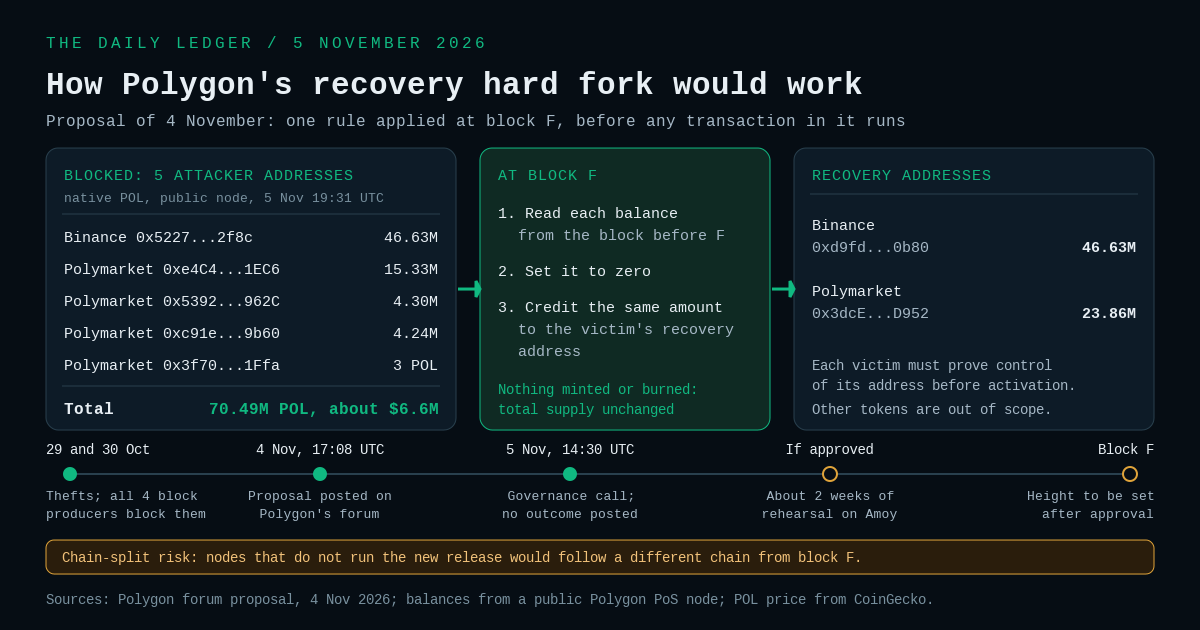
Nodes that do not upgrade would follow a different chain from block F, and its authors call it "an extreme action that should not be reproduced commonly." The first forum objection asked how Polygon could refuse a court order once it had reassigned a balance. That is the difference from a stablecoin address freeze, which an issuer runs from its own contract. It was on the agenda of Polygon's governance call at 14:30 UTC on 5 November; no outcome had been posted by the cutoff. The same day an unrelated Polygon fork, Uburu, activated at block 96,787,900, and nodes on older software stopped following the chain.
3. Today's Headlines
Bitcoin follows the Nasdaq lower
A chip-led selloff had the Nasdaq down 5.2 percent at 19:09 UTC, and bitcoin fell from above $80,000 to just under $76,000, CoinDesk's live coverage shows. CME FedWatch odds of a December Fed hike fell to 69 percent.
United Kingdom: the Bank of England raises rates
The Monetary Policy Committee raised Bank Rate to 4 percent by 8 votes to 1, with Catherine Mann wanting half a point. UK inflation was 3.5 percent in September.
Zcash's NU7 upgrade is hours away
At 19:30 UTC Zcash was at block 3,543,073, 332 short of NU7's activation height, or about 02:30 UTC on Friday at the recent pace. NU7 cuts the target time between blocks from 75 to 25 seconds, so confirmations arrive about three times faster. It also invalidates all version 4 transactions, so one saved or signed offline beforehand must be rebuilt. Our 25 October issue covered Sprout funds.
4. Security Note
No new incident was documented in this window; this is a reminder prompted by the proposal. Any fork would credit only two recovery addresses, held by Binance and Polymarket, and Polymarket says it has already refunded 95 percent of affected wallets with no claims required. The rule: treat any offer of "recovered POL", a fork airdrop or a wallet "upgrade" for the fork as a scam. Only validators, exchanges and node operators would need to upgrade.
5. From the Academy Library
Our blockchain architecture guide explains how validators and node software agree on one chain. New readers can start at Academy School.
A block list can stop stolen funds. Only a change to the rules can return them, and that change is precedent as much as code.
Disclaimer: This publication is for education and information only. It is not financial, investment, legal, tax, or security advice.
Sources and further reading
- Polygon forum: PIP proposal, recovery of funds held in blocked addresses, 4 November 2026
- Polygonscan: blocked attacker address holding POL taken from Binance, 0x5227...2f8c
- Polygonscan: largest blocked attacker address holding POL taken from Polymarket, 0xe4C4...1EC6
- Polygon forum: PPGC-47 governance call agenda, 5 November 2026
- GitHub: Bor v2.11.0 release and the Uburu hard fork
- Polymarket: security incident post-mortem, 29 October 2026
- CoinDesk: live updates as bitcoin falls with the Nasdaq, 5 November 2026
- LiveBitcoinNews: US spot bitcoin ETFs flip to $74.6M inflows as FBTC leads
- Bank of England: Monetary Policy Summary, November 2026
- ZIP 259: NU7 deployment
- Blockchair: Zcash network statistics
- CoinGecko: bitcoin and ether prices
- CoinGecko: POL price
- Alternative.me: Fear and Greed Index