
The Daily Ledger: 22 November 2026
Why Did Bitcoin Crash on One Exchange but Not Others?
Bitcoin traded at C$24,250 on Kraken's Canadian dollar market while the world price held near $57,000: why one exchange's book can crash alone. Plus a two-year low and Chainflip halts after a vault drain.
THE DAILY LEDGER
22 November 2026
Kraken's Canadian dollar markets break away from the world price and Kraken says the trades stand, bitcoin touches a two-year low before recovering, and Chainflip halts after its Ethereum vault is drained.
Reporting window: 21 November 2026, 06:00 UTC to 22 November, 06:00 UTC (07:00 Europe/Stockholm, CET). Data cutoff: 22 November, 06:00 UTC. Prices are CoinGecko 00:00 UTC daily snapshots compared with the previous day's 00:00 UTC snapshot. This issue was added to the archive on 28 November 2026 and uses only information available at the cutoff.
Why did bitcoin crash on one exchange but not others? Because a price is only the last trade in one order book, and on Kraken's Canadian dollar market the buyers ran out. Bitcoin traded at C$24,250 there at 08:00 UTC on 21 November, about $17,000 and roughly 70 percent below the world price. Kraken says every order executed correctly and the trades stand.
1. The Day in Numbers
- Bitcoin: $60,121 at 00:00 UTC, up 2.2 percent against the previous day's 00:00 UTC snapshot of $58,818. CoinGecko daily data.
- Ether: $1,682.85 at 00:00 UTC, up 3.9 percent on the same basis. CoinGecko daily data.
- Fear and Greed: 11, Extreme Fear, down 1 point from 12. Alternative.me daily reading, 22 November, 00:00 UTC.
- Liquidations: about $1.8 billion of leveraged positions were forcibly closed over 24 hours, $1.3 billion of them bets on rising prices, per CoinGlass data cited by CoinDesk on Saturday afternoon. A rolling figure.
2. Why did bitcoin crash on one exchange but not others?
Each trading pair has its own order book: resting offers to buy (bids) and to sell. A market order fills against whatever bids are there, and a stop-loss becomes a market order once its trigger is hit. In a deep book that costs a little slippage. In a thin one, each sale eats down through the bids until it finds someone willing to pay far less. The C$24,250 trade was exactly that: a market sell.
Kraken says heavy selling hit its Canadian dollar pairs from about 20:00 UTC on 20 November. Its public data show the whole Canadian dollar complex moved, not just bitcoin. Ether fell from about C$2,300 to C$796, and Kraken's own US dollar to Canadian dollar pair from about 1.43 to 0.56. Divide bitcoin's C$32,000 at 08:00 UTC by 0.555 and you get about US$57,640, close to Kraken's US dollar price. Inside Kraken, Canadian dollars had become scarce; bitcoin had not become cheap. Kraken's US dollar market never went below $55,100.
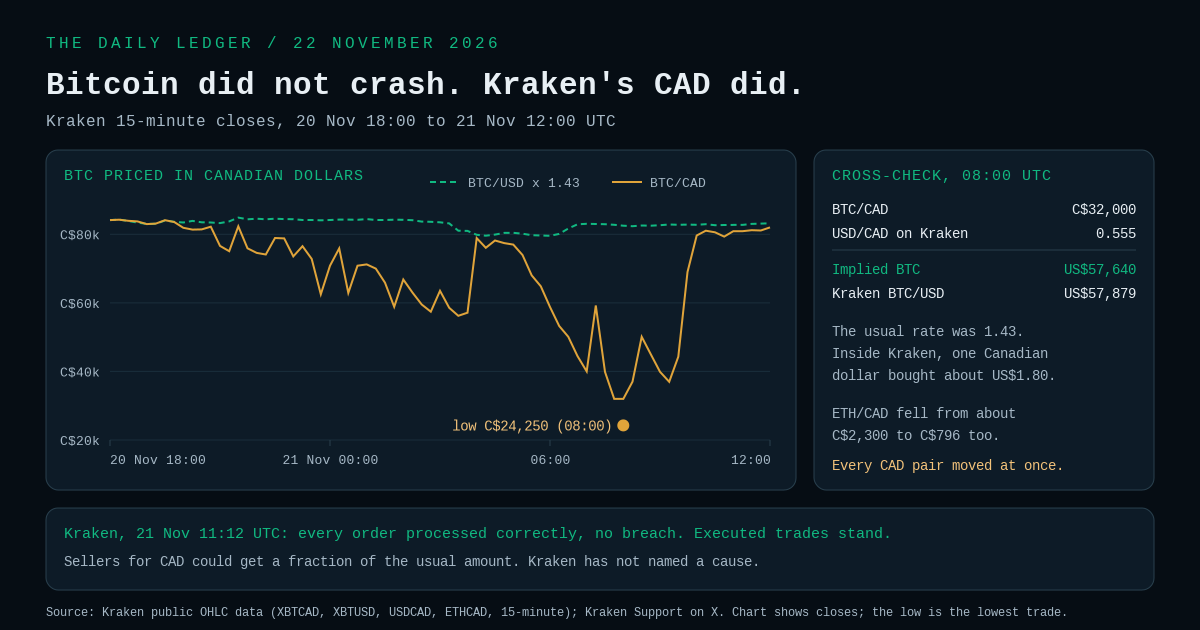
Arbitrage would normally close a gap like this, but it needs fresh Canadian dollars, and those arrive through the banking system, slower than trading and on a weekend. That is our reading, not Kraken's: Kraken found no breach, will not reverse trades and has not named a cause. Its data show volume jumping to about 18 to 27 bitcoin, with a sharp drop, in the first quarter hour of every hour from 19:00 to 03:00 UTC. Who was selling, and how many stop-losses fired, is unknown.
3. Today's Headlines
Bitcoin touches a two-year low, then recovers
Bitcoin fell to $55,130 early on Saturday, its weakest since September 2024, then climbed back above $60,000 after a Friday in which the Nasdaq fell more than 4 percent, CoinDesk reported.
An ether treasury firm's Aave loan draws attention
BTCS's 8-K of 19 November puts its Aave debt at about $54 million and says it "can provide no assurance" that "a liquidation will not occur." CoinDesk estimated on 21 November that the position becomes liquidatable near $1,450 per ether if unchanged.
South Korea: Upbit and Bithumb freeze CYBER transfers
At 16:13 UTC, 5,213,000 CYBER were minted on Solana and the same amount left the token's Ethereum bridge two minutes later, The Block reported. Both Korean exchanges suspended CYBER deposits and withdrawals, and Cyber asked users to avoid the bridge.
4. Security Note
At 07:10 UTC on 21 November one transaction took 520.22 ETH, about 3.25 million USDC and 758,000 USDT, roughly $4.86 million, from Chainflip's Ethereum vault. Onchain Lens says it carried a valid signature from the vault's signing key, and the funds went to Tornado Cash. At 09:14 UTC Chainflip disabled deposits, withdrawals, swaps and quoting. It had published no cause or total by the cutoff. The rule: when a swap service halts, send nothing to its deposit addresses and ignore anyone offering refunds or "recovery" outside its own channels.
5. From the Academy Library
Read how crypto market makers are paid to see who normally fills a thin book, and our beginner's guide to crypto trading on market, limit and stop orders. New readers can start at Academy School.
A price on a screen describes one book at one moment. The thinner the book, the less it says about the asset.
Disclaimer: This publication is for education and information only. It is not financial, investment, legal, tax, or security advice.
Sources and further reading
- Kraken Support on X: CAD pairs statement, 21 November 2026
- Kraken public trades: BTC/CAD from 08:00 UTC, 21 November
- Kraken public trades: ETH/CAD from 08:00 UTC, 21 November
- Kraken public trades: USD/CAD from 07:45 UTC, 21 November
- Kraken public trades: BTC/USD from 06:16 UTC, 21 November
- CoinDesk: bitcoin bounces 9 percent from a two-year low, 21 November 2026
- BTCS Inc.: Form 8-K, 19 November 2026
- CoinDesk: BTCS warns its Aave loan could be liquidated, 21 November 2026
- The Block: Cyber investigating suspected bridge exploit as Upbit and Bithumb freeze transfers
- Cyber on X: CYBER bridge update, 21 November 2026
- Onchain Lens on X: Chainflip Ethereum vault drained, 21 November 2026
- Chainflip on X: protocol in full safe mode, 21 November 2026
- CoinGecko: bitcoin daily price snapshots
- CoinGecko: ether daily price snapshots
- Alternative.me: Fear and Greed Index history