
The Daily Ledger: 21 November 2026
Can States Ban Prediction Markets Like Kalshi?
A federal judge refused the CFTC's bid to stop New York pursuing Kalshi, as appeals courts split on whether states can ban prediction markets. Plus Hong Kong's crypto dealer and custodian bill and more coinjoin mixing of Binance theft proceeds.
THE DAILY LEDGER
21 November 2026
A federal judge lets New York pursue Kalshi, Hong Kong publishes a bill to license crypto dealers and custodians, and Binance theft proceeds move through coinjoin mixers.
Reporting window: 20 November 2026, 06:00 UTC to 21 November, 06:00 UTC (07:00 Europe/Stockholm). Data cutoff: 21 November, 06:00 UTC. Prices are CoinGecko 00:00 UTC daily snapshots compared with the previous day's 00:00 UTC snapshot. This issue was added to the archive on 28 November 2026 and uses only information available at the cutoff.
Can states ban prediction markets like Kalshi? No court has given a final answer, but on 20 November a federal judge in Manhattan refused the CFTC's emergency request to stop New York's attorney general from pursuing Kalshi, and most federal appeals courts that have ruled so far have let states enforce their gambling laws.
1. The Day in Numbers
- Bitcoin: $58,818 at 00:00 UTC, down 5.0 percent against the previous day's 00:00 UTC snapshot of $61,921. Selling continued after the snapshot: the hourly reading at 05:00 UTC was $56,229. CoinGecko data.
- Ether: $1,619.51 at 00:00 UTC, down 7.8 percent from $1,755.59 on the same basis. CoinGecko daily data.
- Fear and Greed: 12, Extreme Fear, unchanged from 12. Alternative.me daily reading, 21 November, 00:00 UTC.
- US spot bitcoin ETFs: net outflows of $582.2 million on Thursday 19 November, the third straight outflow day, taking November to about $3.47 billion out, per SoSoValue data reported by The Block. Friday's session is not included, and totals can be revised.
2. Can states ban prediction markets like Kalshi?
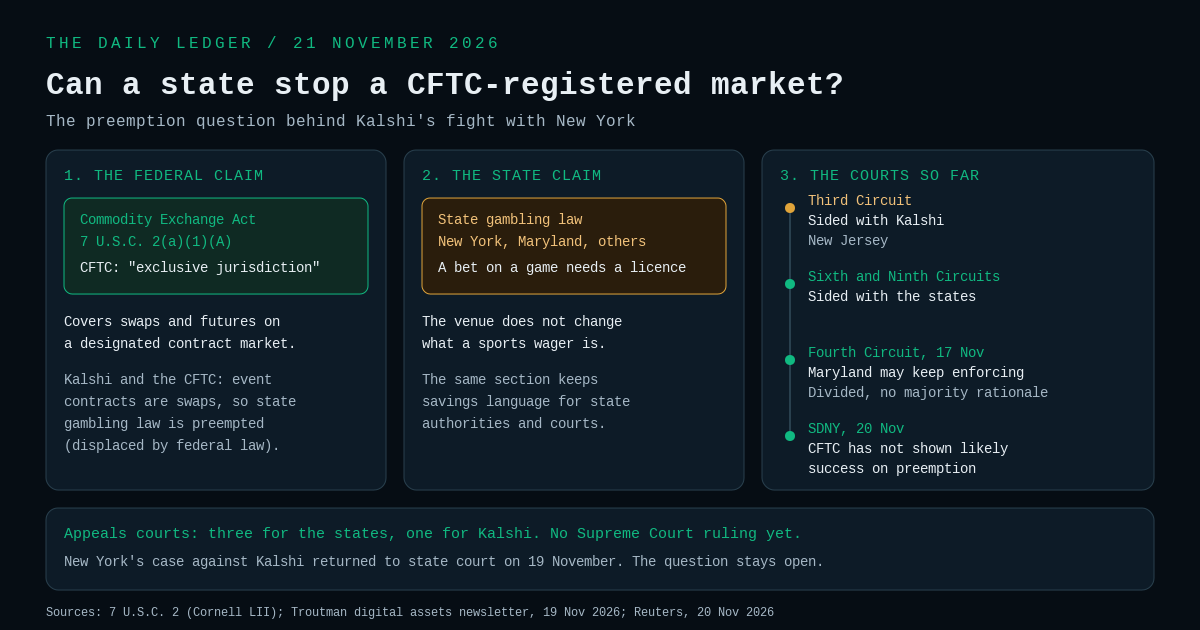
New York Attorney General Letitia James sued Kalshi on 31 July, arguing it needed a state Gaming Commission licence to offer contracts on sports, elections and other events. Kalshi is a CFTC-registered exchange, and the CFTC treats those contracts as swaps. The Commodity Exchange Act gives the CFTC "exclusive jurisdiction" over swaps and futures traded on such exchanges. If that covers event contracts, state gambling law is preempted, meaning federal law displaces it. States reply that a bet on a game is a wager wherever it is placed, and point to savings language in the same section that preserves state authority.
On 19 November Judge Vernon Broderick sent New York's lawsuit back to state court. The CFTC asked for an emergency hearing, and Judge Lorna Schofield ruled that it had "not established a likelihood of success on the merits," Reuters reported.
The appeals courts are split. The Sixth and Ninth Circuits found no preemption and the Third sided with Kalshi, Troutman notes. On 17 November a divided Fourth Circuit let Maryland keep enforcing, with no majority reasoning. Still unknown: what the state court does next, and whether the Supreme Court takes the question.
3. Today's Headlines
Hong Kong publishes its crypto dealer and custodian bill
Hong Kong gazetted a bill (issued 17:15 Hong Kong time) requiring anyone offering virtual asset dealing, advisory, management or custody services to be licensed by or registered with the Securities and Futures Commission. Banks would also need to register. First reading is on 2 December; no start date is set.
House bill targets insider trading on prediction markets
Representatives Sean Casten and Ted Lieu introduced a bill for a Justice Department programme that would let people report prediction-market fraud anonymously. It has not passed either chamber.
ECB opens Appia tokenisation work to industry groups
The Eurosystem invited market participants to work on tokenised deposits, tokenised securities and shared network governance. Only groups of firms may apply, by 11 December.
ARK drops a crypto index ETF
ARK asked the SEC to withdraw the registration for its ARK CoinDesk 20 Crypto ETF, saying it does not intend to proceed. No shares were sold.
4. Security Note
Elliptic says at least 2,310 BTC (about $149 million) from the Binance theft has gone through coinjoins, roughly 90 percent of it since Tuesday, The Block reported. A coinjoin merges many users' coins into one transaction so outputs are hard to match to inputs. Elliptic counts $2.85 billion already frozen. The rule: never buy bitcoin from a stranger at a discount, and never let an unknown party move funds through your exchange account. Laundered coins have to land somewhere, and that account is the one that gets questioned.
5. From the Academy Library
Our letter Are prediction markets regulated as swaps? covers the classification behind this fight, and the crypto tax and regulatory guide maps who regulates what. On tracing stolen coins, see can stolen crypto be traced and recovered. New readers can start at Academy School.
Two federal courts in two days have left Kalshi to answer to New York's gambling law. The deeper question, who regulates a bet that looks like a swap, is still waiting for one answer.
Disclaimer: This publication is for education and information only. It is not financial, investment, legal, tax, or security advice.
Sources and further reading
- Reuters, via Yahoo Finance: US judge rejects CFTC emergency bid to block New York from policing Kalshi, 20 November 2026
- Cornell LII: 7 U.S.C. 2, jurisdiction of the Commission
- Troutman: digital assets and blockchain newsletter, 19 November 2026
- Hong Kong Government: Virtual Asset Services Legislation (Amendment) Bill 2026 gazetted
- The Block: Rep. Casten seeks to curb prediction market insider trading
- ECB: Eurosystem invites market participants to join Appia analytical and practical work
- SEC EDGAR: ARK CoinDesk 20 Crypto ETF, Form RW, 20 November 2026
- The Block: Binance hack laundering ramps up as $149 million in bitcoin is mixed
- The Block: US spot bitcoin ETFs see $582 million in daily net outflows
- CoinGecko: bitcoin price data
- CoinGecko: ether daily price data
- Alternative.me: Fear and Greed Index