
The Daily Ledger: 15 November 2026
Why Near-Empty DeFi Lending Markets Get Exploited
An attacker shrank Kava Lend's dormant BUSD market to dust, inflated collateral about 243,000-fold and borrowed 55.2 million KAVA. Plus a second $1 billion week of bitcoin ETF outflows and Unocoin's $200,000 admission.
THE DAILY LEDGER
15 November 2026
A near-empty BUSD market lets an attacker drain Kava Lend, bitcoin ETFs lose more than $1 billion for a second week, and India's Unocoin admits a $200,000 loss.
Reporting window: 14 November 2026, 06:00 UTC to 15 November, 06:00 UTC (07:00 Europe/Stockholm, CET). Data cutoff: 15 November, 06:00 UTC. Prices are CoinGecko 00:00 UTC daily snapshots compared with the previous day's 00:00 UTC snapshot. The Kava Lend attack began at 04:01 UTC on 14 November, before the window opened; Kava's first public acknowledgement came at 11:28 UTC, inside it. Times from US sources are converted from Eastern Time (UTC minus 5). This issue was added to the archive on 28 November 2026 and uses only information available at the cutoff.
Why do near-empty DeFi lending markets get exploited? Because interest maths that is harmless in a busy pool can break when almost nothing is left in it. On 14 November an attacker shrank Kava Lend's dormant BUSD market to dust and borrowed about 55.2 million KAVA, worth about $3.76 million before the attack, The Block reported.
1. The Day in Numbers
- Bitcoin: $64,120 at 00:00 UTC, down 6.1 percent from the previous day's 00:00 UTC snapshot of $68,314. CoinGecko daily data.
- Ether: $1,768.45 at 00:00 UTC, down 8.5 percent on the same basis. CoinGecko daily data.
- Fear and Greed: 10, Extreme Fear, down 3 points from 13. Alternative.me daily reading, 15 November, 00:00 UTC.
- US spot bitcoin ETFs, week to 13 November: net outflows of $1.07 billion, per The Block's analysis of SoSoValue data. Daily totals can be revised.
2. Why near-empty DeFi lending markets get exploited
A lending market tracks what depositors are owed with an index, a running multiplier. When interest accrues, Kava Lend raises the index by the interest borrowers paid divided by the market's net supply: cash plus loans minus reserves. In a busy market that divisor is large, so the index creeps up in tiny steps.
BUSD is a stablecoin Paxos stopped minting in February 2023, and its Kava Lend market was nearly empty. At 04:01 UTC the attacker used a small BUSD loan to push net supply to two hundred-millionths of a dollar. Kava's source code skips the division only when supply is exactly zero. A tiny positive number passed, and within three minutes every BUSD deposit was revalued about 243,000-fold. The attacker's own BUSD counted as roughly 1.25 billion BUSD of collateral.
It then borrowed KAVA 127 times, using a second account to clear each loan and stay under the borrowing cap. The pool fell from about 55.33 million KAVA to 0.19 KAVA. So one forgotten market emptied a different one: KAVA depositors paid for a BUSD bug, because collateral counts across the whole protocol.
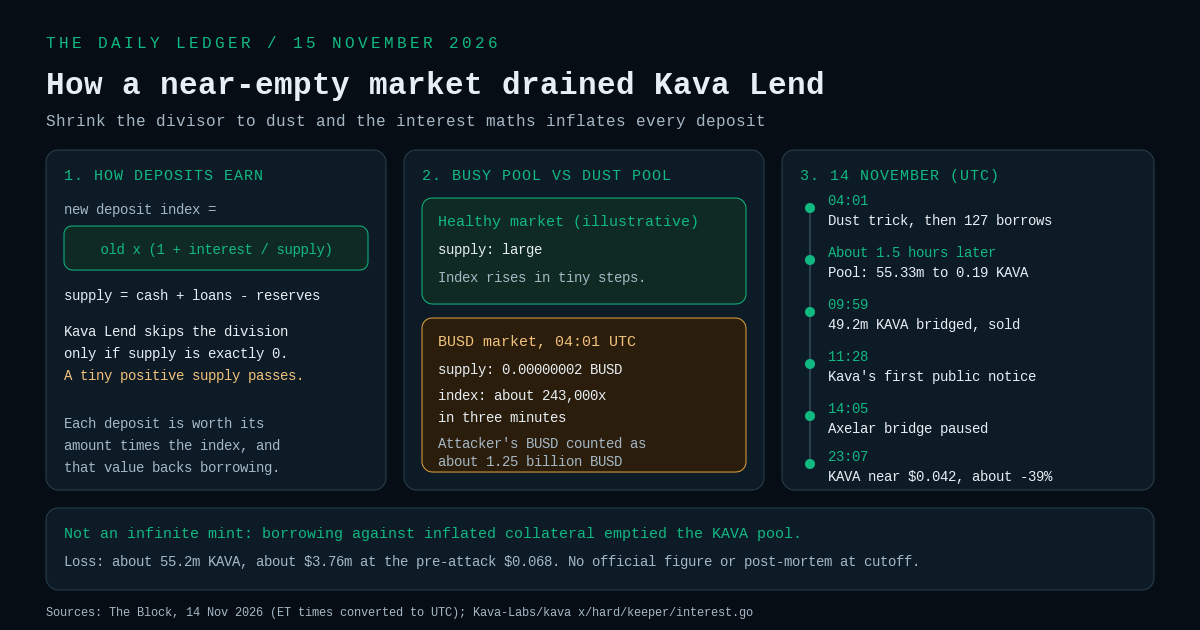
From 09:59 UTC about 49.2 million KAVA crossed to BNB Chain and most was sold for about $2.09 million. At 11:28 UTC Kava said it was tracking unexpected activity in its ecosystem, later said it was "not an infinite mint" confined to Kava Lend, and paused its Axelar bridge at 14:05 UTC. KAVA fell about 39 percent to near $0.042. Still unknown: an official loss figure, a post-mortem, and whether depositors will be repaid.
3. Today's Headlines
Bitcoin ETFs lose $1 billion for a second week
The $1.07 billion weekly outflow followed $1.28 billion the week before, with seven straight outflow days since 5 November, The Block found. Spot ether funds lost $398.9 million, a seventh negative week.
India: rupee withdrawals stuck at Coinbase India
Coinbase India told users rupee withdrawals remain unavailable because its unnamed banking partner's payouts are down for all clients, while UPI deposits still work, Business Today reported. ZebPay reported banking-partner delays on 11 November.
Louisiana hits back at the CFTC
Attorney General Liz Murrill called CFTC chair Michael Selig an "obsequious standard bearer" for prediction markets, The Block reported, after the CFTC sued the state over a state court order against 31 entities tied to Kalshi, Polymarket and others. Louisiana is the 12th state the agency has sued.
4. Security Note
Unocoin said on 14 November that about $200,000 left three of its more than 20 hot wallets, reversing its 9 November assurance that nothing was lost, Bitcoin.com News noted. The transfers used Unocoin's own keys, including encrypted backups printed on paper about eight years ago. Unocoin will cover the loss and warns that emails, home addresses, encrypted passwords, balances and KYC details may be exposed. The rule: after any exchange data leak, treat every call or message "from" that exchange as suspect, never share a password, one-time code or recovery phrase, and contact support only through an address you type yourself.
5. From the Academy Library
Our DeFi guide explains how lending pools work, the lexicon contrasts this bug with oracle manipulation and asks whether an audit means a contract is safe, and the exploit tracker logs incidents like this one. The 14 November issue covers Unocoin's keys. New readers can start at Academy School.
An empty market is not a harmless one. If a protocol still accepts an asset as collateral, its quietest pool is part of everyone's risk.
Disclaimer: This publication is for education and information only. It is not financial, investment, legal, tax, or security advice.
Sources and further reading
- The Block: Kava Lend loses roughly $3.8 million to hack, 14 November 2026
- Kava Labs: Kava Lend (x/hard) interest code
- The Block: Paxos will no longer issue BUSD, 13 February 2023
- The Block (SoSoValue data): bitcoin ETFs lose $1 billion for a second week, 14 November 2026
- Business Today: Coinbase halts INR withdrawals in India amid banking outage, 14 November 2026
- The Block: Louisiana AG responds to CFTC chair, 14 November 2026
- CFTC release 9326-26: CFTC sues Louisiana, 13 November 2026
- Unocoin: security incident update, 14 November 2026
- Bitcoin.com News: Unocoin admits $200K crypto loss, 14 November 2026
- CoinGecko: bitcoin daily price snapshots
- CoinGecko: ether daily price snapshots
- Alternative.me: Fear and Greed Index history