
The Daily Ledger: 14 November 2026
How Does 2-of-3 Multisig Custody Work? Unocoin and BitGo
BitGo says the ETH that left Unocoin's wallets was signed with Unocoin's own user and backup keys: how 2-of-3 multisig custody works. Plus the CFTC sues Louisiana and Trezor confirms implanted wallets.
THE DAILY LEDGER
14 November 2026
BitGo says the ETH that left Unocoin's wallets was signed with the two keys Unocoin holds, the CFTC sues Louisiana over prediction markets, and Trezor confirms implanted wallets from a former reseller.
Reporting window: 13 November 2026, 06:00 UTC to 14 November, 06:00 UTC (07:00 Europe/Stockholm). Data cutoff: 14 November, 06:00 UTC. Prices are CoinGecko 00:00 UTC daily snapshots compared with the previous day's 00:00 UTC snapshot. This issue was added to the archive on 28 November 2026 and uses only information available at the cutoff.
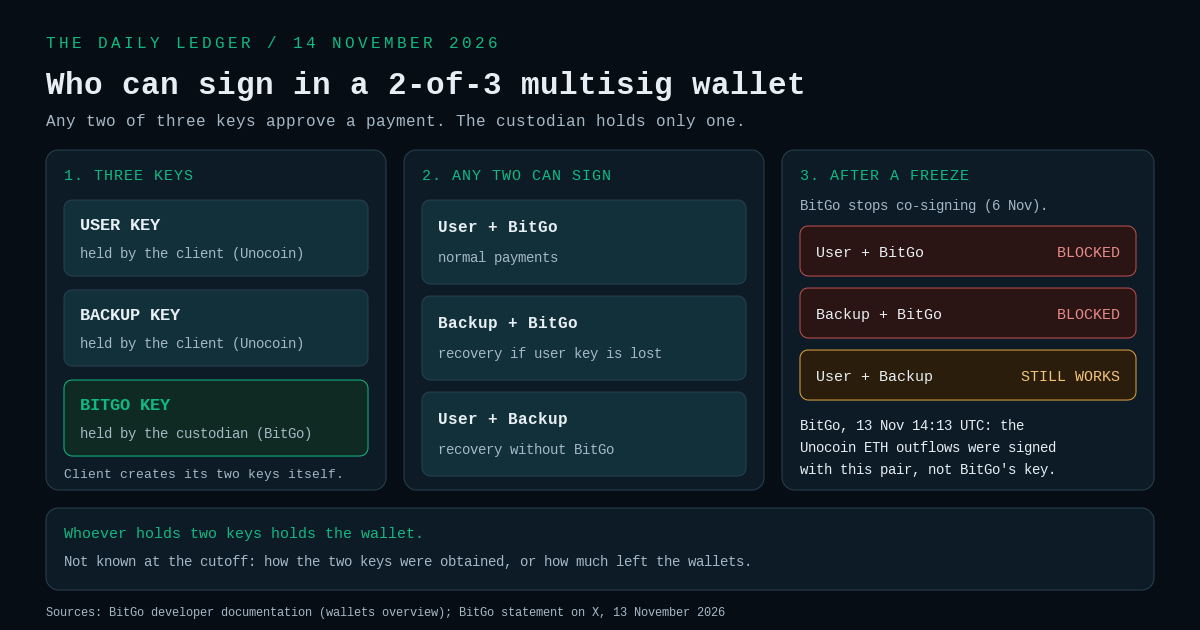
How does 2-of-3 multisig custody work? A wallet has three keys, any two of which can approve a payment, and the custodian usually holds only one. That is why BitGo could say on 13 November that it was not breached even though ETH left the Indian exchange Unocoin's BitGo wallets: according to BitGo, the transactions were signed with the two keys Unocoin holds.
1. The Day in Numbers
- Bitcoin: $68,314 at 00:00 UTC, down 4.3 percent against the previous day's 00:00 UTC snapshot of $71,372. CoinGecko daily data.
- Ether: $1,932.28 at 00:00 UTC, down 4.2 percent from $2,017.35 on the same basis. CoinGecko daily data.
- Fear and Greed: 13, Extreme Fear, down 7 points from 20. Alternative.me daily reading, 14 November, 00:00 UTC.
- Window low: bitcoin's lowest hourly CoinGecko reading was $66,691 at 04:00 UTC on 14 November, a sample rather than a true intraday low.
2. How 2-of-3 multisig custody works
BitGo's developer documentation gives every wallet three keys: a user key, a backup key and a BitGo key. Normal transactions are signed with the user key and BitGo's key, and the backup key can stand in for either. In a self-custody wallet the client creates the user and backup keys itself, and BitGo "never has access" to them. The design is for resilience: losing one key, or BitGo, does not lock the funds.
Unocoin met the cost of that design. It asked BitGo to freeze its account on 6 November after spotting unauthorised activity, and suspended customer logins on 9 November. A freeze means BitGo stops co-signing, so it blocks only the pairs that need BitGo's key. On 12 November Unocoin flagged outgoing ETH transactions. At 14:13 UTC on 13 November BitGo said they were "signed using the user and backup keys held by Unocoin" and broadcast "without BitGo's participation", and that the freeze "functioned as intended". Whoever holds two keys holds the wallet.
Still unknown: how those keys were obtained and how much left. Unocoin says more than 90 percent of customer crypto is in cold storage and that no funds were lost, but also that it lacks "complete visibility" into its BitGo wallets, The Block reported.
3. Today's Headlines
The CFTC sues Louisiana
The CFTC sued Louisiana on 13 November, its 12th suit against a state, after a state court order halted more than 30 firms tied to CFTC-regulated event contracts. Chairman Michael Selig called the state's case "naked lawfare".
Kraken's parent trades less, earns more than last quarter
Payward reported third-quarter transaction volume of $353 billion, down 30 percent on a year earlier, and adjusted EBITDA of $60 million, up from $23 million in the second quarter. Its spot market share nearly doubled, to 6.5 percent in September.
United Kingdom, Singapore and Thailand: synchronised FX settlement
The Bank of England, the Monetary Authority of Singapore and the Bank of Thailand completed a trial in which a Partior-built coordinating layer makes linked payments in two currencies settle together or not at all. It is a prototype; the Bank of England plans a live synchronisation interface in 2028.
United Kingdom: crypto and the FATF review
A RUSI taskforce report says "the UK's crypto challenge is enforcement" ahead of its next anti-money-laundering evaluation by the FATF, the global standard setter. Decrypt reports that assessors visit in June 2027, before the UK crypto regime takes effect on 25 October 2027.
4. Security Note
On 12 November Trezor confirmed implants in three Safe 5 devices bought from CryptoBilis, its former Southeast Asian reseller, between 20 August and 23 September 2026. An extra board behind the screen copied recovery words and passphrases and sent them out over the mobile network. Firmware 2.13.1, released on 11 November, blocks the implants found so far but cannot protect a phrase already captured. Trezor has cut about 80 percent of its reseller network; 48 CryptoBilis buyers have come forward and none has reported losses, BleepingComputer reported. The rule: buy a hardware wallet from its maker, and if yours came from CryptoBilis, move funds to a new wallet with a new recovery phrase.
5. From the Academy Library
Read Custody Without Slogans, how MPC wallets differ from multisig, and how to spot a counterfeit hardware wallet. New readers can start at Academy School.
A custodian's freeze reaches only the key it holds. Count the keys, then ask who holds each one.
Disclaimer: This publication is for education and information only. It is not financial, investment, legal, tax, or security advice.
Sources and further reading
- BitGo: statement on Unocoin, 13 November 2026
- BitGo developer documentation: wallets overview
- The Block: Unocoin flags outgoing BitGo ETH transactions
- CFTC: CFTC sues Louisiana, 13 November 2026
- Payward: Q3 2026 financial highlights
- Bank of England, MAS and Bank of Thailand: Project Meridian FX APAC
- RUSI: UK FATF Mutual Evaluation Taskforce, third meeting report
- Decrypt: crypto laundering a material risk for the UK ahead of FATF review
- Trezor: our CryptoBilis investigation, 12 November 2026
- BleepingComputer: Trezor confirms crypto-stealing implants in three wallets
- CoinGecko: bitcoin daily price snapshots
- CoinGecko: ether daily price snapshots
- Alternative.me: Fear and Greed Index history