
The Quiet Ledger · Independent analysis
The Quiet Ledger: Issue #4 | 4 September 2026
Bitcoin holds near $79K as completed-session ETF inflows stay positive, a strong jobs report shifts rate expectations, and Cronos turns blockchain finality into a practical risk question.
From: Ledgers Academy (newsletter@ledgersacadamy.com)
Subject: Jobs, ETF demand, and what a chain rollback really changes
Preview: Bitcoin holds near $79K, Friday fund flows remain pending, and Cronos turns finality into a practical risk question.
THE QUIET LEDGER
Issue #4 | Week of 29 August to 4 September 2026
A strong jobs report, selective fund demand, and the limits of reversing a blockchain after an exploit
Bitcoin ends the week slightly lower, Ether falls further, and sentiment remains firmly in Greed. That calm summary hides a busy sequence: a sharp short squeeze, a strong US jobs report, a major chain rollback, and several steps toward tokenized markets. The week was less about one dominant narrative than about where financial systems draw their boundaries.
1. The Macro Pulse
Bitcoin: $78,814, down 0.5 percent over seven days
Ethereum: $2,439, down 2.5 percent over seven days
Fear and Greed Index: 74, Greed, up from 73 one week earlier
Spot ETF Flows
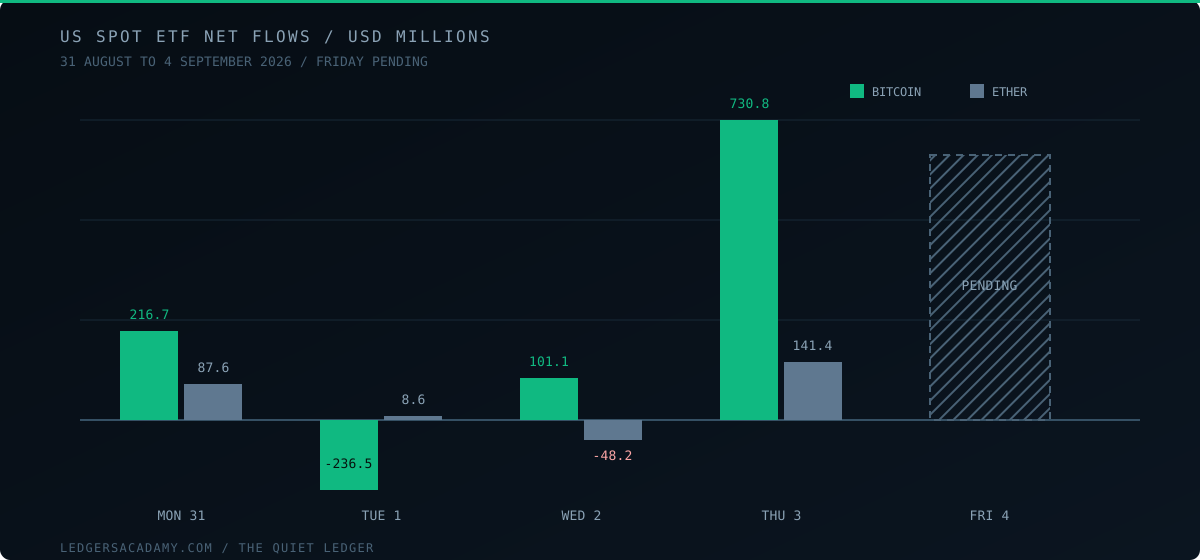
- US spot Bitcoin ETFs added $812.1 million across the four completed sessions from Monday through Thursday. Friday's figures were still pending at publication.
- US spot Ether ETFs added $189.4 million over the same completed sessions. The total stayed positive despite a $48.2 million outflow on Wednesday.
- The daily path was uneven. Bitcoin funds moved from a $236.5 million Tuesday outflow to a $730.8 million Thursday inflow. A weekly total can conceal how quickly allocation changed inside the week.
Liquidation Dynamics
- Bitcoin and Ether gained more than 5 percent on Thursday as traders repriced the September rate path.
- A rolling 24 hour snapshot showed more than $500 million liquidated, including $416 million of shorts and $92 million of longs.
- More than 119,000 traders were affected. The imbalance shows that the move was amplified by forced buying from short positions rather than spot demand alone.
Macro and Central Bank Trends
- US payrolls increased by 162,000 in August, above the 53,000 consensus estimate. Unemployment held at 4.1 percent.
- Average hourly earnings rose 0.3 percent from July and 3.1 percent from a year earlier. Markets priced roughly 60 percent odds of a 25 basis point September rate increase after the release.
- Euro area inflation accelerated to 3.3 percent in August from 2.9 percent in July, with energy inflation rising to 14.3 percent.
Takeaway: Crypto absorbed a stronger jobs report without giving back the whole week's move, but the policy path became less comfortable. Positive ETF demand provided support, while Thursday's liquidation imbalance showed how much of the rally came from positioning. Friday's unfinished fund data is a reason to leave the weekly total open rather than fill the gap with a zero.
Sources: Farside Bitcoin ETF flows, Farside Ether ETF flows, August jobs report coverage, and Eurostat.
2. This Week in Headlines
Policy and Institutions
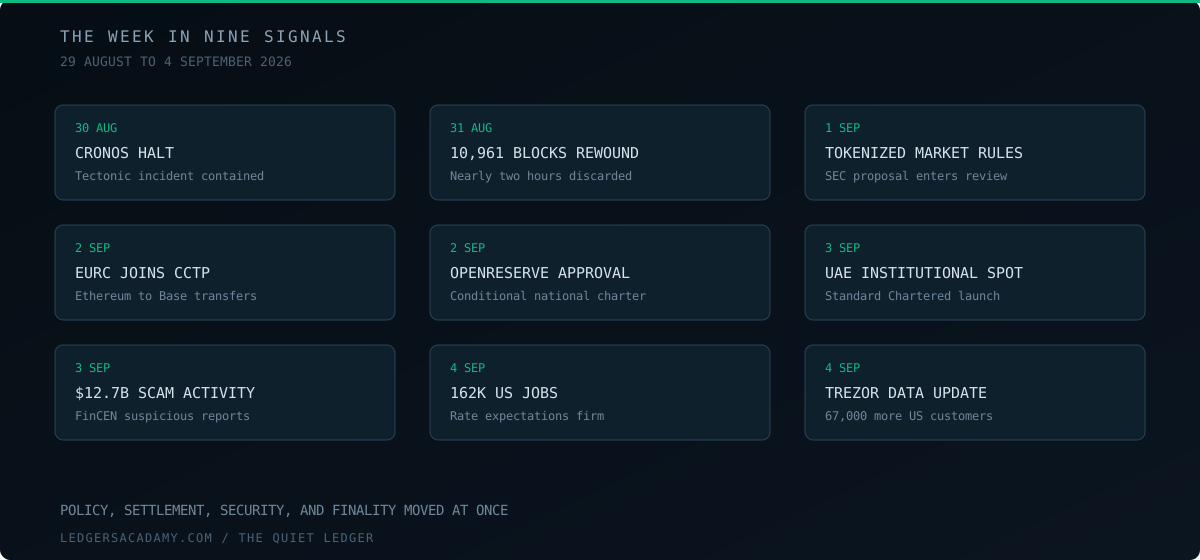
- The SEC published a broad transfer-agent modernization proposal. It directly addresses blockchain ownership records, tokenized securities, cross-chain interoperability, and data integrity. Comments are due 3 November.
- Standard Chartered opened institutional BTC and ETH spot trading in the UAE. Eligible clients receive deliverable assets through the bank's regulated DIFC operation.
- South Korea published a three-phase tokenized securities roadmap. The first legal changes take effect in February 2027, with retail purchase limits and capital requirements for account-management firms.
Security and Market Structure
- Cronos rewound 10,961 blocks after the Tectonic incident. The discarded history covered about one hour and 54 minutes. Funds already bridged to Ethereum sat outside the reach of that rollback.
- Trezor said about 67,000 additional US customers were exposed in a ShipMonk incident. Names, contact details, addresses, and order numbers were affected. Devices, private keys, and wallet backups were not.
- FinCEN identified $12.7 billion of suspicious reported activity tied to digital asset investment scams. The figure covers activity in 33,904 regulatory reports. It is not a confirmed victim-loss total.
Protocols and Settlement
- Circle added native EURC transfers to CCTP. The first route connects Ethereum and Base by burning EURC on the source chain and minting native EURC on the destination.
- SoFi and Payward connected banking and crypto settlement plans. The agreement includes Kraken support for SoFiUSD and around-the-clock institutional dollar settlement.
- The OCC conditionally approved OpenReserve Bank. Final chartering still depends on pre-opening requirements, while deposit insurance and Federal Reserve access require separate decisions.
3. The Weekly Deep Dive: What Finality Means After a Chain Rollback
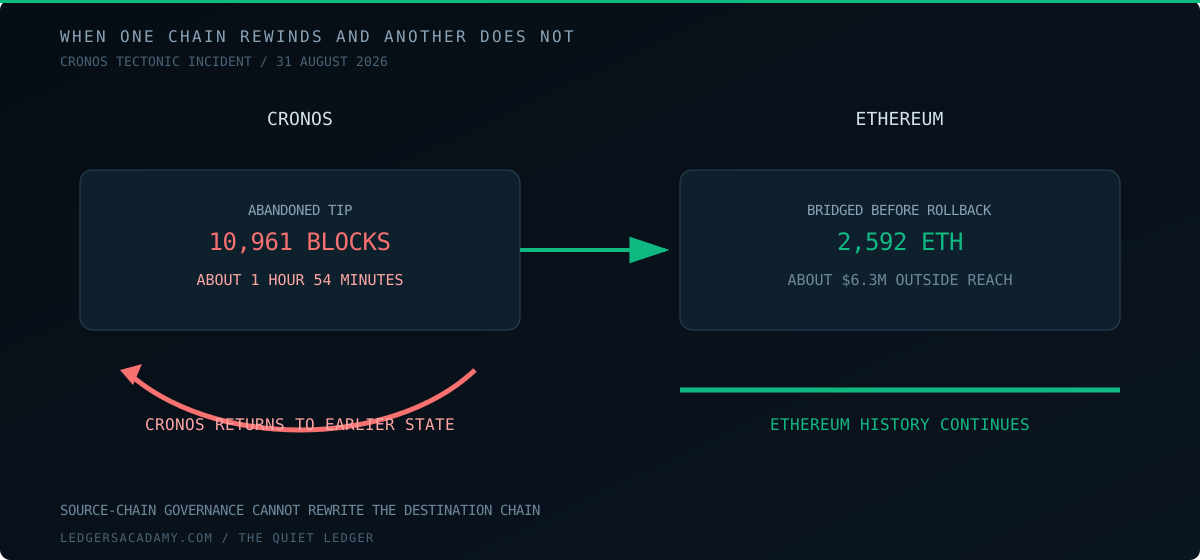
Finality is the point at which a transaction should no longer be reversible. Users often treat it as a technical property of consensus, but emergency governance can complicate that picture. Cronos validators restored the chain to block 90,896,189 after the Tectonic exploit. Compared with the abandoned tip, 10,961 blocks and nearly two hours of history disappeared.
Four layers of the decision
- Consensus finality: The protocol decides when enough validators have accepted a block that normal reorganization should no longer replace it.
- Social finality: Validators, developers, exchanges, and applications decide which history they will recognize after an exceptional event.
- Application finality: Lending markets, exchanges, and wallets update balances according to the chain they consider canonical.
- Cross-chain finality: A bridge may have already accepted a transaction and released value on another network. Rewinding the source chain does not automatically reverse the destination.
That last boundary defined the Cronos response. PeckShield tracked about 2,592 ETH, worth roughly $6.3 million at the time, that had reached Ethereum. Cronos validators could choose an earlier Cronos state. They could not rewrite Ethereum.
A rollback can also remove unrelated activity. Trades, transfers, and application updates inside the discarded window may vanish even when their users had nothing to do with the exploit. This is why the question is larger than whether stolen assets were frozen.
Questions worth asking before using a chain
- How concentrated is the validator set, and who coordinates emergency action?
- Does the protocol document when finalized history can be abandoned?
- How long do bridges and exchanges wait before treating deposits as irreversible?
- What happens to unrelated users if a rollback removes otherwise valid transactions?
Finality is not a slogan. It is a set of technical and institutional promises that become visible only when participants disagree about which history should survive.
4. Security and Onchain Radar
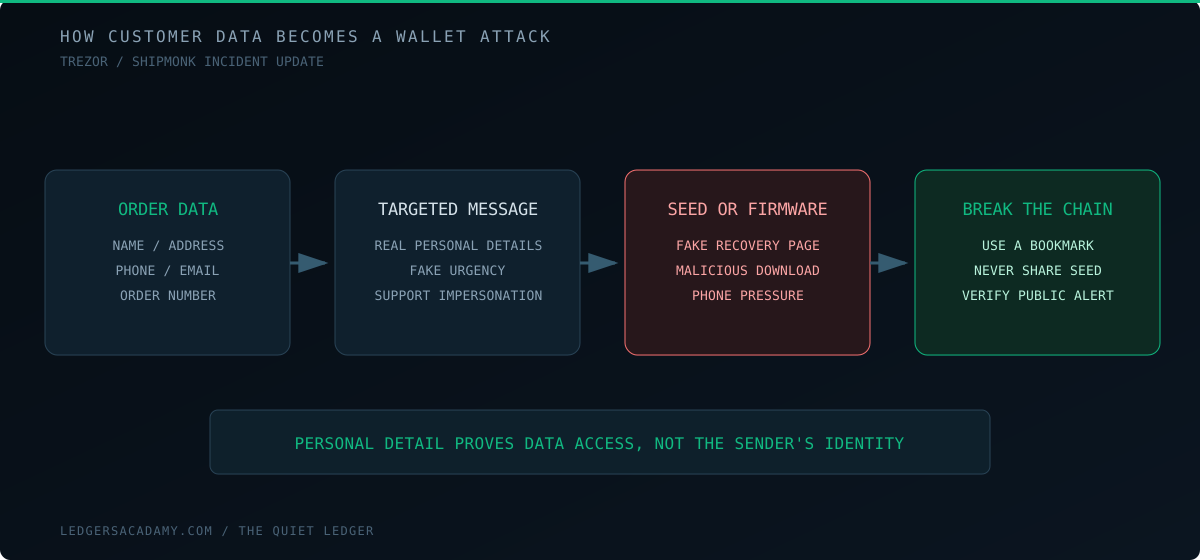
The Trezor update did not expose seed phrases or device keys. It exposed information that makes targeted phishing more convincing. An attacker who knows a customer's name, address, phone number, and hardware-wallet order can construct a message that feels private and urgent.
- No hardware-wallet vendor needs your seed phrase to investigate an order or breach.
- Do not install replacement firmware from an email, text message, or telephone support link.
- Open the vendor's official site from a saved bookmark and compare any alert with its public security page.
- Assume that a caller who knows your address may still be a scammer. Personal detail proves data access, not identity.
FinCEN's $12.7 billion figure adds scale but needs careful language. It describes suspicious financial activity reported under anti-money-laundering rules, not adjudicated losses. The practical pattern remains familiar: trust built over time, pressure to move funds, and a final demand for crypto that is difficult to reverse.
5. From the Academy Library
- Master Guide: Blockchain Architecture: Layer 1, Layer 2, and Modular Chains, for consensus, settlement, and cross-chain trust assumptions.
- Lexicon: Proof of Work vs Proof of Stake, for how different networks decide which history becomes canonical.
Recommended Tools
- Farside Investors for daily US spot ETF flow tables.
- Revoke.cash for reviewing token approvals after suspicious interactions.
- Official block explorers for checking confirmations and transaction status on each side of a bridge.
This week offered no single clean signal. Jobs were stronger, fund demand stayed positive through Thursday, and a rollback showed where one chain's authority ends. Keep those boundaries visible.
The Ledgers Academy Team
Website: ledgersacadamy.com
Research and notes: @TheQuietLedge on X
Disclaimer: Published strictly for educational purposes. Not financial or legal advice.
You are receiving this email because you subscribed at ledgersacadamy.com. Unsubscribe