
The Daily Ledger: 12 November 2026
When Will Ethereum Be Quantum Resistant?
When will Ethereum be quantum resistant? The Ethereum Foundation targets December 2029, and Ethlabs now proposes 2027 and shelves faster slots. Plus MSCI confirms Strategy's exit and Deutsche Bank custody goes live.
THE DAILY LEDGER
12 November 2026
Ethlabs proposes a 2027 deadline for a quantum-resistant Ethereum and shelves faster slots, MSCI confirms Strategy's exit from its indexes, and Deutsche Bank opens crypto custody in Europe.
Reporting window: 11 November 2026, 06:00 UTC to 12 November, 06:00 UTC (07:00 Europe/Stockholm, CET). Data cutoff: 12 November, 06:00 UTC. Prices are CoinGecko 00:00 UTC daily snapshots compared with the previous day's 00:00 UTC snapshot. This issue was added to the archive on 28 November 2026 and uses only information available at the cutoff.
When will Ethereum be quantum resistant? On the Ethereum Foundation's published plan, by December 2029. On 11 November Ethlabs, an Ethereum research group, proposed bringing that forward to 2027 and withdrawing its own faster-slots plan to free up the work. It is a proposal: core developers have not adopted it.
1. The Day in Numbers
- Bitcoin: $73,974 at 00:00 UTC, up 0.3 percent against the previous day's 00:00 UTC snapshot of $73,721. CoinGecko daily data.
- Ether: $2,055.37 at 00:00 UTC, up 0.2 percent on the same basis. CoinGecko daily data.
- Fear and Greed: 28, Fear, down 1 point from 29. Alternative.me daily reading, 12 November, 00:00 UTC.
- Dollar stablecoins: $289.48 billion in DefiLlama's reading for 11 November, down from $296.39 billion on 1 November. DefiLlama data. Past readings can be revised.
2. When will Ethereum be quantum resistant? Two roadmaps
The risk sits in signatures. An Ethereum address is a hash of a public key, and the key itself appears onchain the first time an account sends a transaction. Ethereum.org says a capable quantum computer could derive the private key from that exposed key, while accounts that have only received ether show just the hash. It calls this "not an imminent threat", and pq.ethereum.org says past transactions and finalized blocks would stay valid. The danger is new, forged spending.
The Foundation's 7 September roadmap targets quantum resistance across execution, consensus and data by December 2029, and at Devcon researcher Justin Drake said he hopes to finish by December 2028. Ethlabs' "pqai27" goes further. In the Hegotá upgrade, consensus would become post-quantum and every account would get a post-quantum route through Frame Transactions, a draft that lets account logic replace the single key, paired with SPHINCS, a hash-based signature scheme. Full capacity for post-quantum transactions and data is a stretch goal for 2027. "Post-AI" means cryptography resting on as few assumptions as possible and clients hardened against AI bug-hunting.
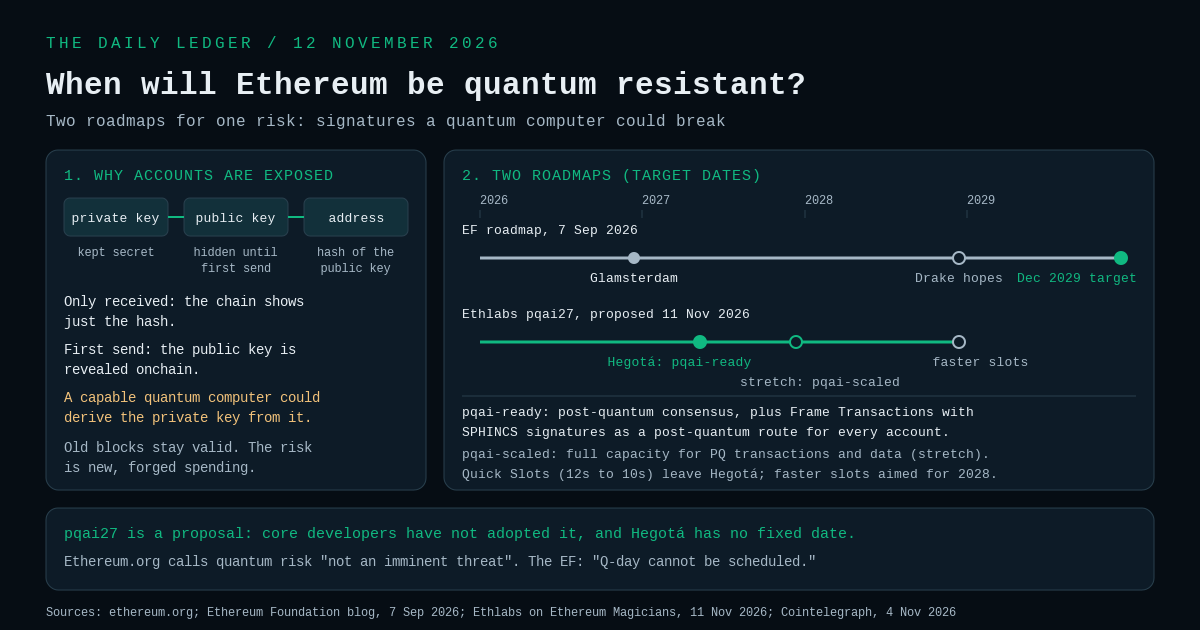
To make room, Ethlabs will withdraw Quick Slots (EIP-8198, which cuts slots from 12 to 10 seconds) from Hegotá and aim for faster slots in 2028. It wants FOCIL, a censorship-resistance feature, scheduled only if it does not delay the goal. Still unknown: whether core developers agree, which post-quantum consensus design wins (Ethlabs calls it "the biggest open question"), and how quickly holders of exposed keys would move. Migration would be opt-in, and post-quantum transactions would cost more at first.
3. Today's Headlines
MSCI confirms Strategy's exit on 30 November
MSCI's November review deletes Strategy, Metaplanet and Upexi from its indexes after the close on 30 November and puts Sharplink on a watchlist, Cointelegraph reported at 00:09 UTC. Issue #10 explained the rule behind it.
Germany: Deutsche Bank's crypto custody goes live
Deutsche Bank now holds bitcoin, ether, USDC, EURC and EURAU for institutional and corporate clients from Frankfurt, passported across Europe, Bitcoin Magazine reported. The assets are not covered by a deposit-guarantee scheme.
Turkey: the FSB asks for a stablecoin regime
A Financial Stability Board peer review credits Turkey with licensing crypto firms and banning crypto for domestic payments, and recommends a dedicated stablecoin regime and stronger enforcement.
4. Security Note
Evergreen reminder: there is no Ethereum quantum migration to sign up for. Frame Transactions are a draft and Hegotá is still being scoped, so a website, email or direct message offering to "quantum-proof" your wallet is not offering an Ethereum feature. The rule: never type your recovery phrase into a site or share it with anyone, whatever the reason given. A genuine account change is a transaction you approve in your own wallet, and no legitimate tool needs the phrase itself.
5. From the Academy Library
Frame Transactions extend the ideas in our account abstraction explainer, and our Glamsterdam guide covers the upgrade before Hegotá. New readers can start at Academy School.
Nobody can date the day a quantum computer breaks today's signatures. The argument is over how wide a margin to leave, and what to give up to get it.
Disclaimer: This publication is for education and information only. It is not financial, investment, legal, tax, or security advice.
Sources and further reading
- Ethereum Magicians: an Ethlabs view on post-quantum and post-AI timelines (pqai27), 11 November 2026
- Ethereum Foundation blog: protocol priorities, 7 September 2026
- ethereum.org: quantum resistance
- pq.ethereum.org: post-quantum Ethereum
- Cointelegraph: Drake hopes to finish the post-quantum transition by December 2028, 4 November 2026
- EIP-8141: Frame Transaction
- EIP-8198: Quick Slots
- Cointelegraph: MSCI confirms Strategy's removal from indexes at the end of November
- Bitcoin Magazine: Deutsche Bank's bitcoin custody goes live, 11 November 2026
- Financial Stability Board: peer review of Türkiye's crypto-asset and stablecoin framework, 11 November 2026
- CoinGecko: bitcoin daily price snapshots
- CoinGecko: ether daily price snapshots
- Alternative.me: Fear and Greed Index history
- DefiLlama: total stablecoin supply data