
Ledgers Academy Letter
The Daily Ledger: 3 October 2026
Europe maps three routes to central bank settlement for tokenised markets. US hiring adds little momentum, and El Salvador receives IMF financing with Bitcoin restrictions intact.
Subject: Europe's tokenised markets still need a cash anchor
Preview: Three routes to central bank settlement, a cautious US jobs report, and the conditions behind El Salvador's latest IMF payment.
THE DAILY LEDGER
3 October 2026
Europe maps the payment side of tokenised finance, US hiring slows, and El Salvador receives financing with Bitcoin restrictions intact.
Reporting window: 1 October 2026, 00:00 UTC to 3 October, 02:39:06 UTC (04:39:06 Europe/Stockholm). This is an early Saturday briefing, not a completed Saturday session. Market snapshots were retrieved at 02:39:06 UTC; their own update times appear below.
Why tokenised markets need central bank money comes down to settlement: recording a bond on a blockchain does not decide what counts as final payment. The Bank for International Settlements' framework puts central bank reserves beneath programmable payments. Europe's latest presentation makes that design question concrete, while Friday's US employment report offers a reminder that better infrastructure and stronger demand are separate questions.
1. The Day in Numbers
- Bitcoin: $84,646, down 0.29 percent over a rolling 24 hours. CoinGecko snapshot: 3 October, 02:37:20 UTC.
- Ether: $2,679.58, down 1.09 percent over the same rolling window and at the same timestamp.
- Fear and Greed: 67, Greed, down 5 points from 72. Alternative.me's daily reading: 3 October, 00:00 UTC.
- Bitcoin dominance: 58.70 percent of CoinGecko's tracked market value. Global snapshot: 3 October, 02:35:20 UTC. Coverage is provider-specific.
2. Why tokenised markets need central bank money
Tokenisation records an asset or claim on a programmable platform. A tokenised bond still needs a buyer's payment and a seller's delivery. Atomic settlement links those steps so both happen together or neither happens. That reduces the risk of delivering an asset without receiving payment, but it does not make every payment token equally sound.
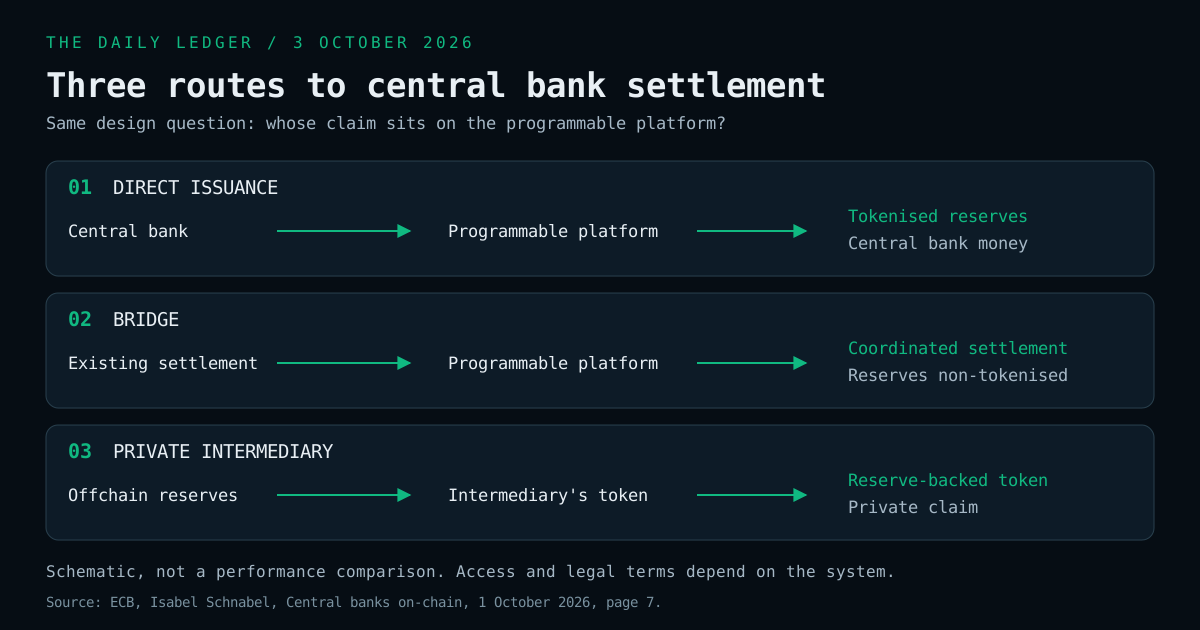
In slides presented on 1 October, ECB Executive Board member Isabel Schnabel distinguished three routes: directly issued tokenised reserves; a bridge connecting existing central bank settlement to a programmable platform; and a private intermediary issuing tokens backed by reserves. In the third route, the token remains a private claim.
The practical question is whose obligation the buyer holds at the moment of payment. A shared database cannot answer that alone. The slides describe architectures, not a guarantee that every asset, institution or public blockchain can use them.
3. Today's Headlines
US hiring offers little momentum
The 2 October employment release estimates 29,000 additional September payroll jobs and 4.2 percent unemployment. July and August gains were revised down by a combined 60,000. These estimates can change; they do not determine the next interest-rate decision.
El Salvador's financing comes with limits
The IMF's 1 October decision releases about $138 million. It grants waivers for missed conditions, including Bitcoin accumulation, but envisages no further accumulation beyond documented donations. Financing approval is not an endorsement of unrestricted state purchases.
Treasury targets a fundraising network
On 2 October, US Treasury sanctioned individuals and entities it says used sham charities and cryptocurrency channels to finance Hamas. Treasury alleges more than $2 million was collected during 2020 to 2026. That is a multiyear network total, not one day's onchain flow.
4. Security Note
Evergreen reminder: a token approval is permission for another address to spend tokens, not proof that a website is trustworthy. The ERC-20 standard separates that allowance from a simple transfer. Before approving, check the spender and limit in the wallet. If either is unexplained, stop and verify through the service's independently located documentation. A professional interface does not validate the permission.
5. From the Academy Library
Our crypto policy and CBDC guide separates proposals from operating systems. Read how stablecoin address freezes work and how token approvals and wallet drainers differ from ordinary payments. New readers can start at Academy School.
A token changes how a claim moves. The issuer, the settlement asset and the permissions still determine what that movement means.
Disclaimer: This publication is for education and information only. It is not financial, investment, legal, tax, or security advice.
Sources and further reading
- ECB: Central banks on-chain, 1 October 2026, especially pages 2, 6 and 7
- BIS: The next-generation monetary and financial system, 2025 background framework
- BLS: September 2026 employment report, released 2 October
- IMF: El Salvador programme reviews, 1 October 2026
- US Treasury: Hamas financing designations, 2 October 2026
- CoinGecko: BTC and ETH price snapshots
- CoinGecko: global market snapshot
- Alternative.me: current and previous Fear and Greed readings
- Ethereum: ERC-20 approval and allowance specification