
Ledgers Academy Letter
The Quiet Ledger: Issue #8 | 2 October 2026
The Bitget forensic reports showed a breach that never touched a private key, and a day later the SEC proposed where investment advisers may hold client crypto. A quiet week for price in which custody was the only real subject.
Subject: Bitget's attacker never stole a key, and the SEC has just proposed who may hold one
Preview: The forensic reports landed on Wednesday: the way in was a security product, and the keys signed what they were told. On Thursday the SEC proposed where investment advisers may keep client crypto.
THE QUIET LEDGER
Issue #8 | Saturday 26 September to Friday 2 October 2026
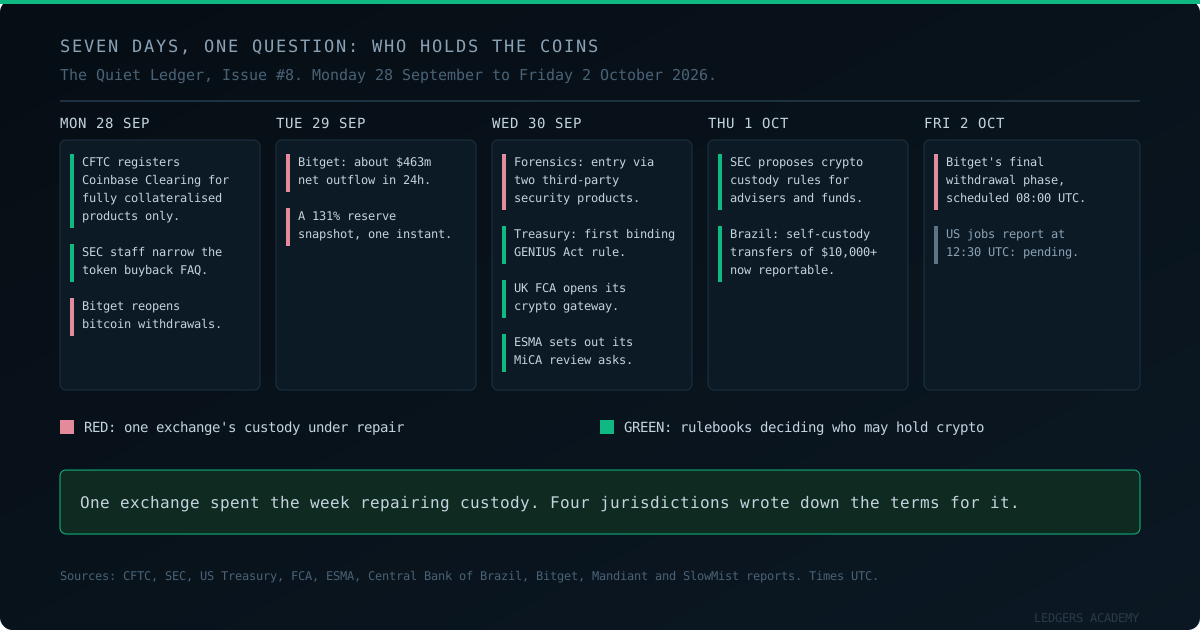
A week in which the price barely moved and custody was the only subject: the Bitget forensic reports showed a breach that never touched a private key, and the SEC proposed crypto custody rules for investment advisers and funds
Reporting window Saturday 26 September to Friday 2 October 2026. Data cutoff 06:45 UTC on Friday 2 October (08:45 Europe/Stockholm). Prices are CoinGecko 00:00 UTC snapshots unless stated. US fund flows cover the four completed sessions from Monday to Thursday; Friday's session is pending, and so is the US September jobs report, due at 12:30 UTC today.
Bitcoin's daily snapshots spanned only about $1,360 this week, while the important news happened in rulebooks and incident reports. The forensic reports on Bitget's breach arrived on Wednesday and showed that the attacker never needed a private key: it took over the machine that asks for signatures. The next day the SEC proposed crypto custody rules for investment advisers and funds, a step-by-step answer to where a professional may keep a client's coins. Our reading is that custody, not price, is now where crypto's real decisions are made, and this was the week four jurisdictions started writing them down.
1. The Macro Pulse
- Bitcoin: $84,842 at 00:00 UTC on Friday, up about 0.9 percent from $84,076 a week earlier. An intraday reading of $86,050 at 06:34 UTC puts the week nearer 2.4 percent.
- Ether: $2,705 at 00:00 UTC, up about 0.5 percent, having sat within $30 of $2,690 all week.
- Fear and Greed: 72, Greed, up one point from 71 the previous Friday, and between 70 and 74 every day.
- US spot ETFs, four completed sessions: bitcoin funds took about $51.3 million net; ether funds lost about $100.7 million. Wednesday's $148.7 million bitcoin outflow ended a nine-session streak worth about $3.08 billion. Friday is pending.
- Rates: the 10-year Treasury yield rose from 5.17 percent to 5.29 percent on Wednesday, the same day as the bitcoin outflow, before easing to 5.24. August core PCE came in at 3.0 percent a year, and the Reserve Bank of Australia raised its cash rate to 4.60 percent on Tuesday.
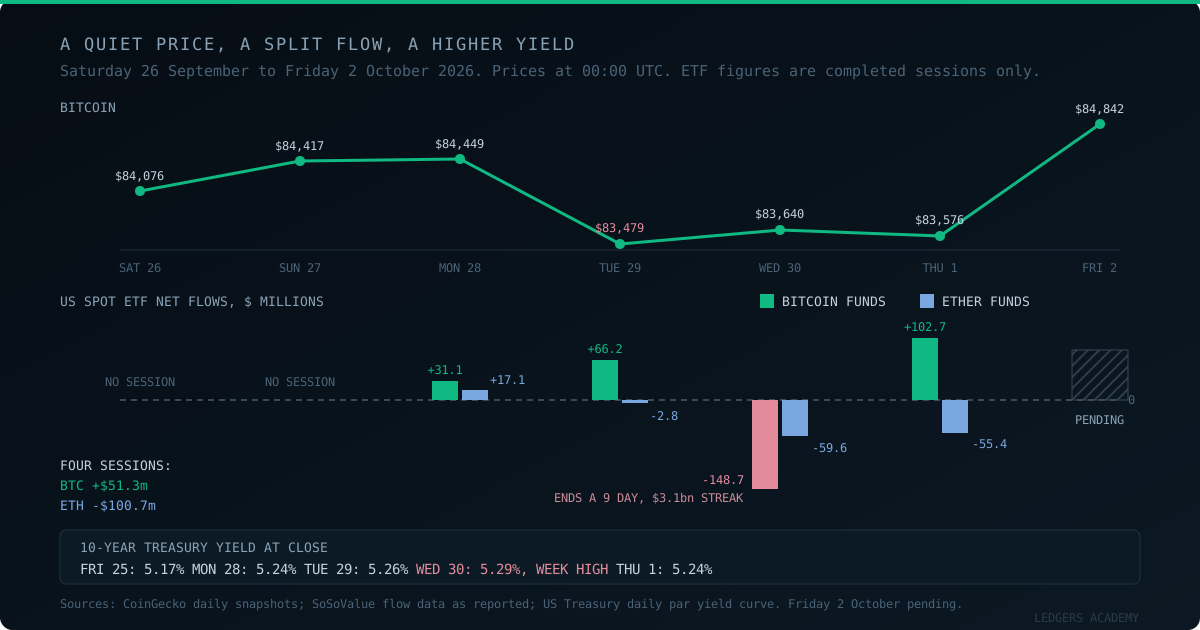
The takeaway: after September brought about $2.65 billion into the bitcoin funds, the first week of the new quarter was close to flat, and the one heavy outflow day coincided with the week's highest long-term yield. That is a description of a completed week.
2. This Week in Headlines
Washington: custody and stablecoins get rules
The SEC proposed crypto custody rules for advisers and funds on Thursday, covered in the deep dive below. On Wednesday the Treasury published the first binding rule under the GENIUS Act, an interim final rule setting out how states get their stablecoin regimes certified as substantially similar to the federal one. It opens the state route for issuers with less than $10 billion outstanding.
The CFTC registered Coinbase Clearing on Monday, limited to fully collateralised futures, options and swaps, as our Monday Daily Ledger explained. The same day SEC staff narrowed their token buyback answer: a buyback is outside the "essential managerial efforts" test only on a functional network that "has no central party".
Outside the United States
The UK Financial Conduct Authority opened its crypto authorisation gateway on Wednesday. Firms that want to keep operating should apply by 28 February 2027, the regime starts on 25 October 2027. Authorisation is not automatic. The European Securities and Markets Authority published its MiCA review requests the same day: stricter rules for influencer marketing, disclosure for staking and lending, and clearer criteria for when decentralised finance is genuinely decentralised.
Brazil's Resolution BCB 588 took effect on Thursday. Regulated institutions must now report transfers of at least the equivalent of $10,000 to or from self-custody wallets to COAF, the financial intelligence unit. It is a reporting duty, not a ban or a limit.
Institutions and protocols
Strategy's 8-K reported 1,665 bitcoin bought for $142.7 million at an average of $85,681, taking it to 847,666, funded by selling common stock. BitMine passed six million ether, most of it staked. Bitwise listed a spot NEAR fund that stakes its holdings, and Goldman Sachs made its $100 billion Treasury fund available on Lynq, a permissioned Avalanche network. On Ethereum, the Glamsterdam upgrade is scheduled for the Sepolia test network on 6 October at 13:53 UTC, with mainnet undated.
3. The Weekly Deep Dive: the SEC crypto custody rule for investment advisers
An investment adviser who manages your money and can move it is said to have custody, and the Advisers Act custody rule requires such an adviser to keep client assets with a qualified custodian, such as a bank, a registered broker-dealer or a futures commission merchant. That works for shares. For many crypto assets, as the SEC's own fact sheet concedes, no permitted custodian exists, and whether a state-chartered trust company counts as a "bank" has been a case-by-case legal question. Advisers have had to choose between avoiding crypto and accepting legal uncertainty.
How the proposed SEC crypto custody rule would work
The proposal sets out three tiers, each used only when the one before is unavailable.
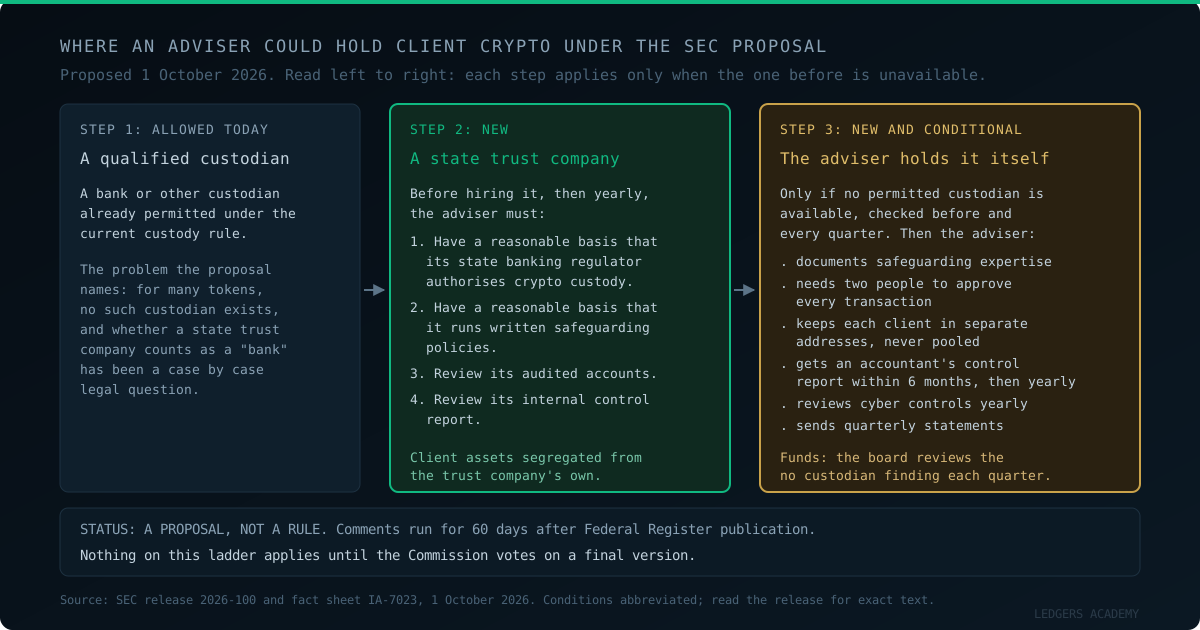
First, an existing qualified custodian. Second, a state trust company, provided the adviser checks every year that its state banking regulator authorises it to hold crypto, reviews its audited accounts and control report, and keeps client assets separate from the trust company's own. Third, only where no permitted custodian is available, the adviser may hold the asset itself, under the heaviest conditions: re-check the absence of a custodian every quarter, require at least two people to authorise every transaction, keep each client in separate addresses, obtain an independent accountant's control report, and agree in writing to treat the asset as a "financial asset" under state law. A fund's board must review that finding each quarter.
Why this week, and where it falls short
The timing is coincidence; the overlap is not. The two-person authorisation rule is a direct control against the failure in Bitget's forensic reports, where a compromised machine issued withdrawals that nobody had approved. Our reading is that the proposal asks advisers for exactly the human check that an automated withdrawal layer is built to do without.
The limits are real. This is a proposal, with comments open for 60 days after Federal Register publication, and nothing changes until a final vote. The self-custody test is one the adviser applies to itself. Per-client addresses improve traceability but multiply the keys to protect, and state trust company supervision differs by state. None of this applies to your own wallet: the rule governs professionals holding other people's assets.
What you can check: if an adviser manages crypto for you, ask which tier your assets would sit in and who the custodian is, and read the adviser's Form ADV on the SEC's adviser search. The proposal would add crypto custody questions to that form.
4. Security and Onchain Radar
Bitget published two forensic reports on Wednesday. Mandiant's status report found that the attacker gained privileged access to two third-party security appliances, planted a web shell, and moved from there to the production wallet job server. SlowMist's progress report traces the earliest malicious activity to 31 August, a zero-day in one of those products, and recovered a custom tool that forged the withdrawal system's risk-control parameters.
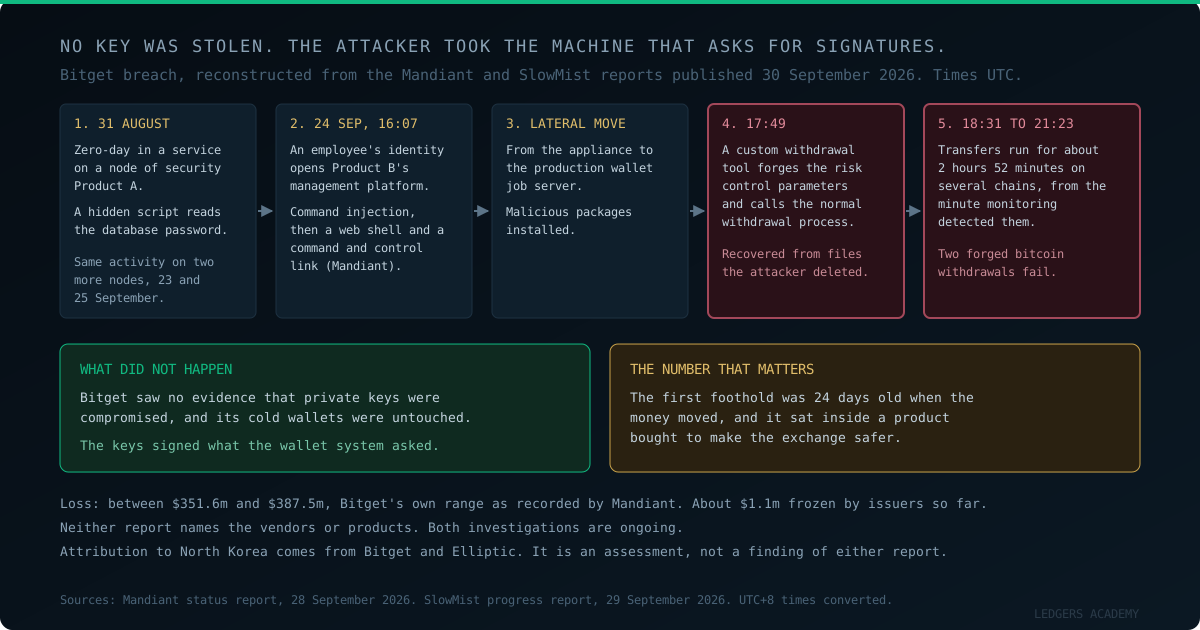
Confirmed: a loss Bitget puts between $351.6 million and $387.5 million, no evidence of compromised private keys, cold wallets untouched, transfers running for nearly three hours after detection, and about $1.1 million frozen by issuers. Not confirmed: the vendors, which neither report names, and the attacker. Bitget and Elliptic point to North Korea; Mandiant does not attribute. Elsewhere, NEAR Intents pledged full compensation after a bridge bug drained about $3.8 million, and a counterfeit of an unlaunched network drew about 768 ETH from 1,335 addresses.
The lesson is that a signing key is only as safe as whatever is allowed to give it instructions. The rules:
- Keep on any exchange only the balance this week's activity needs. This attacker held a foothold for 24 days before the money moved.
- On your own hardware wallet, approve only what the device's own screen shows you, and refuse anything it cannot display. That is the personal version of the same failure, covered in our note on blind signing.
- For shared or business funds, require two approvers for every outgoing transaction, the same control the SEC proposal demands.
- Treat anyone offering to recover funds for a fee as the next attack.
5. From the Academy Library
Splitting signing authority between people or devices is explained in MPC wallets, and what a reserve snapshot can and cannot prove in proof of reserves. The American and European rulebooks are mapped in the crypto tax and regulatory guide, last week's question about who holds the coins in a fund is in Issue #7, and new readers can start at Academy School.
Three useful, non-affiliate tools: the SEC's Investment Adviser Public Disclosure search for any adviser's Form ADV, the FCA's Financial Services Register for checking a UK firm's status, and the full proposing release, the only source for the exact conditions.
Dates to keep
- Today, 08:00 and 12:30 UTC: Bitget's final scheduled withdrawal phase, then the US September jobs report.
- 6 October: Glamsterdam on the Sepolia test network.
- 27 and 28 October: the next Federal Reserve meeting.
- 30 November: comments close on the Treasury's state stablecoin rule.
- 28 February 2027: the FCA's application deadline for firms that want to keep operating in the UK.
The money barely moved this week and the rules moved a great deal. A hack that never touched a key and a proposal requiring two people to approve every transaction arrived two days apart, and between them they describe where crypto's risk now sits.
Disclaimer: This publication is for education and information only. It is not financial, investment, legal, tax, or security advice.
Sources and further reading
Regulation and policy
- SEC: proposal on how investment advisers and funds can custody crypto assets, 1 October 2026
- SEC: fact sheet IA-7023, crypto custody rules
- SEC: proposing release IA-7023
- SEC Division of Corporation Finance: crypto asset FAQs, updated 28 September 2026
- Federal Register 2026-19966: state certification procedures for the Stablecoin Certification Review Committee
- ABA Banking Journal: new rule establishes procedures for reviewing state stablecoin regulations
- CFTC: register of derivatives clearing organizations
- Finance Magnates: Coinbase completes its US derivatives infrastructure with CFTC clearing registration
- FCA: FCA opens gateway for regulated crypto
- ESMA: changes to make MiCA clearer, safer and ready for emerging services
- UseTheBitcoin: Brazil's reporting rule for self-custody crypto transfers
- Migalhas: analysis of Central Bank of Brazil Resolutions 588 and 589 (Portuguese)
Security
- Mandiant: Bitget incident response status report, 28 September 2026
- SlowMist: investigation progress report on Bitget, 29 September 2026
- The Hacker News: Bitget confirms a third-party zero-day
- Elliptic: Bitget attack pushes suspected North Korea crypto heists over $1 billion in 2026
- Unchained: NEAR Intents pledges full compensation after a $3.8 million drain
- Cointelegraph: fake GIWA blockchain scam drains $2 million in ETH
Institutions and protocols
- SEC EDGAR: Strategy Inc Form 8-K, 28 September 2026
- SEC EDGAR: BitMine holdings update, 28 September 2026
- The Crypto Times: Bitwise NEAR ETF debuts with staking
- Bitcoin.com News: Goldman Sachs puts a $100 billion Treasury fund on Avalanche rails
- Ethereum Foundation: Glamsterdam testnet announcement
Markets and macro
- KuCoin News: US spot bitcoin ETFs, 28 September and 29 September
- KuCoin News: US spot ether ETFs, 28 September and 29 September
- TokenPost: spot bitcoin ETFs end a nine-day inflow streak, 30 September
- TokenPost: spot bitcoin and ether ETF flows, 1 October
- The Crypto Times: September ETF totals
- US Treasury: daily par yield curve rates, 2026
- BEA: personal income and outlays, August 2026
- Reserve Bank of Australia: monetary policy decision, 29 September 2026
- Federal Reserve: FOMC meeting calendar
- CoinGecko: daily price snapshots used in the charts above
- Alternative.me: Fear and Greed Index