
The Daily Ledger: 23 November 2026
How Bridge Mint Exploits Create Unbacked Tokens
How do bridge mint exploits create unbacked tokens? A privileged minter printed ACE on BNB Chain and traders emptied Fusionist's reserve. Plus Russia's exchange crypto rules and Visa's agent wallet.
THE DAILY LEDGER
23 November 2026
An attacker with minting rights prints unbacked ACE and traders empty Fusionist's bridge reserve, Bank of Russia rules for exchange crypto trading take effect, and Visa Crypto Labs launches a wallet in which AI agents earn a stablecoin.
Reporting window: 22 November 2026, 06:00 UTC to 23 November, 06:00 UTC (07:00 Europe/Stockholm, CET). Data cutoff: 23 November, 06:00 UTC. Prices are CoinGecko 00:00 UTC daily snapshots compared with the previous day's 00:00 UTC snapshot. This issue was added to the archive on 28 November 2026 and uses only information available at the cutoff.
How do bridge mint exploits create unbacked tokens? Someone who controls the minting permission on one chain creates tokens with nothing locked on the other, and the bridge then honours them as real. On 22 November that happened to Fusionist's ACE on BNB Chain: an attacker sold about $2 million of printed ACE, and traders then used the bridge to drain about $3.7 million of genuine ACE.
1. The Day in Numbers
- Bitcoin: $61,172 at 00:00 UTC, up 1.7 percent against the previous day's 00:00 UTC snapshot of $60,121. CoinGecko daily data.
- Ether: $1,721.62 at 00:00 UTC, up 2.3 percent on the same basis. CoinGecko daily data.
- Fear and Greed: 11, Extreme Fear, unchanged from 11. Alternative.me daily reading, 23 November, 00:00 UTC.
- Largest single ACE mint: 10 quintillion ACE in one BNB Chain transaction at 20:28 UTC on 22 November. ACE's stated maximum supply is 147 million, per The Block.
2. How bridge mint exploits create unbacked tokens
ACE is the native token of Endurance, Fusionist's own chain, where it pays transaction fees. A copy circulates on BNB Chain. The link between them is a lock-and-mint bridge: a reserve on Endurance holds real ACE, and the BNB Chain copy should be minted only when ACE is locked there. Sending the copy back burns it and releases the same amount from the reserve.
That promise depends on the minter, an address the token contract trusts to create supply. At 17:55 UTC a transaction from such an address minted about 3.46 million ACE through the bridge's minting contract, with nothing locked behind it. At 19:08 UTC Blockaid reported that "a privileged token-bridge minter minted unbacked ACE and sold it for USDT". Onchain Lens traced about $1.87 million of proceeds through Tornado Cash.
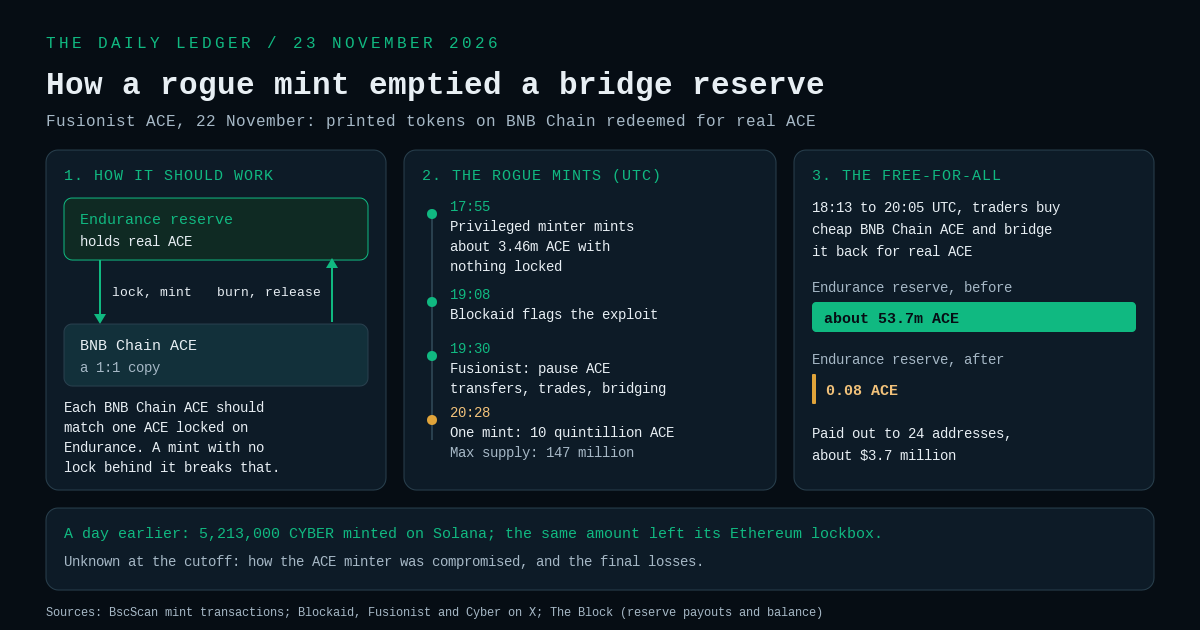
Then came the free-for-all. BNB Chain ACE crashed, yet the bridge still redeemed each token one for one. From 18:13 to 20:05 UTC the Endurance reserve paid out about 53.7 million ACE to 24 addresses and was left with 0.08 ACE, The Block reports; one trader turned about $50 into about $17,670. In effect, the bridge could not tell printed tokens from backed ones.
A day earlier Cyber hit the same pattern: 5,213,000 CYBER were minted on Solana and the same amount left its Ethereum lockbox two minutes later, which Cyber acknowledged. Still unknown for Fusionist at the cutoff: how the minter was compromised, the final loss, and what happens to holders.
3. Today's Headlines
Russia's rules for exchange crypto trading take effect
A Bank of Russia ordinance letting exchanges run organised crypto trading applies from 22 November, but only once the central bank approves each exchange's trading rules. Exchanges must register participants, keep order and trade registers and report to the regulator. Moscow Exchange plans pilot trades in bitcoin, ether and USDT from 1 December, reports say.
Visa Crypto Labs launches an agent wallet
Cuy Sheffield, head of Visa Crypto Labs, announced a new Visa CLI: US users with eligible Visa cards verify an AI agent with the card, then earn OUSD, a dollar stablecoin issued by Bridge, when it completes creative tasks. His launch note calls it "an experimental agent wallet for OUSD built on Tempo and the Machine Payments Protocol".
Bitcoin steadies around $60,000
CoinGecko's hourly readings in the window ranged from $58,817 to $61,606, after a fall to $55,130 that CoinDesk called the weakest since September 2024. Hourly readings miss intraday extremes.
4. Security Note: a crashing bridged token is not a bargain
At 19:30 UTC Fusionist asked users to "pause ACE transfers, trades, and bridging on BSC". Gate said it would reverse ACE/USDT trades executed between 17:55 and 19:15 UTC and treat incident-linked ACE deposited after 17:55 UTC as "fork coins". The rule: when a project posts an exploit alert, stop bridging, depositing and trading that token until it gives an all-clear. A price far below other venues signals broken supply, and trades can be reversed.
5. From the Academy Library
Our lexicon entry on cross-chain bridges compares bridge designs, and the exploit tracker follows incidents like these. The 8 September issue shows unbacked tokens appearing on a Bitcoin sidechain. New readers can start at Academy School.
A bridged token is only as sound as the key that can mint it. Who holds that permission, and how it is guarded, deserves as much scrutiny as the bridge's code.
Disclaimer: This publication is for education and information only. It is not financial, investment, legal, tax, or security advice.
Sources and further reading
- The Block: a $2 million exploit leads to a $3.7 million free-for-all as traders empty Fusionist's ACE bridge, 22 November 2026
- BscScan: first unbacked ACE mint, 17:55 UTC
- BscScan: 10 quintillion ACE mint, 20:28 UTC
- Blockaid on X: ongoing exploit on Fusionist, 22 November 2026
- Onchain Lens on X: Fusionist exploit proceeds routed through Tornado Cash
- Fusionist on X: security alert, ACE on BSC
- Gate: ACE rollback and futures announcement
- Etherscan: 5,213,000 CYBER leave the bridge lockbox, 21 November
- Cyber on X: CYBER bridge update, 21 November 2026
- The Block: Cyber investigating suspected $1 million bridge exploit
- Bank of Russia: how to conduct trading in cryptocurrencies (in Russian)
- Cryptonews.net: Russian exchanges cleared to launch crypto trading as Moscow Exchange targets 1 December pilot
- Crypto Briefing: Visa CLI agent wallet lets AI agents earn OUSD
- Cuy Sheffield on X: new version of Visa CLI
- Cuy Sheffield on X: How do people earn from the AI economy?
- CoinDesk: bitcoin bounces 9 percent from two-year low
- CoinGecko: bitcoin daily data
- CoinGecko: bitcoin hourly data
- CoinGecko: ether daily data
- Alternative.me: Fear and Greed Index