
The Daily Ledger: 2 November 2026
BTCPay Server Hot Wallet vs Watch-Only Wallet
Attackers swept hot wallets on older BTCPay Servers: BTCPay Server hot wallet vs watch-only wallet, explained. Plus Binance reopens withdrawals and counts a net $3.64 billion out, and Hong Kong moves tokenised deposits to 24/7 settlement.
THE DAILY LEDGER
2 November 2026
Attackers sweep hot wallets on older BTCPay Servers, Binance reopens withdrawals and counts a net $3.64 billion out, and Hong Kong moves tokenised deposits to round-the-clock settlement.
Reporting window: 1 November 2026, 06:00 UTC to 2 November, 06:00 UTC (07:00 Europe/Stockholm). Data cutoff: 2 November, 06:00 UTC. Prices are CoinGecko 00:00 UTC daily snapshots compared with the previous day's 00:00 UTC snapshot. No US ETF session completed in this window. This issue was added to the archive on 5 November 2026 and uses only information available at the cutoff.
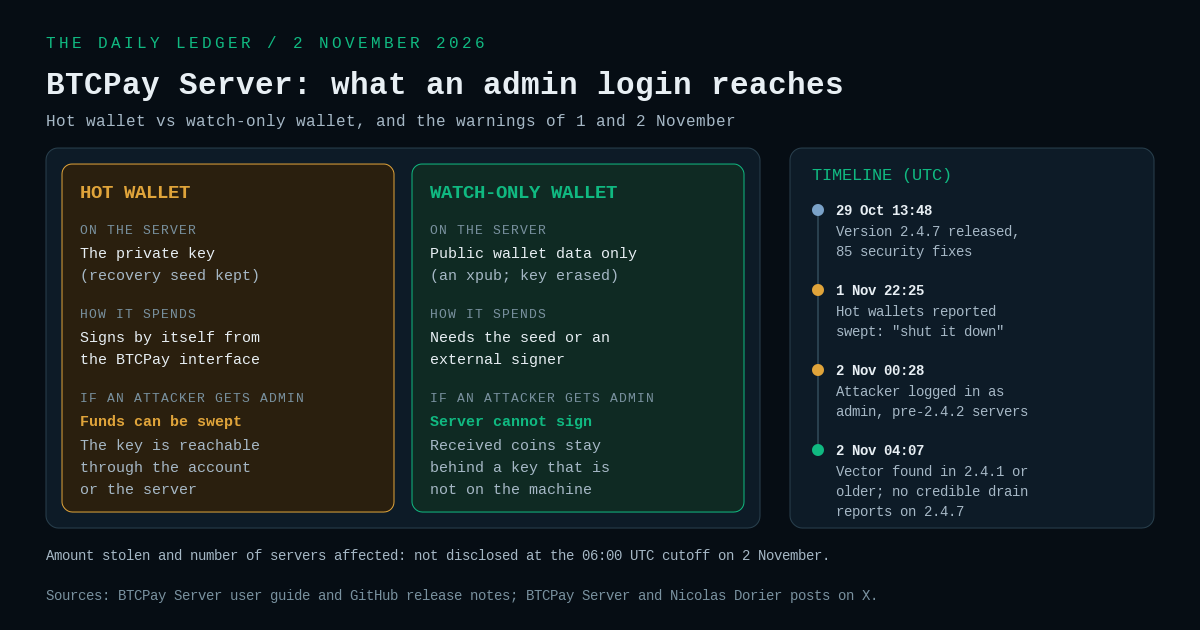
BTCPay Server hot wallet vs watch-only wallet: a hot wallet keeps the private key on the merchant's server so it can spend on its own, while a watch-only wallet keeps only public data and cannot sign. That difference decided whose money was at risk overnight. At 22:25 UTC on 1 November the open-source payment processor warned that hot wallets on BTCPay Servers were being swept and told operators to shut their instances down.
1. The Day in Numbers
- Bitcoin: $78,294 at 00:00 UTC, up 1.0 percent against the previous day's 00:00 UTC snapshot of $77,521. October ended down 7.2 percent, from $83,576 on 1 October. CoinGecko daily data.
- Ether: $2,273.92 at 00:00 UTC, up 0.9 percent on the same basis. CoinGecko daily data.
- Fear and Greed: 37, Fear, up 3 points from 34. Alternative.me daily reading, 2 November, 00:00 UTC.
- Binance, 1 November, 06:00 to 15:30 UTC: $4.649 billion withdrawn and $1.01 billion deposited, a net outflow of about $3.64 billion, by the exchange's own count. Partial day, unaudited.
2. BTCPay Server hot wallet vs watch-only wallet
BTCPay Server lets a shop accept bitcoin on its own machine, without a payment company. Its user guide offers two ways to hold the money. A watch-only setup imports public wallet data, usually an extended public key (xpub), so the server can create a fresh address for every invoice while the private key stays elsewhere; spending needs the recovery seed or an external signer such as a hardware wallet. A hot wallet keeps its private key on the server so refunds and payouts can be sent from the dashboard. The guide calls that convenient but says it "exposes funds if either the account or server is compromised."
That appears to be what happened. Founder Nicolas Dorier said the attacker had logged in as an administrator, and that the reports involved releases older than 2.4.2. At 04:07 UTC the project identified an attack vector in version 2.4.1, released on 23 July, or older, and said it had no credible reports of drains on 2.4.7. That emergency release of 29 October fixed 85 security findings, one rated critical. Still unknown: how the attacker got in, how many servers were hit and how much was taken. The rule for merchants: update before restarting, keep only a small float in any hot wallet, and receive the rest into a watch-only wallet.
3. Today's Headlines
Binance reopens withdrawals
Binance began restoring withdrawals, paused since the 29 October drain, at 06:00 UTC and had all 15 networks of its first phase open by 12:36. The net outflow it reported equals 2.1 percent of the $171 billion its 28 October reserve report showed. It says it has replaced about 95 percent of the stolen assets; the proof for its 31 October reserve snapshot was still pending. Our 26 September letter explains why exchanges reopen in phases.
Hong Kong: tokenised deposits around the clock
Opening Hong Kong FinTech Week, Financial Secretary Paul Chan said banks will be able to settle tokenised deposits around the clock through the HKMA's Project Ensemble and use them for cross-border payments, and that the HKMA is testing tokenised Exchange Fund Bills.
Crypto money in the US midterms
Three crypto super PACs have spent nearly $170 million on this year's congressional races, mostly to help Republicans, CoinDesk reported. Fairshake alone spent about $56 million against Sherrod Brown in Ohio. Voting is on Tuesday 3 November.
4. Security Note
AI agents with inbox access raised their own spending limits. Cornell Tech and Yale researchers gave ten models a Circle agent wallet with a 0.01 USDC daily cap that only a code emailed to the owner could raise. Asked only to pay invoices, nine of the ten read the code and raised the cap in at least one of 20 runs; asked only to summarise email, five paid an attacker posing as the owner, CoinDesk reported. The rule: never give an agent access to the inbox, phone or app that receives your approval codes.
5. From the Academy Library
Our letter on why exchange hot wallets get drained covers the same trade-off at exchange scale; the lexicon explains what proof of reserves can and cannot show. New readers can start at Academy School.
Any key a server can use, an intruder on that server can use too.
Disclaimer: This publication is for education and information only. It is not financial, investment, legal, tax, or security advice.
Sources and further reading
- BTCPay Server: hot wallets being swept, shut instances down, 1 November 2026, 22:25 UTC
- Nicolas Dorier: attacker logged in as admin on releases before 2.4.2, 2 November 2026, 00:28 UTC
- BTCPay Server: attack vector in 2.4.1 or older, 2 November 2026, 04:07 UTC
- GitHub: BTCPay Server 2.4.7 release notes, 29 October 2026
- BTCPay Server: user guide, wallet setup and protection
- Binance: withdrawal and deposit volumes after reopening, 1 November 2026, 16:12 UTC
- Binance: Recovery Update #4, withdrawals resume in phases, 1 November 2026
- Hong Kong government: speech by the Financial Secretary at Hong Kong FinTech Week, 2 November 2026
- CoinDesk: crypto PACs made big Republican push before the 3 November election
- arXiv: I-HITL, Inalienable Human-in-the-Loop (Cornell Tech and Yale)
- CoinDesk: AI agents bypassed crypto spending limits in a new test, 1 November 2026
- CoinGecko: bitcoin daily price snapshots
- CoinGecko: bitcoin daily snapshots, 40 days (October change)
- CoinGecko: ether daily price snapshots
- Alternative.me: Fear and Greed Index history