
The Daily Ledger: 29 October 2026
What a Fed Dissent Means for Bitcoin
The Fed held at 3.75 to 4 percent with two votes for a hike: what a Fed dissent means and how it reaches bitcoin. Plus DTCC's tokenization service goes live and Treasury sanctions North Korea's IT worker money.
THE DAILY LEDGER
29 October 2026
The Fed holds rates with two votes for a hike, DTCC switches on tokenized securities, and the US Treasury sanctions crypto launderers for North Korea's IT workers.
Reporting window: 28 October 2026, 06:00 UTC to 29 October, 06:00 UTC (07:00 Europe/Stockholm). Data cutoff: 29 October, 06:00 UTC. Prices are CoinGecko 00:00 UTC daily snapshots compared with the previous day's 00:00 UTC snapshot. This issue was added to the archive on 30 October 2026 and uses only information available at the cutoff.
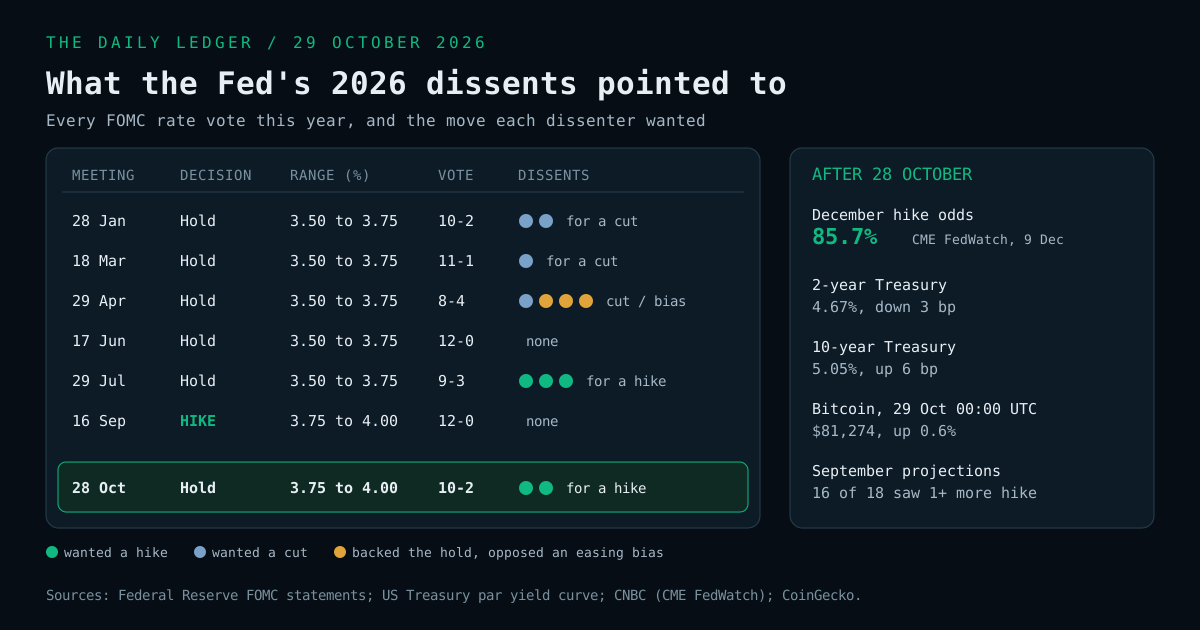
What does a Fed dissent mean? It is a voting official's public "no", printed in the statement with the move they wanted instead, and the fastest clue to where the next decision leans. On 28 October the Federal Reserve held its target range at 3.75 to 4 percent by 10 votes to 2, and both dissenters wanted a quarter-point hike.
1. The Day in Numbers
- Bitcoin: $81,274 at 00:00 UTC, up 0.6 percent against the previous day's 00:00 UTC snapshot of $80,801. CoinGecko daily data.
- Ether: $2,357.47 at 00:00 UTC, up 0.4 percent on the same basis. CoinGecko daily data.
- Fear and Greed: 51, Neutral, unchanged from the day before. Alternative.me daily reading, 29 October, 00:00 UTC.
- US spot bitcoin ETFs, Wednesday 28 October: a net inflow of $137.3 million, $136 million of it into BlackRock's IBIT, per TokenPost's early tally. Completed session; early totals can be revised.
- Treasury yields, 28 October close: the 2-year at 4.67 percent, down 3 basis points, and the 10-year at 5.05 percent, up 6, per the US Treasury yield curve.
2. What a Fed dissent means, and why bitcoin shrugged
The Federal Open Market Committee has twelve voters: the seven Fed governors, the New York Fed president and four other regional presidents who rotate each year. Votes are named, so a "no" is a deliberate signal. Unlike FOMC minutes, which arrive three weeks later, a dissent is published with the decision at 14:00 Eastern time.
This time Governor Lisa Cook and Cleveland Fed President Beth Hammack preferred to raise rates. The statement also dropped September's line that its hike would "support a timelier return" to 2 percent inflation. This year shows why their direction matters: in July three officials voted for a hike at a hold, and in September the Committee raised rates 12 to 0. That is one sequence, not a rule.
Crypto feels this through expectations rather than the decision itself. After the statement, CME FedWatch put the chance of a December hike at 85.7 percent, CNBC reported. A higher expected policy rate raises the return on cash and Treasury bills, which bitcoin has to compete with, and makes borrowing for leveraged trades dearer. CoinDesk's morning preview named three or more hike votes as the outcome that could lift the dollar and weigh on bitcoin. There were two, a December hike was already largely expected, and bitcoin edged higher. Still unknown: the data due before the 8 and 9 December meeting.
3. Today's Headlines
DTCC switches on tokenized securities
The Depository Trust Company, which has more than $114 trillion of assets in custody, launched its Tokenization Service, turning securities it holds into tokens deliverable to approved wallets. Twenty firms, including Citi, Fidelity, J.P. Morgan and Morgan Stanley, have signed up. It runs on Canton and DTCC's private Besu chain for now.
Google previews key-splitting custody for banks
Google previewed Multi-Party Compute, which splits signing keys across separate secure environments and checks each transaction against an institution's rules first, CoinDesk reported. Its documentation marks it as a preview; commercial launch is planned for early 2027.
Switzerland: Tether sets up a scam-prevention foundation
Tether and ten partners, including Chainalysis, Payward and the Solana Foundation, launched FASE, a Swiss not-for-profit advised by the UN Office on Drugs and Crime. Early programmes include scam-prevention education for up to 10 million young people.
4. Security Note
The US Treasury sanctioned 10 individuals and one entity behind North Korea's IT worker schemes, in which operatives use stolen identities and invented personas to win remote jobs, while the regime takes most of their wages. Two Russians named handled about $5.5 million in cryptocurrency conversions between them, Treasury says, and the workers also used their access to plant malware and steal data. The rule for anyone hiring remote developers: verify identity on a live video call against official documents, pay only accounts in that verified name, and give no signing keys or production access until those checks are complete.
5. From the Academy Library
Our letter on what a Fed rate hike does to bitcoin covers the rate channel; the macro and market cycles guide adds the dollar and liquidity. New readers can start at Academy School.
A dissent shows where the argument inside the Fed is heading, not where it will end.
Disclaimer: This publication is for education and information only. It is not financial, investment, legal, tax, or security advice.
Sources and further reading
- Federal Reserve: FOMC statement, 28 October 2026
- Federal Reserve: implementation note, 28 October 2026
- Federal Reserve: FOMC statement, 16 September 2026
- Federal Reserve: FOMC statement, 29 July 2026
- Federal Reserve: FOMC meeting calendars and statements
- Federal Reserve: Summary of Economic Projections, 16 September 2026
- Federal Reserve: structure of the FOMC
- US Treasury: daily par yield curve rates, October 2026
- CNBC: Treasury yields after the Fed decision, 28 October 2026
- CoinDesk: dissents and more, three things to watch at the Fed meeting
- DTCC: DTCC Tokenization Service goes live, 28 October 2026
- CoinDesk: Google to preview crypto custody security system
- Google Cloud: Multi-party Compute architecture
- Tether: launch of the FASE Foundation, 28 October 2026
- US Treasury: sanctions on facilitators of DPRK IT worker fraud, 28 October 2026
- TokenPost: US spot bitcoin ETFs add $137.3 million, 28 October
- CoinGecko: bitcoin daily price snapshots
- CoinGecko: ether daily price snapshots
- Alternative.me: Fear and Greed Index history