
Ledgers Academy Letter
The Daily Ledger: 16 September 2026
The Federal Reserve raised its target range to 3.75 to 4 percent on a unanimous vote, its first increase since July 2023, and crypto closed higher anyway. Sixteen of eighteen policy makers expect at least one more rise, and a House committee advanced the first bitcoin reserve bill.
Subject: The Fed raised rates for the first time since 2023
Preview: A unanimous quarter-point rise, 16 of 18 officials expecting another, and crypto closed higher anyway.
THE DAILY LEDGER
16 September 2026
The Federal Reserve lifts its target range to 3.75 to 4 percent on a 12 to 0 vote, a House committee sends the first strategic bitcoin reserve bill to the floor, and sentiment falls out of greed
Editor's note: this issue uses the completed daily candle for 16 September 2026, 00:00 to 23:59 UTC, from Binance. Prices are closes for that session rather than an intraday snapshot.
The Federal Open Market Committee raised the federal funds target range by a quarter point to 3.75 to 4 percent on Wednesday, its first increase since July 2023, on a unanimous 12 to 0 vote. Crypto closed higher on the day. That combination is not a contradiction, and it is the thing worth understanding.
1. The Day in Numbers
- Bitcoin: $76,206 at the 16 September close, up 0.7 percent on the session after Tuesday's fall.
- Ether: $2,418 at the close, up 0.8 percent.
- Fear and Greed Index: 51, Neutral, down 18 points from Tuesday and out of greed for the first time this month.
- Federal funds target range: 3.75 to 4 percent, raised by 25 basis points on a 12 to 0 vote.
- US spot bitcoin ETFs: $450.4 million of net redemptions on Tuesday 15 September, the last completed session before the decision, per Farside Investors.
2. What does a Fed rate hike do to bitcoin?
Less on the day than most people expect, and more over the following months. A policy rate is the price of risk-free money. Raise it and every asset that pays nothing today but promises something later is worth slightly less, because cash now pays more. Crypto sits at the far end of that spectrum.
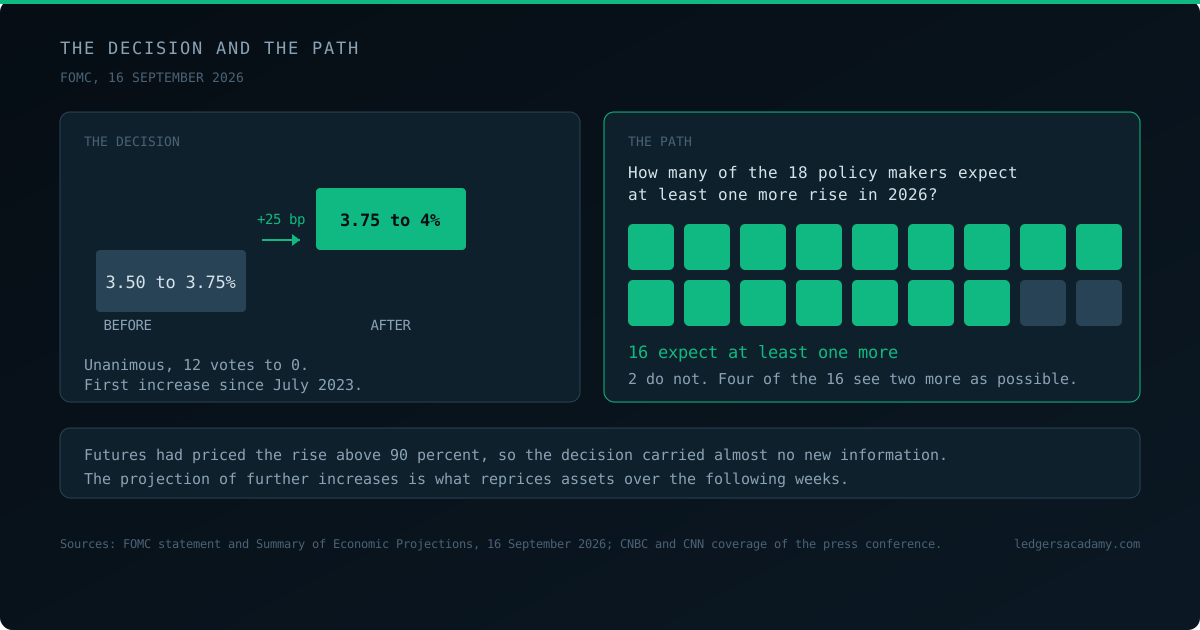
But markets trade surprises. Futures had put the odds of this rise above 90 percent, so the decision carried almost no new information and crypto drifted up as uncertainty cleared. The projections were the new part. Sixteen of the eighteen policy makers expect at least one further increase before year end, and four of those see two more as possible. That is the number that reprices assets over weeks rather than hours.
Chair Kevin Warsh was direct at the press conference. He said the committee cannot affect any individual price such as oil or groceries, but that what it can do "is ensure that any change in relative prices don't broaden out, don't have second and third order effects on the economy." Read alongside last week's energy shock, that is a central bank saying it will not look through oil-driven inflation. For crypto the takeaway is not the quarter point. It is that the bar for cuts moved further away.
3. Today's Headlines
A bitcoin reserve bill clears a House committee for the first time
The House Financial Services Committee voted 28 to 21 to report the American Reserve Modernization Act, H.R. 8957, which would place forfeited bitcoin in a Treasury-run reserve under a 20-year lock. It is the first such bill to clear a full committee, and with the Senate's market structure bill dead it is now the main federal crypto vehicle still moving.
Sentiment leaves greed
The Fear and Greed Index fell from 69 on Tuesday to 51 on Wednesday. An 18-point drop in one session is unusual, and it reflects Tuesday's price action and outflows rather than Wednesday's decision, since the index runs on trailing inputs.
Redemptions concentrate in the largest funds
Tuesday's $450.4 million of outflows came mostly from two products, with Fidelity's fund down $214.8 million and BlackRock's down $161.7 million. Concentration cuts both ways: the same two funds drove Monday's inflows.
4. Security Note: an approved module is part of your wallet
Tuesday's $7.73 million restaking loss is worth a rule rather than a headline. The victim was a Safe smart wallet that had authorized a custom trading module. That module exposed a public function which accepted attacker-supplied data and ran it in the wallet's own context, so no key was stolen and no core protocol broke. The wallet did what something it trusted told it to do. The rule applies to anyone using a smart contract wallet or a trading bot: every module you approve is an extension of your wallet, carrying your permissions. Review what you have authorized, remove what you no longer use, and treat a new module with the suspicion you would give a seed phrase prompt.
5. From the Academy Library
Our guide to bitcoin market cycles and macro explains the discount-rate channel in full, and Academy School chapter seven covers the same ground as a lesson. For the wallet mechanics behind today's security note, see what a smart contract is. Start at Academy School.
Bottom line: The quarter point was already in the price. The projection that sixteen of eighteen officials want at least one more is the part that had not been.
Sources and further reading
- Binance: BTC daily candles
- Binance: ETH daily candles
- Alternative.me: Crypto Fear and Greed Index history
- Crypto Daily: spot bitcoin ETF flows for 15 September, citing Farside Investors
- Federal Reserve: FOMC statement, 16 September 2026
- CNBC: Fed raises rates to 3.75 to 4 percent
- CNBC: Warsh says inflation is still too high as the Fed hikes
- CNN: what Warsh said about the first rate rise since 2023
- TFTC: the ARMA markup in the House Financial Services Committee
- The Crypto Times: committee reports the reserve bill 28 to 21
- Crypto Daily: how the Safe wallet module was abused
Disclaimer: This publication is for education and information only. It is not financial, investment, legal, tax, or security advice.