
The Daily Ledger: 27 October 2026
What Happens to Stablecoin Reserves If the Issuer Fails
Ripple wins final OCC approval for a trust bank to hold RLUSD's reserves: what happens to stablecoin reserves if the issuer fails. Plus Strategy pauses its bitcoin buying, Aviva tokenises a sterling fund and Keystone scraps 18,835 wallets over a stolen authenticity key.
THE DAILY LEDGER
27 October 2026
Ripple wins final approval for a national trust bank to hold RLUSD's reserves, Strategy pauses its bitcoin buying, and Aviva Investors tokenises its £22 billion sterling fund.
Reporting window: 26 October 2026, 06:00 UTC to 27 October, 06:00 UTC (07:00 Europe/Stockholm). Data cutoff: 27 October, 06:00 UTC. Prices are CoinGecko 00:00 UTC daily snapshots compared with the previous day's 00:00 UTC snapshot. This issue was added to the archive on 30 October 2026 and uses only information available at the cutoff.
What happens to stablecoin reserves if the issuer fails? Under the US GENIUS Act, the required reserves stay outside the issuer's bankruptcy estate and holders are paid from them before any other creditor. On 26 October Ripple added a federal layer for its RLUSD stablecoin: final approval from the Office of the Comptroller of the Currency (OCC) for Ripple National Trust Bank, which will act as collateral trustee of those reserves.
1. The Day in Numbers
- Bitcoin: $80,029 at 00:00 UTC, down 0.02 percent against the previous day's 00:00 UTC snapshot of $80,049. CoinGecko daily data.
- Ether: $2,320.67 at 00:00 UTC, down 0.3 percent on the same basis. CoinGecko daily data.
- Fear and Greed: 48, Neutral, down 2 points from 50. Alternative.me daily reading, 27 October, 00:00 UTC.
- US spot bitcoin ETFs, Monday 26 October: a net inflow of about $110 million, all of it into BlackRock's IBIT, per SoSoValue data reported by Odaily. Completed session; early totals can be revised.
2. What happens to stablecoin reserves if the issuer fails?
RLUSD, a dollar stablecoin Ripple values at about $2.5 billion, is issued by Standard Custody & Trust Company, a New York trust company. New York already requires issuers to keep reserves segregated from company money and held for holders. The new federal bank, not yet open, is approved to manage those reserves and act as their collateral trustee: an institution that holds assets under a legal duty to the people they secure, here RLUSD holders, rather than to the company. It cannot take deposits or make loans, The Block notes.
If an issuer collapses, Section 11 of the GENIUS Act sets the order. Required reserves are excluded from the bankruptcy estate, holders share them ratably ahead of every other claimant, and a court should use best efforts to start paying out within 14 days of a hearing. If reserves fall short, holders' remaining claims still rank first, even above bankruptcy costs.
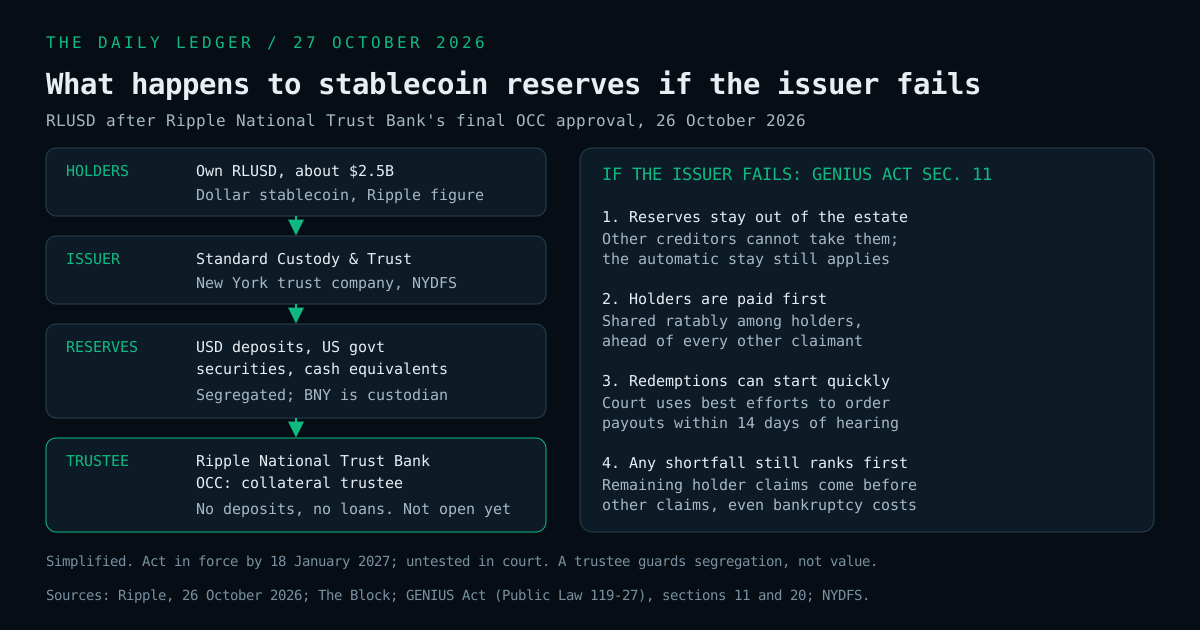
None of this has been tested in court, and the Act takes effect by 18 January 2027 at the latest. A trustee protects segregation, not value: if reserve assets fall, holders still lose, and Ripple's announcement says nothing about deposit insurance. It also gives no date for opening the bank; BNY remains the primary reserve custodian.
3. Today's Headlines
Strategy pauses as Strive buys
Strategy bought no bitcoin from 19 to 25 October and spent $204.9 million repurchasing its STRC preferred shares instead, its filing on 26 October shows. Strive reported buying 6,182 BTC from 17 to 23 October, taking it to 43,000 BTC.
Aviva Investors tokenises its largest fund
Aviva Investors launched a tokenised share class of its Sterling Liquidity Fund, an Ireland-domiciled money market fund of about £22 billion, on the XRP Ledger and invested £50 million in it, Ripple announced. BNY Mellon still holds the assets.
The NBA signs a prediction market pact with the CFTC
The league signed an information-sharing memorandum with the Commodity Futures Trading Commission and named Kalshi and Polymarket its preferred prediction market exchanges, the NBA announced.
4. Security Note
Keystone, a hardware wallet maker, said on 26 October that whoever breached its website (detected 20 October, disclosed 24 October) also took its WebAuth key. That key is written into each device at the factory so Keystone's authentication page can confirm the hardware is genuine. Anyone holding a copy could build a counterfeit that passes the same check. Keystone will destroy 18,835 devices in stock and has paused web shipping; it says recovery phrases and private keys were not involved, while 25,964 buyer records with names and addresses were exposed, Bankless reports. The rule: if your Keystone arrived after 20 October, use it only once support confirms it is genuine, even if it passes the check, and reach support by typing keyst.one yourself, never through a link. Keystone will not ask for devices back, so treat any "recall" as a scam.
5. From the Academy Library
When the failing company is an exchange, read what happens when a crypto exchange goes bankrupt. Our 9 September letter explains what a national trust bank can do, and the lexicon shows how to spot a counterfeit hardware wallet. New readers can start at Academy School.
The Federal Reserve meets on 27 and 28 October. A stablecoin is only as good as the claim behind it.
Disclaimer: This publication is for education and information only. It is not financial, investment, legal, tax, or security advice.
Sources and further reading
- Ripple: Ripple receives final OCC approval to establish national trust bank, 26 October 2026
- The Block: Ripple gains final OCC approval to launch national trust bank
- GovInfo: GENIUS Act, Public Law 119-27, sections 11 and 20
- NYDFS: guidance on the issuance of US dollar-backed stablecoins, 8 June 2022
- SEC: Strategy Inc. Form 8-K, 26 October 2026
- SEC: Strive, Inc. Form 8-K, 26 October 2026
- Ripple: Aviva Investors launches a Sterling Liquidity Fund tokenised share class
- NBA: integrity framework and partnerships for prediction markets, 26 October 2026
- Keystone: statement on the website security incident and customer guidance, 26 October 2026
- Keystone: first disclosure of the website breach, 24 October 2026
- Bankless: Keystone breach widens as attacker grabs its device authentication key
- Federal Reserve: FOMC meeting calendar
- Odaily (SoSoValue data): spot bitcoin ETF flows, 26 October
- CoinGecko: bitcoin daily price snapshots
- CoinGecko: ether daily price snapshots
- Alternative.me: Fear and Greed Index history